
Surrogacy in Delhi
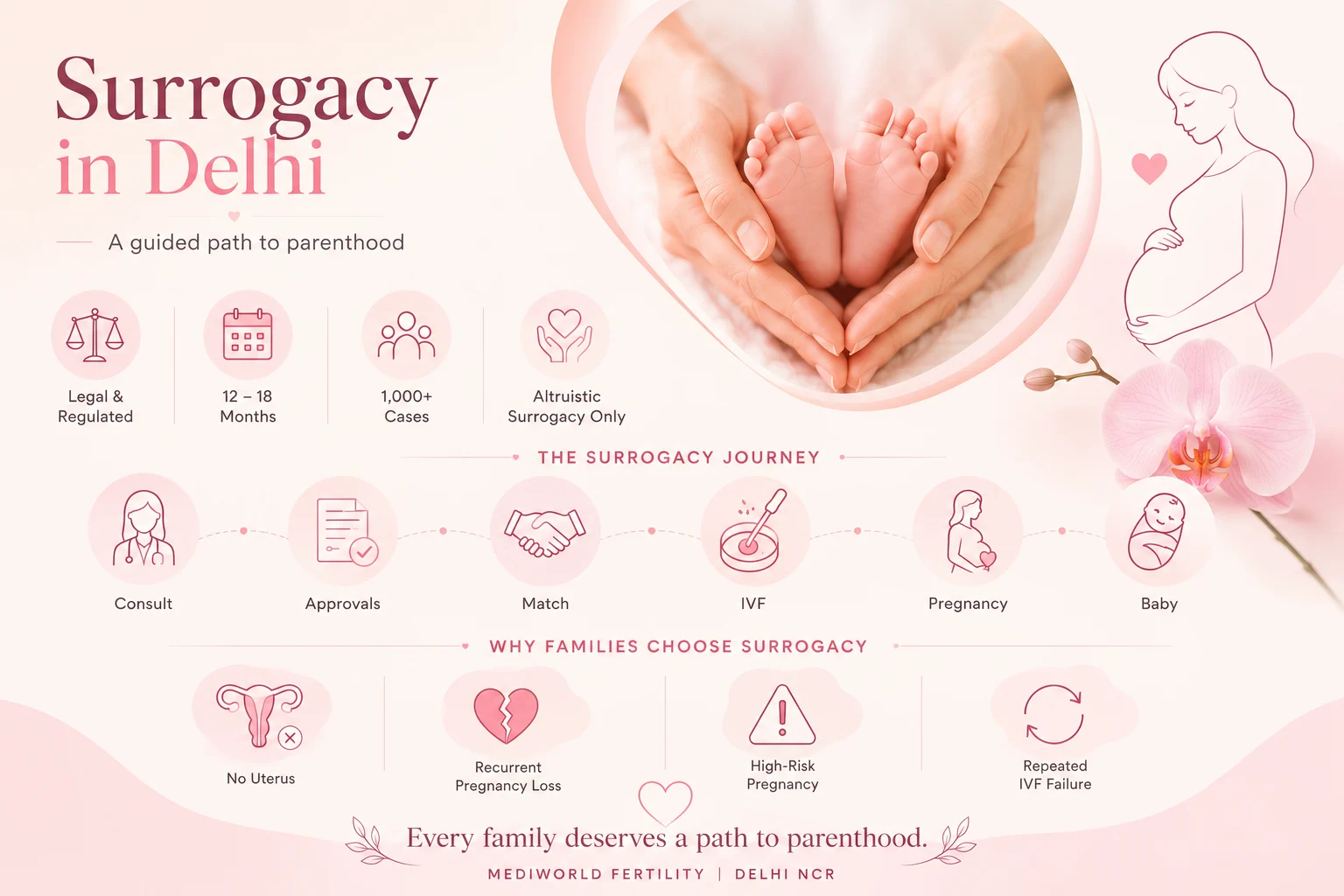
Surrogacy in Delhi is a medically guided, legally regulated process where a gestational carrier carries a pregnancy for intended parents who cannot do so themselves. Under India’s Surrogacy (Regulation) Act 2021 and its 2024 amendments, only altruistic surrogacy is permitted. The process spans 12 to 18 months and involves IVF, legal approvals, surrogate matching, and close pregnancy monitoring. At Mediworld Fertility, our team has supported 1,000+ surrogacy cases over 15 years. Book a consultation to understand your eligibility today.
What Is Surrogacy and How Does It Work in India?
Surrogacy is an arrangement where a woman (the gestational carrier) carries a pregnancy created through IVF on behalf of intended parents. In India, only gestational surrogacy is legal. The surrogate has no genetic connection to the child. The embryo is created using the intended parents’ own eggs and sperm, or donor gametes if medically necessary, and transferred to the surrogate’s uterus. India’s Surrogacy (Regulation) Act 2021 permits only altruistic surrogacy, meaning the surrogate receives no financial payment beyond medical expenses and insurance.
This distinction matters. Gestational surrogacy is not traditional surrogacy. In traditional surrogacy, the surrogate uses her own egg, making her the biological mother of the child. That practice is banned in India because it creates significant legal and emotional complications. In gestational surrogacy, the surrogate is a carrier, not a genetic parent. The child legally and biologically belongs to the intended parents from the moment of birth.
The process relies entirely on IVF treatment in Delhi. Eggs are retrieved, fertilised in our laboratory, and the resulting embryo is transferred into the surrogate’s prepared uterus. Commercial surrogacy, where a surrogate is paid beyond legitimate medical costs, carries penalties of up to Rs 10 lakh and 10 years’ imprisonment under Indian law.
Get Expert Guidance for Your Fertility Journey
Take the next step with Mediworld Fertility. Connect with our team to book your consultation.
 WhatsApp Us

Who Is Eligible for Surrogacy in Delhi?
Under the updated 2024 eligibility rules, intended parents must be a legally married Indian couple, with the woman aged between 25 and 50 and the man between 26 and 55. The couple must have been married for at least five years, have documented medical proof of infertility or a condition preventing pregnancy, and have no existing biological children. Surrogate mothers must be married, aged between 25 and 35, have at least one biological child of their own, and can serve as a surrogate only once in their lifetime.
Some of the most common medical reasons we see for pursuing surrogacy include:
- Absence or surgical removal of the uterus (including MRKH syndrome)
- Severe uterine scarring (Asherman’s syndrome)
- Recurrent pregnancy loss despite healthy embryos
- High-risk pregnancy conditions where carrying a baby poses a serious risk to the mother’s health
- Repeated IVF failure due to uterine factors
- Multiple uterine fibroids making implantation impossible
The 2024 amendment to the Surrogacy (Regulation) Rules introduced an important change: couples where one partner has a certified medical condition preventing them from providing viable gametes can now use a donor egg or donor sperm, provided the District Medical Board issues a certificate of medical necessity. At least one gamete must come from the intending couple. Widows and divorcees between 35 and 45 can also pursue surrogacy using their own eggs and donor sperm.
Single men, foreign nationals without OCI status, and same-sex couples are not currently eligible under Indian law.
Reach Out for Expert Care
The Step-by-Step Surrogacy Process at Mediworld Fertility
The complete surrogacy process in India typically takes 12 to 18 months, from the first consultation to the birth of the child. Here’s exactly what that looks like at Mediworld Fertility.
- Stage 1: Initial Consultation and Eligibility Assessment Everything starts with a detailed consultation with our fertility specialists. We review your medical history, previous treatment records, and current health status. This is where we confirm your eligibility under the Surrogacy (Regulation) Act 2021 and start mapping your individual treatment plan.
- Stage 2: Legal Clearances and Documentation This is the most time-consuming stage, typically taking three to six months. You’ll need a certificate of essentiality and a certificate of eligibility from the District Medical Board. Our team guides you through every document: proof of marriage, age certificates, medical infertility reports, affidavits, and the legal surrogacy agreement. All documentation must be in place before any medical procedure begins.
- Stage 3: Surrogate Matching and Screening Your surrogate must meet all legal eligibility criteria. She undergoes a thorough medical evaluation, psychological screening, and legal counselling. Our team coordinates this entire process, ensuring the surrogate is both medically fit and fully informed of her rights, including her right to withdraw before embryo transfer.
- Stage 4: IVF Cycle and Embryo Creation Once legal clearances are complete and the surrogate is prepared, the IVF cycle begins. Eggs are retrieved from the intended mother (or a certified donor if medically advised) and fertilised with sperm from the intended father using our advanced ICSI procedure when required. Embryos are cultured in our laboratory over five to six days.
- Stage 5: Embryo Transfer The surrogate’s uterus is prepared with hormone therapy to optimise the lining for implantation. A healthy embryo is then transferred using a thin catheter. The transfer itself takes approximately 30 minutes and requires no general anaesthesia. A blood pregnancy test is conducted approximately two weeks later.
- Stage 6: Pregnancy Monitoring Once pregnancy is confirmed, the surrogate receives regular prenatal care, including blood tests, ultrasound scans, and nutritional support. Both the surrogate and the intended parents are supported by our counselling team throughout.
- Stage 7: Delivery, Legal Parentage, and Post-Birth The baby is delivered at a registered hospital. Immediately after birth, the intended parents are legally recognised as the child’s parents. A birth certificate is issued in their names. Our team handles all post-birth documentation, including the surrogacy order from the appropriate authority.
What Are the Success Rates for Surrogacy in Delhi?
In gestational surrogacy at a well-equipped fertility centre, live birth rates per embryo transfer typically range from 55% to 75%, depending on the age and quality of the eggs used, the surrogate’s health, and the clinic’s protocols. When donor eggs from a young, screened donor are used, success rates can rise to between 70% and 85% per transfer. Across multiple transfer attempts, cumulative success rates are significantly higher.
Several factors shape outcomes:
- Age of the egg provider. Egg quality declines with age, particularly after 35. Using eggs from a younger intended mother or a certified donor under 30 consistently improves results.
- Embryo quality and genetic screening. PGT-tested embryos achieve live birth rates of 70 to 80% per transfer, as genetic screening identifies the most viable embryos before transfer.
- Surrogate health. Surrogates at Mediworld Fertility are screened for overall health, uterine receptivity, and psychological fitness before being approved for embryo transfer.
- Clinical expertise. A centre’s laboratory standards, embryologist experience, and transfer protocols all directly affect outcomes. At Mediworld Fertility, our team has performed over 2,000 IVF and ICSI cycles, and our surrogacy programme has supported 1,000+ cases over 15 years.
If the first transfer doesn’t result in pregnancy, a further transfer can be attempted after the team reviews the cycle and adjusts the protocol where needed. Most surrogacy agreements at Mediworld allow for up to three embryo transfer attempts.
Surrogacy Pathways Available at Mediworld Fertility
Not every surrogacy case is the same. Mediworld Fertility offers four main treatment pathways depending on your specific medical situation.
- Surrogacy with your own eggs and sperm is the standard route for couples where both partners can provide viable gametes. The embryo is fully genetically yours.
- Surrogacy with donor eggs is available where the intended mother has a certified medical condition, such as premature ovarian failure, absent uterus, or another condition affecting egg quality, that is confirmed by the District Medical Board under the 2024 amendment. The intended father’s sperm is used to maintain a genetic link.
- Surrogacy with donor sperm follows a similar pathway, used where the male partner has a certified condition affecting sperm viability. The intended mother’s eggs are used.
- Surrogacy with ICSI is recommended where male factor infertility is present alongside a uterine factor requiring surrogacy. Our ICSI procedure allows fertilisation even with very low sperm counts or poor motility.
Our fertility specialists will advise on the most clinically appropriate pathway after reviewing your diagnostic reports.
What Are the Risks of Surrogacy, and How Mediworld Fertility Manages Them?
Surrogacy carries real medical and emotional risks for all parties. Intended parents and surrogates both deserve an honest picture before they begin.
For the surrogate, the medical risks are largely comparable to those of any pregnancy. A systematic review published in Human Reproduction Update found hypertensive disorders in 3.2 to 10% of surrogate pregnancies, and placenta praevia or placental abruption in around 4.9% of cases. A PubMed review of surrogate pregnancy outcomes identifies gestational diabetes and postpartum haemorrhage as additional potential complications. These are the same risks as any pregnancy, and they are managed through close prenatal monitoring. The same research confirms that surrogate candidates are meticulously screened, which keeps overall complication rates low.
For intended parents, the primary risks are an unsuccessful transfer, the emotional weight of waiting, and the possibility that multiple cycles may be needed.
At Mediworld Fertility, we address both dimensions. Our clinical protocols include strict surrogate screening, regular monitoring throughout the pregnancy, and mandatory legal counselling. Our counselling team has conducted over 2,000 couples counselling sessions and supports both the intended parents and the surrogate at every stage of the process.
Legal Compliance and Ongoing Support at Mediworld Fertility
The legal side of surrogacy in India is detailed, and it’s non-negotiable. Every step must comply with the Surrogacy (Regulation) Act 2021 and the 2024 Amendment Rules. Intended parents must obtain a certificate of essentiality and a certificate of eligibility from the District Medical Board. The surrogacy agreement must be notarised and registered. The surrogate must have health insurance covering 36 months from the date of delivery, arranged and paid for by the intended parents.
Under a November 2025 Delhi High Court ruling, NRI and OCI couples living abroad can now appear for District Medical Board hearings virtually, removing a significant practical barrier for international families with Indian origin.
At Mediworld Fertility, our team coordinates all legal documentation from the first consultation. We work with experienced legal professionals to ensure your case is fully compliant, your surrogate’s rights are protected, and the intended parents’ parentage is legally secured after birth. No family should have to handle this alone.
FAQs
What is the difference between gestational and traditional surrogacy in India? expand_more
In gestational surrogacy, the surrogate carries an embryo created through IVF using the intended parents’ (or donors’) eggs and sperm. She has no genetic connection to the child. In traditional surrogacy, the surrogate’s own egg is used, making her the biological mother. Traditional surrogacy is banned in India under the Surrogacy (Regulation) Act 2021 because it creates complex legal and ethical challenges around parentage. All surrogacy performed in India is gestational.
Can we use donor eggs for surrogacy in India under the new law? expand_more
Yes, but with conditions. The 2024 amendment to India’s Surrogacy (Regulation) Rules allows the use of a donor egg or donor sperm if the District Medical Board certifies a medical necessity, such as premature ovarian failure or absent uterus. At least one gamete must still come from the intending couple. Both egg and sperm cannot be donated simultaneously; a genetic link to at least one intended parent is required.
How long does the surrogacy process take from start to finish? expand_more
The full surrogacy process in India typically takes 12 to 18 months. The legal clearance stage alone can take three to six months, as it involves medical board certification, documentation, and the surrogacy agreement. The IVF and embryo transfer phase follows, and the pregnancy itself is approximately nine months. Additional time may be needed if a second transfer attempt is required.
Can NRI or OCI couples pursue surrogacy in India? expand_more
Yes. NRI and OCI couples who meet the standard eligibility criteria under the Surrogacy (Regulation) Act 2021 can pursue surrogacy in India. Following a November 2025 Delhi High Court ruling, these couples can now attend District Medical Board hearings virtually, making the process significantly more accessible for families based abroad. Foreign nationals without Indian origin or OCI status are not eligible.
What happens if the first embryo transfer doesn’t result in pregnancy? expand_more
A failed first transfer is not the end of the process. Our specialists review the cycle, assess embryo quality, surrogate receptivity, and hormone protocols, and adjust the approach before the next attempt. Under Mediworld Fertility’s surrogacy programme, up to three embryo transfer attempts are typically included. Frozen embryos from the original IVF cycle can often be used for subsequent transfers, which avoids the need for a full repeat egg retrieval cycle and reduces both cost and physical burden.

Dr. Neha Gupta's Medical Content Team
Dr. Neha Gupta’s medical content team specialises in creating accurate, clear, and patient-focused healthcare content. With strong clinical understanding and expertise in technical writing and SEO, the team translates complex medical information into reliable, accessible resources that support informed decisions and uphold Dr. Neha Gupta’s commitment to quality care.
Dr. Neha Gupta
Dr. Neha Gupta is an experienced fertility specialist, IVF expert, and senior gynecologist with 21+ years in reproductive medicine. She has successfully treated 2000+ couples using advanced IVF, ICSI, IUI, donor programs, and fertility preservation techniques.