
Frozen Embryo Transfer After Egg Retrieval
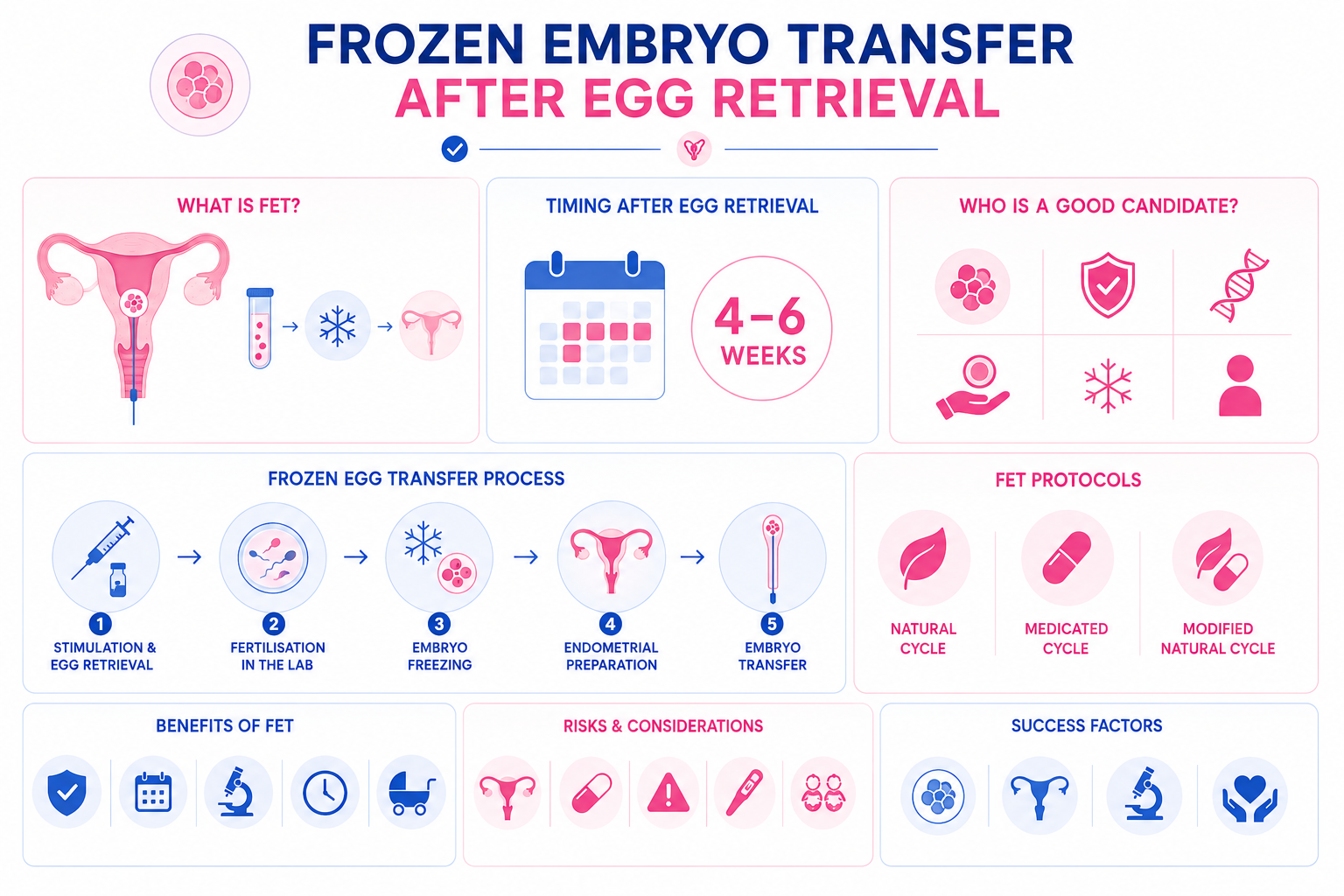
Frozen embryo transfer after egg retrieval at Mediworld Fertility is a structured IVF step where embryos created from retrieved eggs are frozen, then thawed and transferred in a later cycle. Commonly searched as frozen egg transfer, the procedure is clinically known as Frozen Embryo Transfer (FET). Most patients undergo transfer 4 to 6 weeks after egg retrieval, allowing hormones and the uterine lining to return to natural baseline. The frozen egg transfer process includes ovarian stimulation, egg retrieval, fertilisation in the lab, vitrification, endometrial preparation, and a painless transfer procedure. Mediworld Fertility offers experienced embryology, advanced vitrification, and individualised FET protocols for women across Delhi, Gurgaon, Noida, and Faridabad. Book a consultation today.
Frozen Embryo Transfer After Egg Retrieval
At Mediworld Fertility in Delhi, frozen embryo transfer after egg retrieval, commonly searched as frozen egg transfer, is one of the most widely used steps in modern IVF treatment. It allows your treatment team to retrieve eggs in one cycle, fertilise them in the lab, freeze the resulting embryos, and transfer them later when your body is best prepared for implantation.
Patients often ask how many days after egg retrieval is frozen embryo transfer performed. The answer depends on your individual protocol, but most transfers happen 4 to 6 weeks after the retrieval cycle. This timing allows the body to recover from ovarian stimulation and gives the gynaecologist time to prepare the uterine lining carefully.
The frozen egg transfer process combines precise laboratory technique, hormonal preparation, and gentle transfer under ultrasound guidance. Women from Delhi, Gurgaon, Noida, Faridabad, and across NCR choose Mediworld Fertility for experienced IVF specialists, an advanced embryology lab, and individualised treatment planning. Every step is explained in detail so you feel informed and supported throughout your journey.
Get Expert Guidance for Your Fertility Journey
Take the next step with Mediworld Fertility. Connect with our team to book your consultation.
 WhatsApp Us

Understanding Frozen Embryo Transfer (FET) and Egg Retrieval
Frozen Embryo Transfer (FET) is the clinical term for transferring a previously frozen embryo into the uterus. In IVF, eggs are retrieved and fertilised first, then the resulting embryos are frozen using vitrification. The phrase frozen egg transfer is widely used by patients, although what is technically transferred is an embryo.
Two important clinical events are involved, and they happen at different points in your treatment.
Egg retrieval is the first step. Mature eggs are collected from the ovaries through a short procedure under sedation. Once retrieved, the eggs are taken to the embryology lab where they are evaluated for maturity and quality.
Embryo formation and freezing follow. In the lab, retrieved eggs are fertilised with sperm using IVF or ICSI. The fertilised eggs develop into embryos over three to five days, after which the best-quality embryos are frozen through vitrification.
Frozen embryo transfer then occurs in a separate, later cycle. The frozen embryo is thawed and placed into the uterus once the lining is prepared.
The phrase frozen egg embryo transfer sometimes appears in search queries, but in practice it is the embryo, not the unfertilised egg, that is most commonly transferred. Oocyte (egg) freezing is a separate fertility preservation option for women who want to delay pregnancy, and the eggs are later thawed, fertilised, and transferred as embryos when the patient is ready.
Reach Out for Expert Care
How Many Days After Egg Retrieval Is Frozen Embryo Transfer Done?
Frozen embryo transfer after egg retrieval is typically performed 4 to 6 weeks after the retrieval cycle, allowing the body’s hormones and uterine lining to return to a natural baseline before preparation for transfer begins. Some patients may wait one to three menstrual cycles depending on their individual situation.
The Standard Timeline
For most patients, the time between egg retrieval and frozen transfer is around one to three menstrual cycles. The detailed timeline usually looks like this.
- Week 1 to 2 after egg retrieval: body recovery, ovaries return to normal size
- Week 3 to 4: next menstrual period typically arrives
- Week 4 onwards: endometrial preparation begins for the FET cycle
- Week 5 to 6: embryo transfer is performed once the uterine lining reaches optimal thickness
Asking how long after egg retrieval is frozen embryo transfer done leads to roughly the same answer: enough time for your body to recover and your lining to be prepared.
Why Doctors Don’t Transfer Immediately After Retrieval
There are clear medical reasons for waiting. After how many days after egg retrieval frozen embryo transfer is performed is a question shaped by safety as much as scheduling.
- Hormonal levels are elevated after stimulation, which is not ideal for implantation
- The uterine lining needs time to recover from the stimulation cycle
- Risk of ovarian hyperstimulation syndrome (OHSS) is reduced with a delayed transfer
- A “freeze-all” approach gives more time for genetic testing of embryos if needed
Factors That Affect Your FET Timing
Your treatment team plans the transfer based on several factors:
- Menstrual cycle regularity
- Endometrial thickness and pattern on ultrasound
- Whether genetic testing (PGT) is being done on embryos
- Your medical history, age, and previous IVF outcomes
- Any need for additional uterine evaluation before transfer
The Frozen Egg Transfer Process – Step by Step
The frozen egg transfer process at Mediworld Fertility follows five carefully planned stages: ovarian stimulation and egg retrieval, fertilisation in the lab, embryo freezing through vitrification, endometrial preparation, and the actual transfer procedure. Each step is explained clearly so you know what to expect.
Step 1: Ovarian Stimulation and Egg Retrieval
The cycle begins with hormone injections to stimulate the ovaries to grow multiple eggs. Once eggs are mature, egg retrieval is performed under light sedation. The procedure takes around 20 to 30 minutes, and most patients go home the same day. The retrieved eggs are then taken to the lab for the next step of the frozen egg transfer process.
Step 2: Fertilisation in the IVF Lab
Mature eggs are fertilised with sperm using conventional IVF or ICSI, depending on the clinical situation. Over the next three to five days, embryologists monitor development closely. Embryos that reach blastocyst stage with strong growth are selected for the next step. In donor cycles, all donor eggs fertilised are frozen for transfer as needed.
Step 3: Embryo Freezing (Vitrification)
Selected embryos are frozen using vitrification, an ultra-rapid freezing technique that protects embryo quality. Vitrification prevents ice crystal formation, which is critical for survival after thawing. Embryos are stored in liquid nitrogen at minus 196 degrees Celsius until you and your treatment team are ready for the next cycle. This step is a defining part of the frozen egg embryo transfer pathway.
Step 4: Endometrial Preparation Before FET
In the cycle when transfer is planned, the uterine lining is carefully prepared. Hormones such as oestrogen and progesterone are used to build a receptive lining, and the thickness and pattern are tracked through transvaginal ultrasound. Most fertility specialists aim for an endometrial thickness of 7 to 12 mm before transfer is scheduled.
Step 5: The Frozen Embryo Transfer Procedure
The embryo is thawed in the lab and prepared for transfer. The transfer itself is gentle and painless, performed under ultrasound guidance with a thin catheter passed through the cervix. No anaesthesia is usually required. The whole procedure takes around 15 to 20 minutes. This final step completes the protocol for frozen egg transfer that began with egg retrieval weeks earlier and is at the heart of every frozen embryo transfer after egg retrieval plan.
Protocols Used for Frozen Embryo Transfer
The protocol for frozen egg transfer is chosen based on your menstrual cycle, age, hormone profile, and previous IVF history. The three main FET protocols are natural cycle, hormone replacement (medicated) cycle, and modified natural cycle. Each prepares the uterine lining in a slightly different way.
Natural Cycle FET
In a natural cycle FET, the woman’s own menstrual cycle is used to time the transfer. Ovulation is tracked through ultrasound and blood tests, and the embryo is transferred at the appropriate stage of the cycle. This protocol works well for women with regular ovulation.
Hormone Replacement (Medicated) Cycle FET
In a medicated FET cycle, oestrogen and progesterone are given to prepare the uterine lining. This protocol gives the treatment team precise control over timing and is widely used. It is helpful for women with irregular cycles, those using donor eggs, and patients with prior failed natural cycles.
Modified Natural Cycle FET
In a modified natural cycle FET, the patient’s own ovulation is used, but small doses of medication may be added to refine timing or support the luteal phase. It is a middle ground between natural and fully medicated protocols.
Your fertility specialist at Mediworld will recommend the protocol best suited to your clinical situation after a complete evaluation.
Frozen Donor Egg Transfer Process
The frozen donor egg transfer process is used when a woman cannot conceive with her own eggs. Donor eggs are retrieved, fertilised in the lab, and the resulting embryos are frozen. The recipient then undergoes endometrial preparation and a frozen embryo transfer. All donor egg programmes at Mediworld Fertility follow the ART (Regulation) Act, 2021.
The frozen donor egg transfer process is typically considered for:
- Women with very low ovarian reserve
- Women who have experienced repeated IVF failures with own eggs
- Patients with certain genetic conditions
- Women of advanced reproductive age
- Cases where premature ovarian insufficiency is diagnosed
In donor cycles, all donor eggs fertilised are frozen for transfer once embryos are formed and graded. The recipient receives hormonal medication to prepare her uterine lining, and a single embryo (or two, in selected cases) is transferred under ultrasound guidance.
Indian law is clear on donor egg use under the ART Act, 2021, which governs donor selection, anonymity, age criteria, and embryology lab standards. Mediworld Fertility operates in full compliance with these regulations and provides detailed legal counselling to recipient couples.
Who Is a Good Candidate for Frozen Embryo Transfer?
Frozen embryo transfer is suitable for many patients undergoing IVF, including those at risk of Ovarian Hyperstimulation Syndrome (OHSS), women using donor or banked eggs, patients pursuing genetic testing of embryos, and women undergoing freeze-all cycles. Your gynaecologist will discuss whether FET is the right choice based on your medical evaluation.
You may be a good candidate for frozen embryo transfer if you fall into one of these groups:
- Freeze-all cycles: when fresh transfer is not advisable due to high oestrogen levels or thin endometrium
- OHSS risk: women who responded strongly to stimulation and need time to recover
- Genetic testing: patients undergoing PGT-A or PGT-M, where biopsied embryos are frozen before results are available
- Donor egg or banked egg cycles: where embryos must be frozen and transferred in a synchronised cycle
- Fertility preservation: women who froze eggs or embryos before cancer treatment and now want to conceive
- Repeated implantation failure: in some cases, a planned FET cycle gives better control of timing and uterine preparation
Your treatment plan is shaped by your medical history, age, ovarian reserve, and previous IVF outcomes, ensuring care that fits your unique situation.
What to Expect Before, During, and After Frozen Embryo Transfer
The frozen embryo transfer after egg retrieval journey is structured and predictable. Before transfer, your lining is prepared with hormones. The transfer itself is short, painless, and outpatient. After transfer, you continue progesterone support and wait for a pregnancy test around two weeks later.
Before the Transfer
In the weeks leading up to transfer, you will have several ultrasound scans and blood tests to monitor your hormone levels and endometrial lining. You may be asked to take oestrogen tablets, vaginal medication, or injections to prepare your body. Your team will guide you on diet, hydration, sleep, and mild activity during this phase.
During the Transfer Procedure
The frozen egg transfer process ends with a gentle, painless transfer that lasts around 15 to 20 minutes. You lie on the examination table while the embryologist hands the prepared embryo to the gynaecologist, who places it carefully into the uterus using a thin catheter under abdominal ultrasound guidance. Most women feel no discomfort, and no anaesthesia is needed. After a short rest, you can return home the same day.
After the Embryo Transfer (The Two-Week Wait)
The two weeks between transfer and pregnancy test are often the most emotionally intense part of the cycle. Continue your prescribed medications, maintain light activity, eat a balanced diet, sleep well, and avoid strenuous exercise. A beta hCG blood test around 10 to 14 days after transfer confirms whether pregnancy has occurred. Spotting, mild cramps, or breast tenderness can be normal in this period, and your team is available throughout.
Reach Out for Expert Care
Benefits of Frozen Embryo Transfer Over Fresh Transfer
Frozen embryo transfer offers several advantages over fresh transfer in many clinical situations. It allows the uterine lining to recover from stimulation, reduces the risk of OHSS, gives time for genetic testing, and offers flexibility in timing. Many patients also find emotional benefits in a planned, less rushed cycle.
Specific benefits include:
- Better endometrial receptivity: the lining is prepared in a calmer hormonal environment
- Reduced OHSS risk: the body recovers fully before transfer
- Opportunity for genetic testing: PGT results can be reviewed before transfer
- Treatment flexibility: transfer timing can be planned around your personal and work calendar
- Embryo banking: multiple frozen embryos give options for future siblings without repeating stimulation
- Comparable outcomes: for many indications, FET results compare favourably with fresh transfer
Whether FET or fresh transfer is right for you depends on your specific clinical situation, and your fertility specialist will discuss the appropriate choice during your consultation.
Risks and Considerations
Frozen embryo transfer is generally well tolerated, with most risks being minor and short-lived. There is a small chance of failed implantation, miscarriage, or ectopic pregnancy, as with any pregnancy. Hormonal medication used to prepare the lining can cause temporary side effects. Open discussion of risks helps you make informed decisions.
The main considerations to be aware of include:
- Mild cramping or spotting after transfer, which usually settles quickly
- Side effects of hormonal medication, such as bloating, breast tenderness, or mood changes
- Small risk of implantation failure, where pregnancy does not occur
- Slight risk of miscarriage or ectopic pregnancy, similar to natural conception
- Possibility of multiple pregnancy if more than one embryo is transferred
Major risks of FET are not significantly higher than those of natural conception according to current evidence. Your treatment team will explain all risks during your counselling visit.
Frozen Embryo Transfer at Mediworld Fertility, Delhi
Mediworld Fertility offers structured, evidence-based frozen embryo transfer after egg retrieval care in Delhi. With experienced IVF specialists, an advanced embryology lab using vitrification, and individualised FET protocols, we support patients through every step of the journey from egg retrieval to pregnancy test.
Here is what defines the care experience at our clinic.
Experienced IVF and embryology team
- Senior fertility specialists with deep IVF expertise
- Trained embryologists experienced in vitrification and thaw cycles
- Care aligned with national ART regulations
Advanced laboratory infrastructure
- Vitrification-based embryo freezing
- Secure cryopreservation storage
- Standardised quality protocols
Comprehensive patient support
- In-house diagnostics and monitoring
- Detailed counselling for couples
- Multilingual consultations in Hindi and English
Regulatory compliance
- ART (Regulation) Act, 2021 compliant
- Transparent treatment plans
- Documented consent and counselling at every stage
Clinic and contact
- Mediworld Fertility, Delhi
- Accessible to patients across Delhi NCR
- Reach our team by phone to schedule a consultation
Patients searching for trusted frozen egg transfer services in Delhi value our calm, structured, and patient-centred approach.
If you are planning IVF and want to understand frozen embryo transfer after egg retrieval, the team at Mediworld Fertility is here to guide you through every step. Our experienced specialists explain the frozen egg transfer process clearly, design protocols suited to your individual needs, and support you with sensitive, evidence-based care. To book a consultation, call Mediworld Fertility, Delhi. Serving patients across Delhi NCR, Gurgaon, Noida, and Faridabad with structured, guideline-based IVF and FET care.
Frequently Asked Questions
Q1. How many days after egg retrieval is frozen embryo transfer done? Frozen embryo transfer after egg retrieval is typically performed 4 to 6 weeks after the retrieval cycle. Some patients may wait one to three menstrual cycles to allow full hormonal recovery and optimal endometrial preparation.
Q2. What is the difference between frozen egg transfer and frozen embryo transfer? The phrase frozen egg transfer is commonly used by patients, but what is clinically transferred is a frozen embryo, not an unfertilised egg. Eggs are retrieved, fertilised in the lab to form embryos, and the embryos are frozen and later transferred.
Q3. What is the process of frozen egg transfer? The frozen egg transfer process includes ovarian stimulation, egg retrieval, fertilisation in the IVF lab, embryo freezing through vitrification, endometrial preparation in a later cycle, and finally the transfer of the thawed embryo into the uterus.
Q4. How long after egg retrieval is frozen embryo transfer? Most patients undergo frozen embryo transfer 4 to 6 weeks after egg retrieval. The exact timing depends on cycle regularity, hormone levels, endometrial preparation, and any additional testing such as PGT.
Q5. Can all donor eggs be fertilised and frozen for transfer? In donor egg cycles, mature donor eggs are fertilised in the lab and the resulting embryos are graded and frozen. Not every egg fertilises or develops into a viable embryo, but those that do can be frozen for future transfer.
Q6. What is the standard protocol for frozen egg transfer? The standard protocol for frozen egg transfer is selected from natural cycle, hormone replacement (medicated) cycle, or modified natural cycle FET. The choice depends on your menstrual cycle pattern, age, and previous IVF history.

Dr. Neha Gupta's Medical Content Team
Dr. Neha Gupta’s medical content team specialises in creating accurate, clear, and patient-focused healthcare content. With strong clinical understanding and expertise in technical writing and SEO, the team translates complex medical information into reliable, accessible resources that support informed decisions and uphold Dr. Neha Gupta’s commitment to quality care.
Dr. Neha Gupta
Dr. Neha Gupta is an experienced fertility specialist, IVF expert, and senior gynecologist with 21+ years in reproductive medicine. She has successfully treated 2000+ couples using advanced IVF, ICSI, IUI, donor programs, and fertility preservation techniques.