
TESE and Micro TESE Procedure in Delhi
The TESE and Micro TESE procedure in Delhi at Mediworld Fertility offers advanced surgical sperm retrieval for men with azoospermia. Testicular Sperm Extraction uses a small testicular biopsy to recover viable sperm, which is then used with ICSI and IVF for pregnancy. Our Delhi centre performs both conventional TESE and Micro TESE, the gold standard microsurgical technique for non-obstructive azoospermia. Procedures take 30 minutes to 3 hours with recovery in 1 to 2 weeks. TESE cost in Delhi ranges from ₹25,000 to ₹60,000+ and Micro TESE cost in Delhi ranges from ₹80,000 to ₹1,50,000+. With trained microsurgeons, an advanced andrology lab, integrated IVF support, and compassionate counselling, Mediworld Fertility is a trusted destination for male fertility care across Delhi NCR.
What Is TESE and Micro TESE?
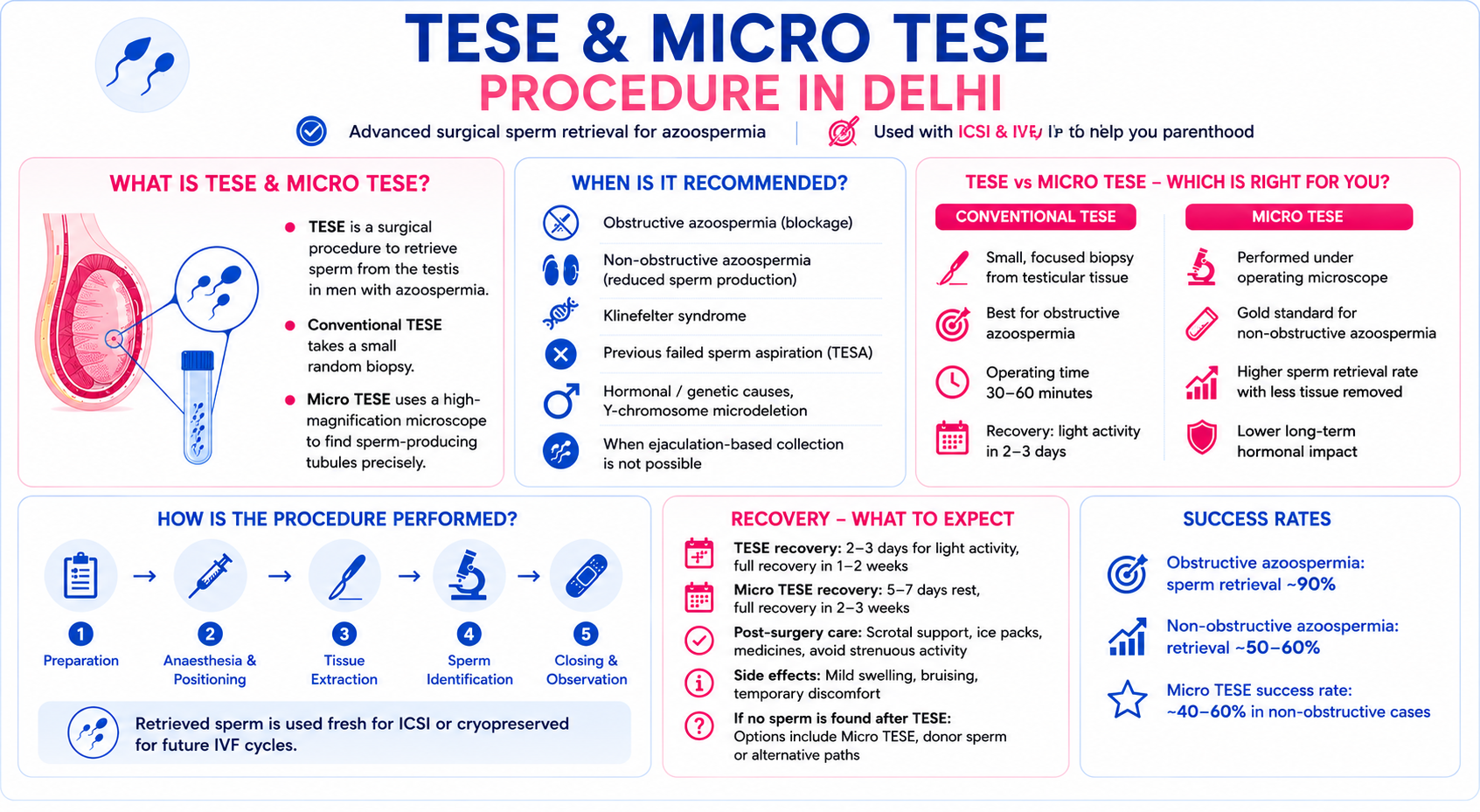
TESE (Testicular Sperm Extraction) is a surgical sperm retrieval procedure for men with azoospermia. Micro TESE is its microsurgical version, performed under an operating microscope for greater precision. Both are offered at Mediworld Fertility’s TESE and Micro TESE procedure in Delhi centre.
The TESE full form in medical practice is Testicular Sperm Extraction. It is a same-day procedure where a small piece of testicular tissue is removed and examined under a microscope to identify viable sperm. Once retrieved, the sperm is used for fertilisation through ICSI as part of an IVF cycle, giving couples a real path to biological parenthood.
The two main approaches differ in technique and ideal use:
- Conventional TESE takes a small random biopsy from the testicular tissue and is well suited to obstructive azoospermia
- Micro TESE procedure uses a high-magnification operating microscope to identify and selectively extract sperm-producing tubules, making it the preferred option for non-obstructive azoospermia
Mediworld Fertility is a dedicated centre for advanced male fertility surgery in Delhi NCR.
Get Expert Guidance for Your Fertility Journey
Take the next step with Mediworld Fertility. Connect with our team to book your consultation.
 WhatsApp Us

When Is the TESE or Micro TESE Procedure Recommended?
The TESE procedure and Micro TESE are recommended for men with azoospermia, the medical term for zero sperm in the ejaculate. They are also advised after failed sperm aspiration, in genetic conditions like Klinefelter syndrome, and when ejaculation-based sample collection is not possible.
Our andrology team carefully reviews each case before recommending surgical retrieval.
TESE and Micro TESE are typically advised for men with:
- Obstructive azoospermia, where a blockage prevents sperm from reaching the ejaculate
- Non-obstructive azoospermia, where sperm production is reduced within the testis
- Klinefelter syndrome, where Micro TESE for Klinefelter can recover viable sperm
- Previous failed sperm retrieval through TESA
- Hormonal or genetic causes of zero sperm count
- Y-chromosome microdeletion
- Conditions where ejaculation-based collection is not possible
TESA vs TESE: understanding the difference
A common question patients ask is about TESE vs TESA. Both retrieve sperm from the testis but in different ways:
- TESA uses a fine needle to aspirate fluid and is simpler
- TESE removes a small tissue sample and yields more sperm, especially in non-obstructive cases
- PESA draws sperm from the epididymis through the skin
- MESA is a microsurgical version of epididymal aspiration
The PESA, TESA, TESE family of techniques covers a wide range of male fertility needs, and the right choice depends on the cause of azoospermia and previous retrieval history.
Reach Out for Expert Care
Micro TESE vs TESE – Which Is Right for You?
The choice between Micro TESE vs TESE depends on the cause of azoospermia. Conventional TESE suits obstructive cases with normal sperm production. Micro TESE procedure is the gold standard for non-obstructive azoospermia, offering higher sperm retrieval with less tissue removed.
Both have a clear clinical place, and our team in Delhi guides each couple to the right option based on diagnosis.
Conventional TESE
- A small, focused biopsy is taken from the testicular tissue
- Best for obstructive azoospermia, where sperm production is normal but blocked
- Operating time is around 30 to 60 minutes
- Quick recovery, with light activity in 2 to 3 days
Micro TESE procedure
- Performed under an operating microscope with high magnification
- Surgeon identifies sperm-producing tubules visually
- Considered the gold standard for non-obstructive azoospermia
- Higher sperm retrieval rate with less testicular tissue removed
- Lower long-term hormonal impact than random biopsy
Micro TESE in Delhi is performed at specialised centres like Mediworld Fertility, where microsurgical training and andrology lab support work together under one roof.
Micro TESE risks are limited and well managed:
- Mild bruising at the incision site
- Temporary scrotal swelling
- A brief, reversible dip in testosterone in some patients
Micro TESE preparation includes guidance on abstinence (typically 2 to 5 days), hormonal optimisation when needed, and detailed counselling so you know exactly what to expect.
How Is the TESE and Micro TESE Procedure Performed?
The TESE surgery is a same-day procedure performed under local or general anaesthesia. A small incision is made in the scrotum, tissue is extracted, and the embryologist examines it in real time for viable sperm. Conventional TESE takes 30 to 60 minutes; Micro TESE takes 2 to 3 hours.
Here is a step-by-step view of the process at Mediworld Fertility.
Step 1: Pre-procedure preparation
- Detailed semen analysis and hormonal workup
- Genetic testing where appropriate
- Scrotal ultrasound to map testicular anatomy
- Abstinence guidance, usually 2 to 5 days before the procedure
- Anaesthesia consultation and fitness clearance
Step 2: Anaesthesia and positioning
- Procedure performed under local or general anaesthesia
- Comfort and safety monitored continuously
- Surgical area prepared in a sterile environment
Step 3: Tissue extraction
- A small incision is made in the scrotum
- For conventional TESE, a small tissue sample is taken
- For Micro TESE, the operating microscope guides selective extraction of sperm-rich tubules
- Tissue is handed to the embryologist in real time
Step 4: Sperm identification and processing
- The embryologist examines tissue under high-magnification optics
- Viable sperm is isolated and prepared for use
- Sperm can be used fresh for TESE ICSI, or cryopreserved for a future TESE IVF cycle
Step 5: Closing and observation
- The incision is closed in layers with absorbable sutures
- Patient shifted to recovery area for short observation
- Most patients go home the same day
TESE procedure pain is well managed. Anaesthesia ensures comfort during surgery, and oral pain medication keeps post-operative discomfort minimal. The IVF TESE procedure pathway then continues with the embryology team for fertilisation and embryo transfer.
TESE and Micro TESE Recovery Time – What to Expect
TESE procedure recovery time is short, with most men returning to light activity in 2 to 3 days and full recovery in 1 to 2 weeks. Micro TESE recovery is slightly longer, with 5 to 7 days of rest advised. Mild swelling and bruising are normal and settle quickly.
Here is a clearer picture of the recovery journey.
TESE procedure recovery time
- Light activity: 2 to 3 days
- Full recovery: 1 to 2 weeks
- Return to desk work: within a few days
- Sexual activity and exercise: after 2 weeks with medical clearance
Micro TESE procedure recovery time
- Rest advised for 5 to 7 days
- Full Micro TESE recovery in 2 to 3 weeks
- Return to normal routine is steady and predictable
Micro TESE post surgery care
- Wear scrotal support for added comfort
- Apply ice packs for the first 24 hours to reduce swelling
- Take prescribed pain medication and antibiotics on schedule
- Avoid strenuous activity, heavy lifting, and cycling
- Keep the incision site clean and dry
TESE procedure side effects and Micro TESE side effects
- Mild swelling and bruising
- Temporary scrotal discomfort
- Small bleeding under the skin in some cases
- Serious complications are rare
What if no sperm is found after TESE?
This is a difficult moment, and our team handles it with sensitivity and clear guidance. If no sperm is found after TESE, options include:
- Re-evaluation by the male fertility specialist
- Considering Micro TESE if conventional TESE was performed first
- Exploring donor sperm with full counselling support
- Considering alternative paths to parenthood
Cryopreservation of successfully retrieved sperm during the first procedure helps avoid repeat surgery in future IVF cycles.
TESE and Micro TESE Success Rate in Delhi
TESE success rate in obstructive azoospermia is around 90 percent, while non-obstructive cases see retrieval rates of 50 to 60 percent. Micro TESE success rate improves outcomes in difficult non-obstructive cases to 40 to 60 percent, comparable to leading international fertility programmes.
We share outcomes openly so couples can plan with realistic expectations.
TESE success rate by azoospermia type
- Obstructive azoospermia: sperm retrieval around 90 percent
- Non-obstructive azoospermia: retrieval around 50 to 60 percent
Micro TESE success rate
- 40 to 60 percent sperm retrieval in non-obstructive cases
- Higher yield than conventional TESE in difficult cases
- Lower risk of significant tissue loss
Micro TESE success rate in Delhi at experienced centres like Mediworld Fertility is in line with internationally reported outcomes when performed by trained microsurgeons with andrology lab support.
Azoospermia TESE success rate factors
- Cause and type of azoospermia
- Hormonal profile, including FSH and testosterone
- Testicular volume
- Genetic factors such as Y-chromosome microdeletion
- Surgeon’s microsurgical experience
IVF with TESE success rates and TESE ICSI success rate
- Fertilisation rates with TESE ICSI are good, even when sperm motility is low
- Pregnancy rates depend on egg quality, embryo development, and maternal age
- Combined TESE IVF outcomes mirror standard IVF success rates when retrieval is successful
TESE sperm quality
- Surgically retrieved sperm is fully viable for ICSI
- Motility is usually low, which is why ICSI is the preferred fertilisation method
- Cryopreserved TESE sperm performs well in future cycles
TESE and Micro TESE Cost in Delhi
TESE cost in Delhi range Starts from approximately ₹35,000+ for conventional TESE. Micro TESE cost in Delhi ranges starts from ₹80,000+ reflecting the microsurgical technique and equipment involved. When combined with an IVF or ICSI cycle, the total cost rises accordingly.
Final figures depend on technique, anaesthesia, and lab workflow.
TESE procedure cost breakdown
- Conventional TESE cost in Delhi starts form ₹35,000+ & Micro TESE cost in Delhi starts from ₹80,000+
- TESE ICSI cost: rises when combined with a full IVF and ICSI cycle, since fertilisation, embryo culture, and transfer are added
Factors that affect cost
- Type of procedure (TESE vs Micro TESE)
- Anaesthesia type and operating room time
- Embryology lab processing
- Sperm cryopreservation, if planned
- Number of IVF or ICSI cycles required
- Pre-procedure investigations and genetic testing
Why Choose Mediworld Fertility for TESE and Micro TESE in Delhi?
Mediworld Fertility brings together specialist andrologists, microsurgeons trained in Micro TESE, an advanced andrology lab, and integrated IVF and ICSI services under one roof. Our Delhi centre offers transparent costs, sensitive counselling, and a trusted record in male fertility surgery across Delhi NCR.
Here is what sets our care apart.
Specialist male fertility expertise
- Dedicated andrologists and microsurgeons trained in the Micro TESE procedure
- Routine experience with both obstructive and non-obstructive azoospermia
- Strong outcomes across TESE and Micro TESE cases
Advanced andrology lab support
- High-magnification optics for real-time sperm identification
- Cryopreservation facilities for TESE sperm storage
- Quality assurance protocols aligned with international standards
Integrated fertility care under one roof
- TESE IVF and TESE ICSI programmes managed by a single team
- Coordinated embryology, gynaecology, and andrology workflows
- Reduced waiting times and seamless treatment cycles
Counselling and emotional support
- Sensitive guidance for couples facing no sperm found after TESE outcomes
- Pre and post-procedure counselling
- Long-term planning for repeat or future cycles
Convenience for Delhi NCR patients
- Centrally accessible Delhi location
- Continued follow-up close to home
- Coordinated appointments for couples
MediWorld Fertility treats every patient with the warmth and respect we would offer our own family.
If you and your partner are exploring options for male-factor infertility, the team at Mediworld Fertility is here to listen, explain, and walk with you through every step. Book a consultation today to learn how the TESE and Micro TESE procedure in Delhi can support your journey to parenthood.
Reach Out for Expert Care
Frequently Asked Questions About TESE and Micro TESE in Delhi
Q1. What is the full form of TESE in medical terms?
TESE stands for Testicular Sperm Extraction. It is a surgical procedure used to retrieve sperm directly from the testis in men with azoospermia, so the sperm can be used with ICSI as part of an IVF cycle to support biological parenthood.
Q2. What is the difference between TESE and TESA?
TESA uses a fine needle to aspirate fluid from the testis and is simpler, while TESE removes a small piece of tissue and yields more sperm, especially in non-obstructive cases. The choice between TESA vs TESE depends on the cause of azoospermia and previous retrieval attempts.
Q3. How long does the Micro TESE procedure take and what is the recovery time?
The Micro TESE procedure typically takes 2 to 3 hours under microsurgical conditions. Micro TESE procedure recovery time is around 5 to 7 days of rest, with most men returning to normal activity within 2 to 3 weeks.
Q4. What happens if no sperm is found after TESE?
If no sperm is found after TESE, our specialists guide couples through the next steps with compassion. Options include considering Micro TESE if conventional TESE was performed first, exploring donor sperm, or discussing alternative paths to parenthood with dedicated counselling support.
Q5. What is the success rate of Micro TESE in Delhi?
Micro TESE success rate in Delhi at experienced centres is approximately 40 to 60 percent in non-obstructive azoospermia, and significantly higher in obstructive cases. The azoospermia TESE success rate depends on the type of azoospermia, hormonal profile, and surgical expertise.
Q6. What is the cost of Micro TESE in Delhi?
Micro TESE cost in Delhi typically ranges from ₹80,000 to ₹1,50,000+, while conventional TESE procedure cost ranges from ₹25,000 to ₹60,000+. Final cost depends on technique, anaesthesia, embryology lab processing, and whether an IVF or ICSI cycle is combined.

Dr. Neha Gupta's Medical Content Team
Dr. Neha Gupta’s medical content team specialises in creating accurate, clear, and patient-focused healthcare content. With strong clinical understanding and expertise in technical writing and SEO, the team translates complex medical information into reliable, accessible resources that support informed decisions and uphold Dr. Neha Gupta’s commitment to quality care.
Dr. Neha Gupta
Dr. Neha Gupta is an experienced fertility specialist, IVF expert, and senior gynecologist with 21+ years in reproductive medicine. She has successfully treated 2000+ couples using advanced IVF, ICSI, IUI, donor programs, and fertility preservation techniques.