
Septate Uterus Treatment in Delhi
A septate uterus is a common congenital uterine condition that can affect fertility, pregnancy outcomes, and recurrent miscarriage risk. At MediWorld Fertility, we provide advanced septate uterus treatment in Delhi using accurate 3D diagnostic imaging, expert evaluation, and minimally invasive hysteroscopic surgery. Our specialists offer personalised care for women diagnosed with partial or complete septate uterus, supporting them through diagnosis, treatment, fertility planning, and pregnancy care. With in-house diagnostics, modern surgical expertise, and integrated reproductive support, MediWorld Fertility delivers comprehensive septate uterus treatment designed to improve conception chances, reduce miscarriage risk, and help patients achieve healthy pregnancies with confidence and expert guidance.
What Is a Septate Uterus?
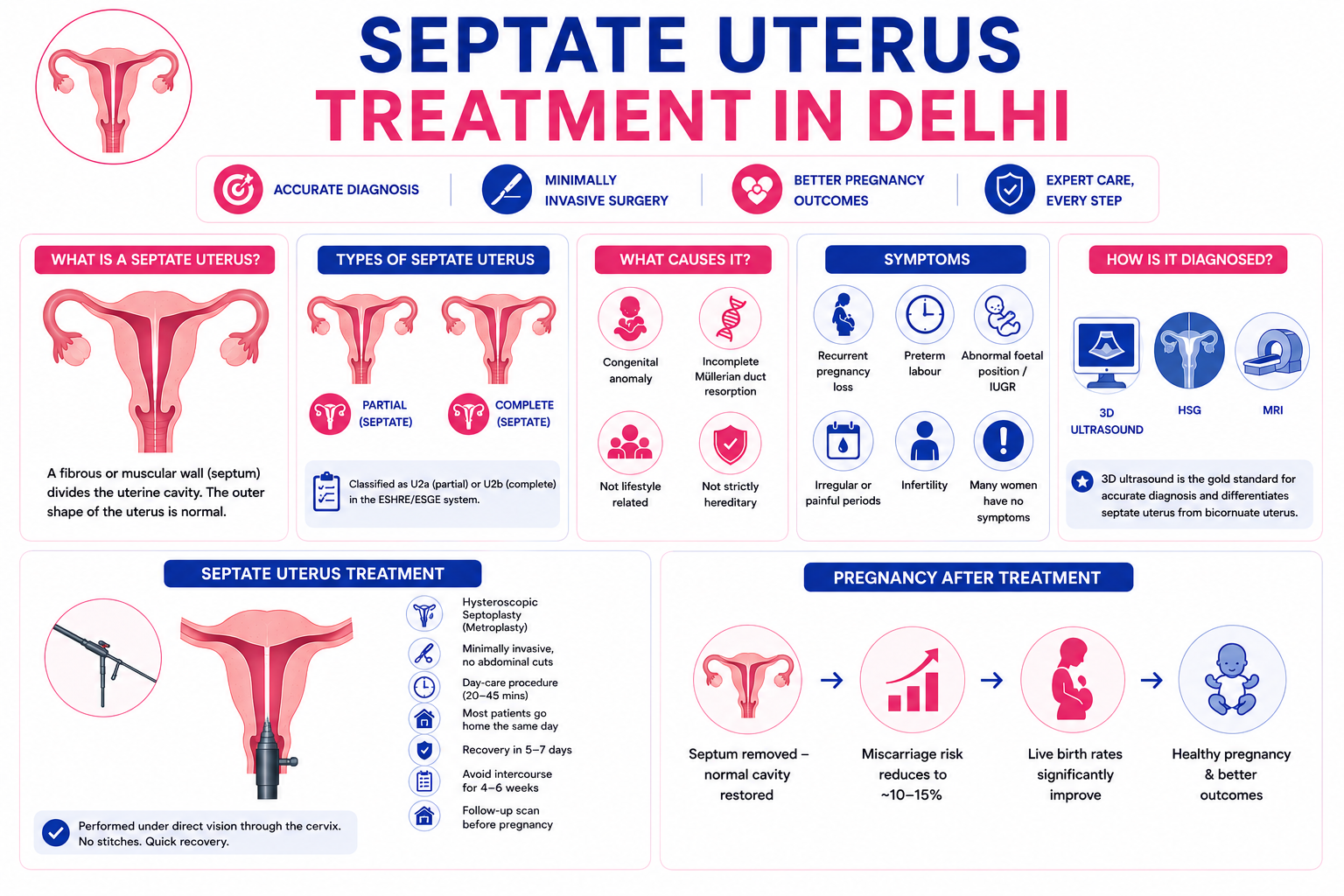
A septate uterus is a congenital condition in which the uterine cavity is divided by a fibrous or muscular wall the uterine septum that forms during foetal development when the Müllerian ducts fail to resorb completely. In a normally developed uterus, this midline tissue dissolves before birth. When resorption is incomplete, the remaining septum creates either a partial or complete division of the uterine cavity. The septate uterus meaning, in simple terms, is a womb that is internally divided though from the outside, the outer contour of the uterus remains smooth and normal-shaped, which is the key distinguishing feature from a bicornuate uterus.
Get Expert Guidance for Your Fertility Journey
Take the next step with Mediworld Fertility. Connect with our team to book your consultation.
 WhatsApp Us

Types of Septate Uterus
A septate uterus is classified based on how far the septum extends into the uterine cavity. Understanding the type you have is essential because it directly influences your symptoms, your risk of pregnancy complications, and the extent of surgery required.
A partial septate uterus also called a subseptate uterus is one where the septum extends partway into the cavity but does not reach the cervix. This is the more common presentation and often the one associated with recurrent first-trimester miscarriage. A complete septate uterus involves a septum that runs the full length of the uterine cavity to the cervix, and in some cases continues as a vaginal septum. An incomplete septate uterus refers to any septum that does not fully divide the cavity, often used interchangeably with partial.
Internationally, the ESHRE/ESGE classification system categorises septate uterus as Class U2 with U2a for partial septum and U2b for complete septum. This is the classification system used at MediWorld Fertility, Delhi, to ensure treatment planning follows current international standards.
One of the most important distinctions in this field is the difference between a septate and bicornuate uterus, as the two are frequently confused. In a septate uterus, the outer fundal contour is normal or minimally indented (less than 1 cm); in a bicornuate uterus, the fundus has a deep external notch (greater than 1 cm). This distinction matters enormously because a bicornuate uterus does not require surgical correction in most cases, while a septate uterus does. The septate vs bicornuate uterus difference is best resolved with a 3D ultrasound or MRI not a standard 2D scan or HSG alone.
Reach Out for Expert Care
What Causes a Septate Uterus?
A septate uterus is a congenital anomaly present from birth arising when the two Müllerian ducts fail to fully resorb their shared midline wall during foetal development. The residual tissue becomes the uterine septum. What causes this incomplete resorption is not fully understood, but a combination of genetic signalling and early developmental factors is believed to be involved.
A common patient concern is whether a septate uterus is hereditary. Current evidence suggests it is not strictly inherited, though a familial predisposition may exist in some cases. It is not caused by lifestyle, diet, injury, or any prior medical treatment.
Symptoms of a Septate Uterus
Many women with a septate uterus have no symptoms at all and discover the condition incidentally during a routine scan or an infertility investigation. However, when symptoms are present, they can significantly affect reproductive health and quality of life.
The most clinically significant symptom associated with a septate uterus is recurrent pregnancy loss. The septum is poorly vascularised tissue it does not carry the blood supply needed to support a developing embryo. When implantation occurs on or near the septum, the pregnancy is at high risk of early miscarriage. Septate uterus miscarriage rates in untreated cases are reported in the range of 25 to 47 percent, making it one of the most important structural causes of recurrent pregnancy loss. Some women also experience preterm labour, abnormal foetal positioning in later pregnancy, or intrauterine growth restriction. Septate uterus pregnancy complications arise because the cavity available for the growing baby is restricted.
In terms of non-pregnancy symptoms, some patients report irregular or painful periods, though these are less universally associated with a septate uterus than the reproductive complications. Septate uterus infertility where the condition directly prevents conception is less common than its association with miscarriage, but it does occur, particularly in complete septate cases where implantation is significantly compromised.
How Is a Septate Uterus Diagnosed?
Accurate diagnosis is the most important step before any septate uterus treatment decision is made, and it is an area where MediWorld Fertility in Delhi offers a clear advantage through in-house advanced imaging.
Septate uterus ultrasound, specifically 3D ultrasound is considered the gold standard first-line investigation. Unlike a standard 2D scan, a 3D ultrasound allows the specialist to simultaneously view the outer uterine contour and the inner cavity in a coronal plane, making it possible to measure the septum, classify its type, and distinguish it reliably from a bicornuate uterus. Septate uterus radiology has advanced significantly over the past decade, and experienced radiologists and fertility specialists can now achieve highly accurate diagnoses without invasive procedures in most cases.
A hysterosalpingogram (HSG) septate uterus HSG is commonly used during routine infertility investigations and may suggest a uterine anomaly, but it cannot distinguish between a septate and bicornuate uterus because it only images the internal cavity and not the external contour. If your HSG has shown an abnormality, a 3D ultrasound or MRI is the essential next step. Septate uterus MRI is indicated in complex or ambiguous cases, or when the patient cannot tolerate ultrasound adequately. MRI provides the most detailed view of both the internal cavity and the external fundal contour, and is particularly useful in diagnosing a complete septate uterus with cervical or vaginal involvement.
At MediWorld Fertility, Delhi, we offer in-house 3D ultrasound and coordinate MRI investigations seamlessly, ensuring that your diagnosis is confirmed with precision before any treatment is recommended.
Septate Uterus Treatment in Delhi at MediWorld Fertility
Septate uterus treatment has been transformed by minimally invasive surgery, and today the procedure is safe, highly effective, and requires no hospital admission for most patients. The standard and preferred treatment for a septate uterus is hysteroscopic septoplasty also called hysteroscopic metroplasty and it is the procedure our specialists perform routinely at MediWorld Fertility, Delhi.
Hysteroscopic septoplasty involves passing a thin telescopic instrument called a hysteroscope through the cervix into the uterine cavity, with no abdominal cuts or stitches required. The uterine septum is then divided using fine scissors or an electrosurgical loop under direct visualisation, restoring the uterine cavity to its normal shape. Septate uterus surgery typically takes 20 to 45 minutes under general or regional anaesthesia and is performed as a day-care procedure most patients go home the same day. Recovery is significantly faster than open surgery, with most patients returning to normal activity within five to seven days.
For a partial septate uterus, the procedure is straightforward and carries a very high success rate. For a complete septate uterus, the surgery is more extensive but remains hysteroscopic in approach at MediWorld Fertility, avoiding the need for laparotomy in the vast majority of cases. After septate uterus surgery, the uterine lining is allowed to heal over six to eight weeks, after which patients are reassessed with a follow-up scan before attempting conception or fertility treatment.
Septate uterus surgery recovery is generally well-tolerated. Mild cramping and light spotting for a few days after the procedure are normal. Patients are advised to avoid intercourse for four to six weeks post-operatively and to attend a follow-up hysteroscopy or ultrasound to confirm complete resection and adequate healing before proceeding with pregnancy attempts or IVF.
Reach Out for Expert Care
Septate Uterus Surgery Cost in Delhi
Septate uterus surgery cost at MediWorld Fertility, Delhi is determined by the type of septum, the complexity of the procedure, the anaesthesia used, and any additional diagnostic workup required. As a general guide, hysteroscopic septoplasty in Delhi ranges from ₹45,000 to ₹95,000+. A complete septate uterus involving cervical or vaginal components may incur higher costs due to extended operative time and post-operative care requirements.
Septate uterus surgery cost in India is significantly lower than equivalent procedures in the United Kingdom, Australia, or the United States, making MediWorld Fertility, Delhi an option for patients from across India and internationally. We provide a full, transparent cost breakdown at your initial consultation with no hidden charges and our team will assist you with insurance documentation where the procedure qualifies under your health policy.
Pregnancy After Septate Uterus Treatment
Successful pregnancy with a septate uterus is entirely achievable and after appropriate treatment, the outcomes are excellent. This is one of the most important messages for any patient who has been told they have this condition. Research consistently shows that after hysteroscopic septoplasty, miscarriage rates fall from the pre-treatment range of 25 to 47 percent to approximately 10 to 15 percent in line with the general population risk. Live birth rates after septate uterus surgery are reported to be significantly higher than in untreated patients.
For women asking whether they can get pregnant with a septate uterus without surgery, the answer depends on the size and type of the septum. A very small arcuate or partial septum may have minimal impact on reproductive outcomes and may not require treatment. A larger partial or complete septate uterus, however, is associated with significantly elevated miscarriage and preterm birth risk, and surgical correction is recommended before attempting pregnancy or IVF.
At MediWorld Fertility, Delhi, we support patients through the complete journey from septate uterus diagnosis and surgical treatment through to conception, IVF support where needed, and pregnancy monitoring. Our fertility specialists work alongside our surgical team to ensure that once your uterine cavity has healed, your path to parenthood continues with the appropriate fertility care plan. Septate uterus and IVF can be managed together effectively, and many of our patients go on to have successful, healthy pregnancies following hysteroscopic treatment.
Why Choose MediWorld Fertility for Septate Uterus Treatment in Delhi?
MediWorld Fertility is one of Delhi’s leading centres for the diagnosis and minimally invasive treatment of uterine anomalies. Our specialists bring together advanced reproductive surgery, in-house 3D diagnostic imaging, and integrated fertility care giving patients a seamless experience from first consultation through to pregnancy and beyond.
What sets MediWorld Fertility apart is our whole-journey approach. A patient who comes to us after a miscarriage or an abnormal scan does not need to be referred between multiple hospitals and specialists. We diagnose, treat, and support fertility all within the same practice in Delhi. Whether you are seeking separate uterus treatment after recurrent pregnancy loss, prior to IVF, or following an incidental diagnosis, our team will provide a personalised, evidence-based plan built around your specific anatomy, medical history, and fertility goals. We welcome patients from across Delhi NCR South Delhi, West Delhi, Noida, Gurgaon, and Faridabad as well as those travelling from other states for specialist care.
Frequently Asked Questions
What is a septate uterus?
A septate uterus is a congenital condition where a fibrous or muscular band of tissue the uterine septum partially or completely divides the uterine cavity. The outer shape of the uterus remains normal. It is the most common uterine anomaly and is highly treatable with minimally invasive hysteroscopic surgery.
What is the difference between a septate and bicornuate uterus?
A septate uterus has a normal outer contour with an internal cavity division. A bicornuate uterus has a deep external notch at the fundus. The distinction is critical because a septate uterus requires surgical correction while a bicornuate uterus usually does not. A 3D ultrasound or MRI is needed to tell them apart reliably.
Can I get pregnant with a septate uterus?
Yes, but the risk of miscarriage and preterm birth is significantly higher in untreated cases. After hysteroscopic septoplasty, most patients see dramatically improved pregnancy outcomes, with live birth rates comparable to the general population.
Is septate uterus surgery painful?
Hysteroscopic septoplasty is performed under anaesthesia; there is no pain during the procedure. Most patients experience mild cramping and light spotting for a few days afterward. The procedure is day-care; no overnight hospital stay is required in most cases.
Is a septate uterus hereditary?
It is a congenital anomaly arising from incomplete Müllerian duct resorption during foetal development. It is not strictly hereditary and is not caused by anything the patient has done. It can be fully corrected with surgery.
What is the success rate of septate uterus surgery?
Hysteroscopic septoplasty achieves full resection in over 90 percent of cases. Post-operatively, miscarriage rates fall significantly and live birth rates improve substantially. At MediWorld Fertility, Delhi, follow-up imaging confirms complete resection before the patient proceeds to conception or IVF.

Dr. Neha Gupta's Medical Content Team
Dr. Neha Gupta’s medical content team specialises in creating accurate, clear, and patient-focused healthcare content. With strong clinical understanding and expertise in technical writing and SEO, the team translates complex medical information into reliable, accessible resources that support informed decisions and uphold Dr. Neha Gupta’s commitment to quality care.
Dr. Neha Gupta
Dr. Neha Gupta is an experienced fertility specialist, IVF expert, and senior gynecologist with 21+ years in reproductive medicine. She has successfully treated 2000+ couples using advanced IVF, ICSI, IUI, donor programs, and fertility preservation techniques.