
Low Ovarian Reserve Treatment in Delhi
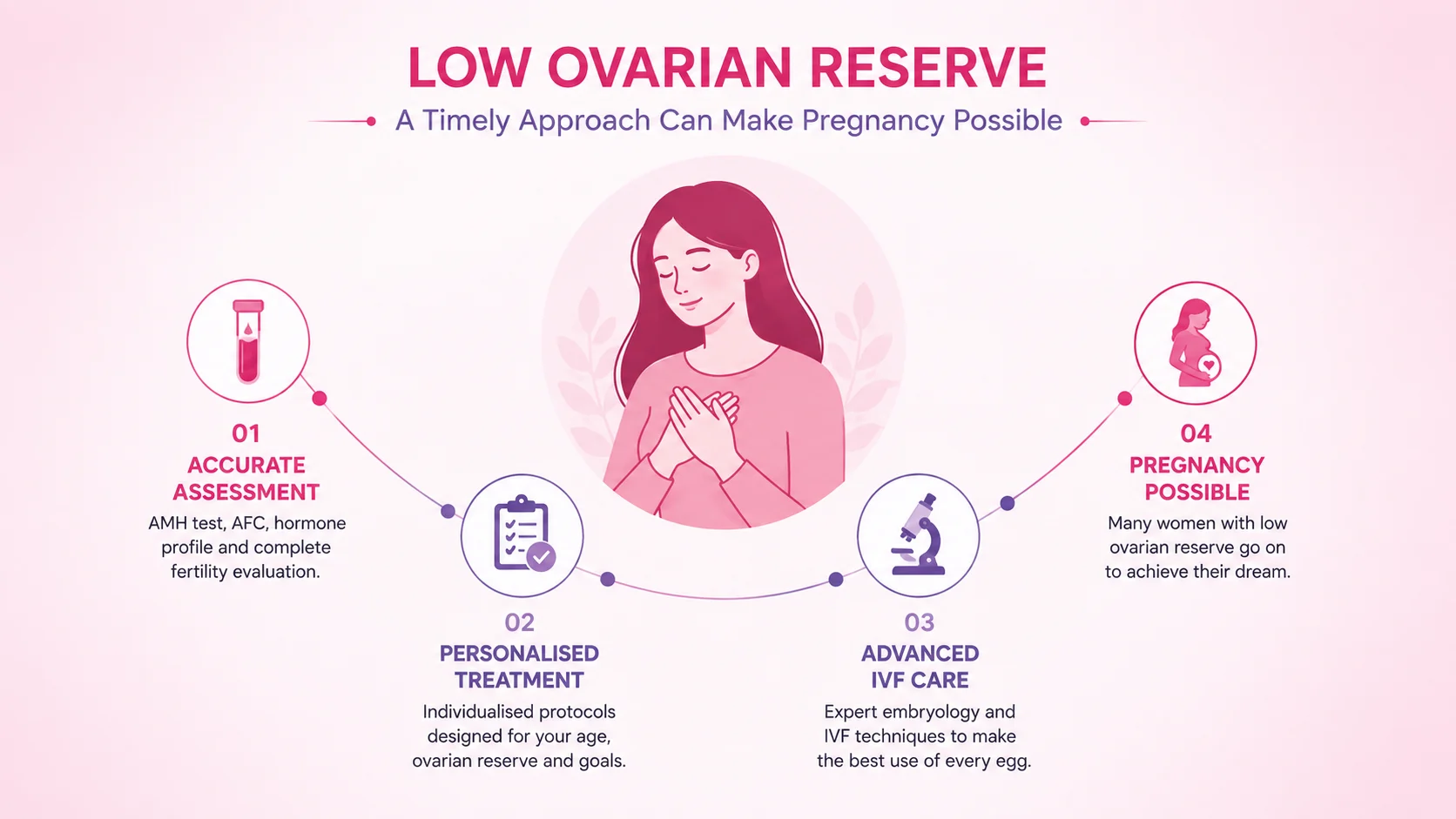
A diagnosis of Low Ovarian Reserve or Diminished Ovarian Reserve is one of the most distressing moments in a woman’s fertility journey. It often arrives after a single blood test result, sometimes during a routine fertility check, and the explanation that follows can feel both technical and emotional. The truth is more hopeful than the headline suggests. Many women with Low Ovarian Reserve, low AMH, or diminished egg quantity go on to conceive, either naturally or with carefully planned fertility treatment. Modern Low Ovarian Reserve Treatment focuses on accurate assessment, personalised stimulation protocols, and timely use of IVF or fertility preservation when needed. At Mediworld Fertility in Delhi NCR, low AMH and DOR are managed with structured evaluation and treatment plans tailored to your age, partner factors, and family-building goals.
What is a Low Ovarian Reserve?
Low Ovarian Reserve Definition
Low Ovarian Reserve, often abbreviated as LOR, refers to a reduction in the number and sometimes the quality of eggs remaining in a woman’s ovaries compared to what would be expected for her age. Every woman is born with a fixed number of eggs, and this pool declines naturally over time. When the decline happens earlier or faster than expected, it is described as a Low Ovarian Reserve.
Diminished Ovarian Reserve
Diminished Ovarian Reserve (DOR) is the term used by reproductive medicine specialists to describe the same condition. DOR is not the same as infertility, and it is not the same as menopause. Women with DOR may still ovulate regularly and still have the chance to conceive, although the window of opportunity may be shorter than for women of the same age with a normal reserve.
How It Differs From Premature Ovarian Insufficiency
Premature Ovarian Insufficiency (POI), sometimes called premature ovarian failure, is a more advanced state where ovarian function has largely stopped before the age of 40. DOR is a step on the spectrum towards reduced ovarian function, but most women with DOR still have working ovaries and ovulatory cycles.
What is AMH and Why Does It Matter?
Anti-Mullerian Hormone (AMH) is produced by small follicles in the ovaries. The level of AMH in your blood gives an indirect measure of how many eggs you have remaining. AMH is the most commonly used marker for ovarian reserve testing.
Normal AMH Levels
AMH levels vary with age. Broad reference ranges are:
- Less than 30 years: 2.0 to 6.8 ng/ml
- 30 to 35 years: 1.5 to 4.0 ng/ml
- 35 to 40 years: 1.0 to 3.0 ng/ml
- Above 40 years: below 1.0 to 1.5 ng/ml is common
These are general ranges, and laboratory cut-offs may vary slightly. A single AMH value should always be interpreted alongside your age, antral follicle count, and clinical picture.
Low AMH Levels
A Low AMH result generally means the ovaries are likely to produce fewer eggs in response to stimulation during fertility treatment. Low AMH does not, on its own, mean you cannot conceive naturally. It is a signal to evaluate your fertility more thoroughly and to plan treatment without unnecessary delay.
AMH and Fertility
AMH predicts the number of eggs likely to be retrieved during IVF, but it is not a reliable predictor of egg quality or natural pregnancy chances at younger ages. This is an important distinction for women who receive a low AMH result in their twenties or early thirties.
Reach Out for Expert Care
Causes of Low Ovarian Reserve
Age-Related Decline
Age is the strongest factor influencing ovarian reserve. After 35, the rate of egg depletion accelerates, and after 40, both quantity and quality decline more sharply.
Genetic Causes
Some women have genetic conditions that affect ovarian function, including Fragile X premutation, Turner syndrome, and other chromosomal variants. A family history of early menopause is also relevant.
Medical Treatments
Previous chemotherapy, pelvic radiation, ovarian surgery for endometriosis or cysts, and certain autoimmune conditions can all reduce ovarian reserve. Women facing planned chemotherapy or radiation should be referred for fertility preservation counselling before treatment begins.
Lifestyle and Environmental Factors
Smoking is consistently linked to earlier ovarian decline. Other contributors include severe undernutrition, exposure to certain industrial chemicals, and untreated thyroid or autoimmune disease.
Unknown Causes
In a significant number of women, no clear cause is identified despite a thorough workup. This is sometimes called idiopathic DOR, and it does not change the principles of treatment.
Symptoms and Warning Signs
Low Ovarian Reserve often has no symptoms. Many women are diagnosed only when they begin trying to conceive. Some signs that warrant evaluation include:
- Cycles becoming shorter than usual (for example, dropping from 28 days to 24 or 25)
- Irregular periods
- Difficulty conceiving despite regular, unprotected intercourse
- Family history of early menopause
- A previous ovarian surgery or chemotherapy
A specialist evaluation is recommended for any woman over 35 who has not conceived after six months of trying, or for women under 35 after one year of trying.
How is Low Ovarian Reserve Diagnosed?
A complete ovarian reserve assessment combines several investigations.
AMH Test
A simple blood test measuring Anti-Mullerian Hormone. It can be done at any point in the menstrual cycle and is the most widely used ovarian reserve marker.
Antral Follicle Count (AFC)
A transvaginal ultrasound performed in the early part of the cycle counts the small antral follicles in both ovaries. Together with AMH, AFC provides a fuller picture of the ovarian reserve.
FSH and Estradiol
Day 2 or Day 3 Follicle Stimulating Hormone (FSH) and estradiol levels offer additional information. Elevated FSH suggests the brain is working harder to drive the ovaries, which can indicate reduced reserve.
Comprehensive Fertility Evaluation
For women planning treatment, a complete workup also includes thyroid function, prolactin, partner semen analysis, and assessment of the uterus and tubes. Treating Low Ovarian Reserve in isolation, without checking the wider fertility picture, leads to missed opportunities for successful conception.
Treatment Options for Low Ovarian Reserve
There is no medication that can grow new eggs. Low Ovarian Reserve Treatment focuses on making the best use of the eggs you have through timing, optimisation, and assisted reproduction when needed.
Lifestyle Optimisation
Stopping smoking, maintaining a healthy body weight, addressing thyroid or vitamin D deficiencies, and managing stress can support overall reproductive health.
Supplements
Several supplements are commonly considered in women with DOR, including DHEA, CoQ10, vitamin D, and inositol. The evidence is mixed and varies by individual. These should only be used after discussion with your fertility specialist, who will consider your hormone profile and overall health.
Ovarian Stimulation Protocols
For women trying to conceive with treatment, individualised stimulation protocols are used to maximise the response from the ovaries. Options include conventional antagonist or agonist protocols, mild stimulation, and Mini IVF for women who respond poorly to standard doses.
IVF for Low Ovarian Reserve
IVF for Low Ovarian Reserve is one of the most effective treatment routes when natural conception has not occurred. The aim is not just to retrieve eggs, but to retrieve the best possible eggs and create good quality embryos for transfer. ICSI is often used to improve fertilisation, and frozen embryo transfer can be planned to optimise the uterine lining.
Mini IVF and Natural Cycle IVF
Some women respond poorly to high-dose stimulation. For them, milder protocols using lower doses of medication, or even natural cycle IVF, may produce a small number of good quality eggs without the side effects of high stimulation.
Egg Donation
When ovarian reserve is very low and treatment with the woman’s own eggs has limited likelihood of success, egg donation becomes an option that allows pregnancy and the experience of carrying the baby. This is a deeply personal decision and is discussed only after detailed counselling.
Fertility Preservation
For women diagnosed with declining ovarian reserve who are not yet ready to conceive, egg freezing offers the option to store eggs at their current quality for use later. Fertility preservation is also recommended before any planned chemotherapy or pelvic radiation.
Reach Out for Expert Care
Can You Get Pregnant with Low Ovarian Reserve?
Yes. Many women with Low Ovarian Reserve, including those with low AMH, conceive naturally or with treatment. Outcomes depend on:
- Age, which influences egg quality more than AMH does
- Partner sperm parameters
- Tubal and uterine factors
- Time since the diagnosis
- The chosen treatment approach
A low AMH at 28 has very different implications from a low AMH at 38. Younger women with low AMH often have a meaningful chance of natural conception. Older women generally benefit from prompt evaluation and timely treatment.
IVF Outcomes
Published evidence shows that IVF can result in pregnancy in women with DOR, particularly when stimulation protocols are individualised and laboratory standards are high. Success per cycle is generally lower than in women with normal reserve, but cumulative success across cycles can be meaningful. No fertility centre can guarantee a pregnancy, and counselling should always be realistic.
Low Ovarian Reserve Treatment in Delhi at Mediworld Fertility
Mediworld Fertility offers comprehensive Low Ovarian Reserve Treatment in Delhi with a focus on accurate assessment, individualised protocols, and supportive care throughout the journey.
Comprehensive Fertility Assessment
Every woman with suspected DOR or low AMH undergoes a detailed evaluation that goes beyond the AMH number, including AFC, hormone profile, partner semen analysis, and a review of uterine and tubal status.
Personalised Treatment Protocols
There is no single right protocol for women with low ovarian reserve. Treatment is built around your age, AMH, AFC, response to any previous cycle, and your family-building goals. Options range from focused timed conception to mild stimulation, conventional IVF, and Mini IVF.
Advanced Embryology Laboratory
An advanced IVF laboratory matters most in low-yield cycles, where every egg counts. Mediworld Fertility maintains modern embryology protocols to support optimal handling of limited eggs, ICSI where indicated, and blastocyst culture or freezing as appropriate.
Book a Fertility Consultation in Delhi
If you have been told your AMH is low, your ovarian reserve is reduced, or you have been trying to conceive without success, an early fertility consultation can help you understand your situation clearly and plan the right next step. Mediworld Fertility offers structured evaluation, personalised treatment protocols, and supportive care for women with Low Ovarian Reserve and Diminished Ovarian Reserve in Delhi NCR.
Book an appointment to review your reports, discuss your fertility goals, and plan treatment that respects both the urgency and the realism your situation deserves.
Frequently Asked Questions
What is a Low Ovarian Reserve? expand_more
Low Ovarian Reserve is a reduction in the number and sometimes quality of eggs remaining in the ovaries compared with what is expected for a woman's age. It is identified through AMH testing and antral follicle count.
Can I get pregnant with low ovarian reserve? expand_more
Yes. Many women with low ovarian reserve conceive naturally or with treatment. Outcomes depend on age, partner factors, and the chosen approach. A fertility specialist evaluation helps clarify your specific chances.
What is a normal AMH level? expand_more
AMH levels vary with age. In broad terms, levels above 1.0 ng/ml are considered reassuring, while levels below 1.0 ng/ml suggest reduced reserve. Interpretation should always be made alongside age and antral follicle count.
Can low ovarian reserve be treated naturally? expand_more
There is no natural treatment that can increase egg numbers, but lifestyle measures such as stopping smoking, maintaining a healthy weight, managing thyroid disorders, and addressing vitamin deficiencies can support overall fertility.
What is the best treatment for diminished ovarian reserve? expand_more
The best treatment depends on your age, AMH, AFC, fertility history, and goals. Options range from timed conception to mild stimulation, conventional IVF, Mini IVF, and egg donation. A personalised plan after a complete evaluation gives the most reliable answer.
Can IVF help with low ovarian reserve? expand_more
Yes. IVF for Low Ovarian Reserve uses individualised stimulation to maximise the response from your ovaries, retrieve eggs, and create embryos for transfer. ICSI is often used to improve fertilisation rates.
Does low AMH mean I cannot conceive? expand_more
No. Low AMH indicates fewer eggs are available, not that conception is impossible. Many women with low AMH conceive, especially when they receive timely fertility care.

Dr. Neha Gupta's Medical Content Team
Dr. Neha Gupta’s medical content team specialises in creating accurate, clear, and patient-focused healthcare content. With strong clinical understanding and expertise in technical writing and SEO, the team translates complex medical information into reliable, accessible resources that support informed decisions and uphold Dr. Neha Gupta’s commitment to quality care.
Dr. Neha Gupta
Dr. Neha Gupta is an experienced fertility specialist, IVF expert, and senior gynecologist with 21+ years in reproductive medicine. She has successfully treated 2000+ couples using advanced IVF, ICSI, IUI, donor programs, and fertility preservation techniques.
 WhatsApp