
Bulky Uterus Treatment in Delhi
For women searching for bulky uterus treatment in Delhi, understanding that a bulky uterus is an ultrasound finding rather than a disease is the first step. A bulky uterus may be caused by fibroids, adenomyosis, hormonal changes, endometrial thickening, or pregnancy-related changes and may or may not require treatment. Symptoms can include heavy periods, pelvic pain, and infertility, although many women have no symptoms. Most women can still conceive naturally, depending on the underlying cause. At Mediworld Fertility, our specialists provide comprehensive evaluation, advanced ultrasound diagnosis, fertility-focused care, and personalized treatment options ranging from observation and medications to minimally invasive procedures and surgery.
What is a Bulky Uterus?
A bulky uterus refers to an enlarged uterus that appears larger than normal on ultrasound imaging. The normal adult uterus measures approximately 7-8 cm in length and 4-5 cm in width. When measurements exceed these dimensions, radiologists report it as “bulky” or “enlarged.” This is a descriptive finding, not a diagnosis in itself. A bulky uterus is a symptom or sign that something is happening inside the uterus, but the real diagnosis comes from understanding what is causing the enlargement.
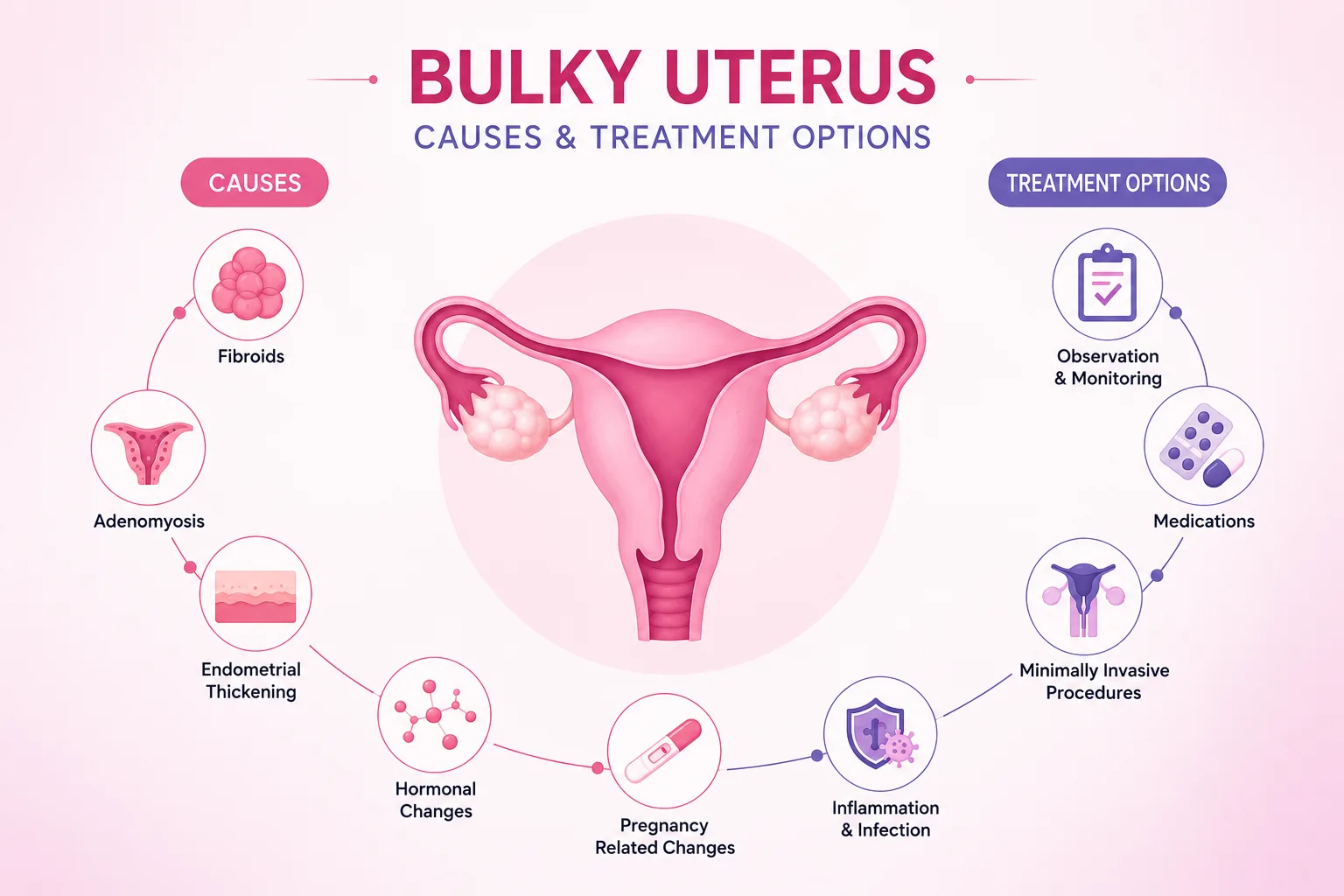
The causes of bulky uterus range from completely benign conditions that require no treatment to conditions that may require intervention. Common causes include uterine fibroids (benign tumors), adenomyosis (a condition where the uterine lining grows into the muscle), hormonal changes, pregnancy, or inflammatory conditions. At Mediworld Fertility, we evaluate every bulky uterus in the context of your complete medical picture, age, symptoms, and reproductive goals to determine whether observation or treatment is needed.A bulky uterus is not a disease but an ultrasound finding that may be linked to fibroids, adenomyosis, hormonal changes, or other gynecological conditions. Understanding the underlying cause is the key to choosing the right treatment approach. This infographic explains the most common causes and available treatment options in a simple visual format.
Symptoms of a Bulky Uterus
Many women with bulky uterus have no symptoms at all. However, depending on the underlying cause, the following symptoms may occur:
- Heavy menstrual bleeding or prolonged periods
- Severe menstrual cramps or dysmenorrhea
- Pelvic pain or pressure sensation during or between periods
- Feeling of fullness in the lower abdomen
- Frequent urination or urgency
- Pain during intercourse
- Infertility or difficulty conceiving
Reach Out for Expert Care
Causes of a Bulky Uterus
Understanding the cause of your bulky uterus is the most important step toward deciding whether treatment is necessary.
Uterine Fibroids (Myomas)
Fibroids are benign smooth muscle tumors that grow within the uterine wall. They are present in approximately 40-60% of women by age 40 and are the most common cause of bulky uterus. Fibroids can range from a few millimeters to several centimeters. They cause the uterus to enlarge by pressing outward or by stimulating the uterus to contract and grow.
When a bulky uterus is associated with fibroids, it is documented as “bulky uterus with fibroid” or “bulky uterus with intramural fibroid.” Intramural fibroids (located within the uterine wall) are more commonly associated with a bulky appearance than submucosal fibroids (protruding into the cavity) or subserosal fibroids (on the outer surface).
Adenomyosis
Adenomyosis occurs when the inner lining of the uterus (endometrium) grows into the uterine muscle (myometrium). This causes the muscle to thicken and the entire uterus to enlarge uniformly. Unlike fibroids, which create distinct masses, adenomyosis causes a diffuse, generalized enlargement. The uterus in adenomyosis typically becomes boggy and tender rather than having visible lumps.
When documented, this finding is noted as “bulky uterus with adenomyosis” or “bulky uterus with diffuse adenomyosis.”
Endometrial Thickening
Thickened endometrium can contribute to a bulky appearance, especially in postmenopausal women or those with hormonal imbalances. This is typically documented as “bulky uterus with thickened endometrium.” While usually benign, it requires monitoring and sometimes biopsy depending on thickness and clinical context.
Hormonal Changes and Anovulation
Unopposed estrogen stimulation (when progesterone levels are insufficient) causes the endometrium to proliferate excessively. This is common in women with irregular periods, polycystic ovary syndrome (PCOS), or those approaching menopause. The uterus may appear mildly to moderately bulky.
Inflammation and Infection
Pelvic inflammatory disease (PID) or endometritis can cause temporary uterine enlargement due to inflammation and edema. In these cases, treatment of the infection typically resolves the bulkiness.
Is a Bulky Uterus Dangerous?
A bulky uterus itself is not dangerous, but it depends entirely on the underlying cause.
Many women live their entire reproductive lives with bulky uterus and fibroids, experiencing no complications. However, certain conditions require monitoring or treatment:
- Severe bleeding that causes anemia
- Infertility or recurrent miscarriage
- Rapid growth of fibroids (which rarely indicates cancer)
- Symptoms significantly affecting quality of life
Key Reassurance: The risk of malignancy (cancer) in a bulky uterus is extremely low, particularly in premenopausal women. Uterine cancer is rare and typically presents with abnormal bleeding after menopause, not simply with a bulky appearance on ultrasound.
At Mediworld Fertility in Delhi, we distinguish between conditions requiring monitoring, conditions requiring treatment, and conditions requiring urgent intervention.
Bulky Uterus with Fibroids
When fibroids are the cause of a bulky uterus, your fertility and treatment options depend on several factors:
Size and Location
- Intramural fibroids within the uterine wall typically cause more bulkiness than subserosal fibroids on the outer surface
- Small fibroids (less than 3 cm) typically do not affect fertility
- Fibroids larger than 4 cm, especially if distorting the uterine cavity, may affect conception or miscarriage risk
Effect on Fertility
A bulky uterus with small to moderate fibroids does not necessarily prevent pregnancy. Many women conceive naturally despite having fibroids. However, large fibroids or those distorting the uterine cavity may reduce implantation success or increase miscarriage risk.
Treatment Considerations
For women planning pregnancy, we may recommend fibroid removal (myomectomy) if fibroids are large, numerous, or distorting the cavity. For women not planning pregnancy, observation is typically recommended unless symptoms warrant intervention.
Bulky Uterus with Adenomyosis
Adenomyosis is increasingly recognized as a common cause of bulky uterus and is particularly prevalent in women over 35.
Symptoms
Women with adenomyosis and bulky uterus typically report:
- Heavy, prolonged menstrual bleeding
- Severe menstrual pain (dysmenorrhea)
- Chronic pelvic pain
- Pain during intercourse
Effect on Fertility
Unlike fibroids, adenomyosis directly affects the uterine environment. Research suggests that adenomyosis can reduce implantation success rates and increase miscarriage risk through several mechanisms:
- Abnormal uterine contractions
- Altered endometrial receptivity
- Increased inflammation and immune activation
Diagnosis and Treatment
Adenomyosis was historically difficult to diagnose definitively without a hysterectomy. Today, specialized ultrasound techniques (transvaginal ultrasound with specific criteria) or MRI can identify adenomyosis with reasonable accuracy.
Treatment options include hormonal therapies, minimally invasive procedures, or in severe cases, hysterectomy for women who have completed childbearing.
Reach Out for Expert Care
Bulky Uterus During Pregnancy
Some women first discover a bulky uterus during their pregnancy ultrasound. This finding requires careful interpretation.
In early pregnancy, a mildly bulky uterus may be completely normal as the uterus begins to enlarge. Mild bulkiness can also represent:
- Retained products of conception after a recent pregnancy
- Subinvolution (incomplete return to normal size) after recent delivery
- Fibroids that were present prior to pregnancy
Can I Get Pregnant with a Bulky Uterus?
Yes. Most women with a bulky uterus can conceive naturally. However:
- Large fibroids distorting the cavity may reduce conception rates
- Adenomyosis may reduce implantation success and increase miscarriage risk
- Untreated inflammation (PID) may affect conception
At Mediworld Fertility, we evaluate whether your bulky uterus affects fertility and recommend preconception optimization if needed.
How is a Bulky Uterus Diagnosed?
The diagnosis of a bulky uterus begins with an ultrasound report.
Transvaginal Ultrasound (Gold Standard)
A specialized probe placed inside the vagina provides high-resolution images of the uterus. This is the most accurate method for detecting bulky uterus and identifying the cause (fibroids, adenomyosis, endometrial thickening). Measurements are documented in centimeters. A bulky uterus is generally defined as exceeding 8-9 cm in length or appearing disproportionately large relative to age and parity.
Additional Imaging: MRI
Magnetic resonance imaging is sometimes recommended when:
- Multiple fibroids make ultrasound interpretation difficult
- Adenomyosis needs clearer delineation
- Surgical planning requires precise mapping
Blood Tests and Endometrial Biopsy
In specific clinical scenarios (postmenopausal bleeding with thick endometrium), an endometrial biopsy may be recommended to rule out endometrial cancer.
Bulky Uterus Treatment in Delhi
Treatment of bulky uterus in Delhi depends on three factors: the underlying cause, your symptoms, and your reproductive goals.
Observation and Monitoring
For asymptomatic women with a mildly bulky uterus and no fibroids, observation is typically recommended. Regular follow-up ultrasounds may be performed annually or as symptoms develop. This is appropriate for most women, as many conditions causing mild bulkiness do not progress or require intervention.
Hormonal Therapy
Medications that suppress estrogen or progesterone can reduce symptoms and sometimes reduce uterine size:
- Combined oral contraceptives reduce menstrual bleeding and can decrease fibroid growth
- Progestin-only methods (levonorgestrel IUD, medroxyprogesterone) reduce bleeding and endometrial proliferation
- GnRH agonists (leuprolide) suppress estrogen production, shrinking fibroids and adenomyosis temporarily; typically used 3-6 months before surgery
Minimally Invasive Procedures
These procedures preserve the uterus while addressing fibroids or adenomyosis:
- Uterine fibroid embolization (UFE): Blocks blood supply to fibroids, causing them to shrink
- Hysteroscopic myomectomy: Removal of submucosal fibroids through the cervix
- Endometrial ablation: Destroys the endometrial lining to reduce heavy bleeding
- Laparoscopic myomectomy: Removal of intramural or subserosal fibroids through small abdominal incisions
Surgical Treatment
- Myomectomy: Surgical removal of individual fibroids while preserving the uterus (ideal for women desiring pregnancy)
- Hysterectomy: Removal of the entire uterus; definitive treatment for symptomatic fibroids or adenomyosis in women who have completed childbearing
Treatment Selection of Bulky Uterus at Mediworld Fertility
Our treatment algorithm considers:
| Factor | Decision |
| Asymptomatic, small bulkiness | Observation and follow-up |
| Heavy bleeding affecting quality of life | Hormonal therapy or minimally invasive procedure |
| Infertility with large fibroid distorting cavity | Myomectomy before conception attempts |
| Symptomatic adenomyosis, fertility desired | Hormonal therapy and possibly hysteroscopic procedures |
| Symptomatic adenomyosis, fertility complete | Hysterectomy or endometrial ablation |
| Rapid fibroid growth | Urgent evaluation for malignancy; consider surgical removal |
Natural Remedies and Lifestyle Changes
While no natural remedy can eliminate fibroids or adenomyosis, certain lifestyle modifications may help manage symptoms:
Dietary Modifications
- Increase fiber intake to reduce estrogen reabsorption (aim for 25-30 grams daily)
- Reduce red meat consumption; choose lean proteins and fish rich in omega-3 fatty acids
- Increase consumption of vegetables and whole grains (associated with reduced fibroid risk)
- Limit processed foods and added sugars
Weight Management
Obesity is associated with increased estrogen levels, which may promote fibroid growth. Achieving a healthy BMI through a balanced diet and exercise may help manage symptoms.
Stress Reduction
Chronic stress elevates cortisol and may worsen inflammation. Yoga, meditation, or mindfulness practices may help reduce pelvic pain and menstrual symptoms.
Important Clarification: Natural remedies and lifestyle changes support overall health but cannot shrink established fibroids or reverse adenomyosis. They are complementary to medical treatment, not alternatives to it.
Why Choose Mediworld Fertility for Bulky Uterus Treatment in Delhi
Mediworld Fertility has specialized in diagnosing and treating bulky uterus and related conditions in women across Delhi, Noida, Gurugram, and Faridabad for over a decade. Our approach is evidence-based, comprehensive, and patient-centered.
Our team is led by Dr. Neha Gupta, Clinical Director and Senior Consultant with 21+ years of experience in reproductive medicine. Having helped over 2,000 couples, she brings hands-on expertise in conditions that directly cause a bulky uterus – including adenomyosis, uterine fibroids, endometriosis, and uterine polyps – along with advanced training in laparoscopic and hysteroscopic surgery.
- Expert gynecologists trained in advanced ultrasound interpretation and minimally invasive procedures
- State-of-the-art transvaginal ultrasound for precise diagnosis
- Individualized treatment plans aligned with your fertility goals
- Access to all treatment options from medical management to minimally invasive and surgical procedures
- Aftercare and follow-up to ensure optimal outcomes
Women from across Delhi NCR choose us because we do not take a one-size-fits-all approach. A bulky uterus found incidentally on an ultrasound may require no treatment at all, while another case may require comprehensive management. We help you understand your specific situation and navigate the best path forward.
ement. We help you understand your specific situation and navigate the best path forward.
Frequently Asked Questions
What is the difference between mildly bulky uterus and moderately bulky uterus? expand_more
Mildly bulky typically refers to uterine measurements of 8-10 cm in length; moderately bulky refers to 10-14 cm. Severely bulky refers to >14 cm. These are relative terms used descriptively on ultrasound reports. The clinical significance depends more on the cause and symptoms than on the degree of bulkiness.
Can exercise or yoga reduce a bulky uterus? expand_more
Exercise and yoga can improve symptoms (reduce pain and heavy bleeding) but cannot shrink established fibroids or reverse adenomyosis. They are valuable supportive measures but not curative.
Does bulky uterus affect fertility? expand_more
Not necessarily. Small to moderate fibroids or mild adenomyosis do not prevent pregnancy in most women. Large fibroids distorting the cavity or moderate to severe adenomyosis may reduce fertility. Evaluation by a fertility specialist can clarify your individual risk.
Is bulky uterus more common after pregnancy? expand_more
Fibroids can develop or enlarge during pregnancy due to increased blood flow and hormonal stimulation. Some women first discover fibroids on postpartum ultrasounds. Adenomyosis becomes more common with parity (increasing number of pregnancies).
What does a bulky uterus mean on ultrasound? expand_more
It means the uterus is larger than average on ultrasound imaging. The specific cause must be identified through detailed ultrasound examination looking for fibroids, adenomyosis, endometrial thickening, or other pathology.

's Medical Content Team
’s medical content team specialises in creating accurate, clear, and patient-focused healthcare content. With strong clinical understanding and expertise in technical writing and SEO, the team translates complex medical information into reliable, accessible resources that support informed decisions and uphold ’s commitment to quality care.
 WhatsApp