
Is Surrogacy Legal in India? Everything You Need to Know in 2026
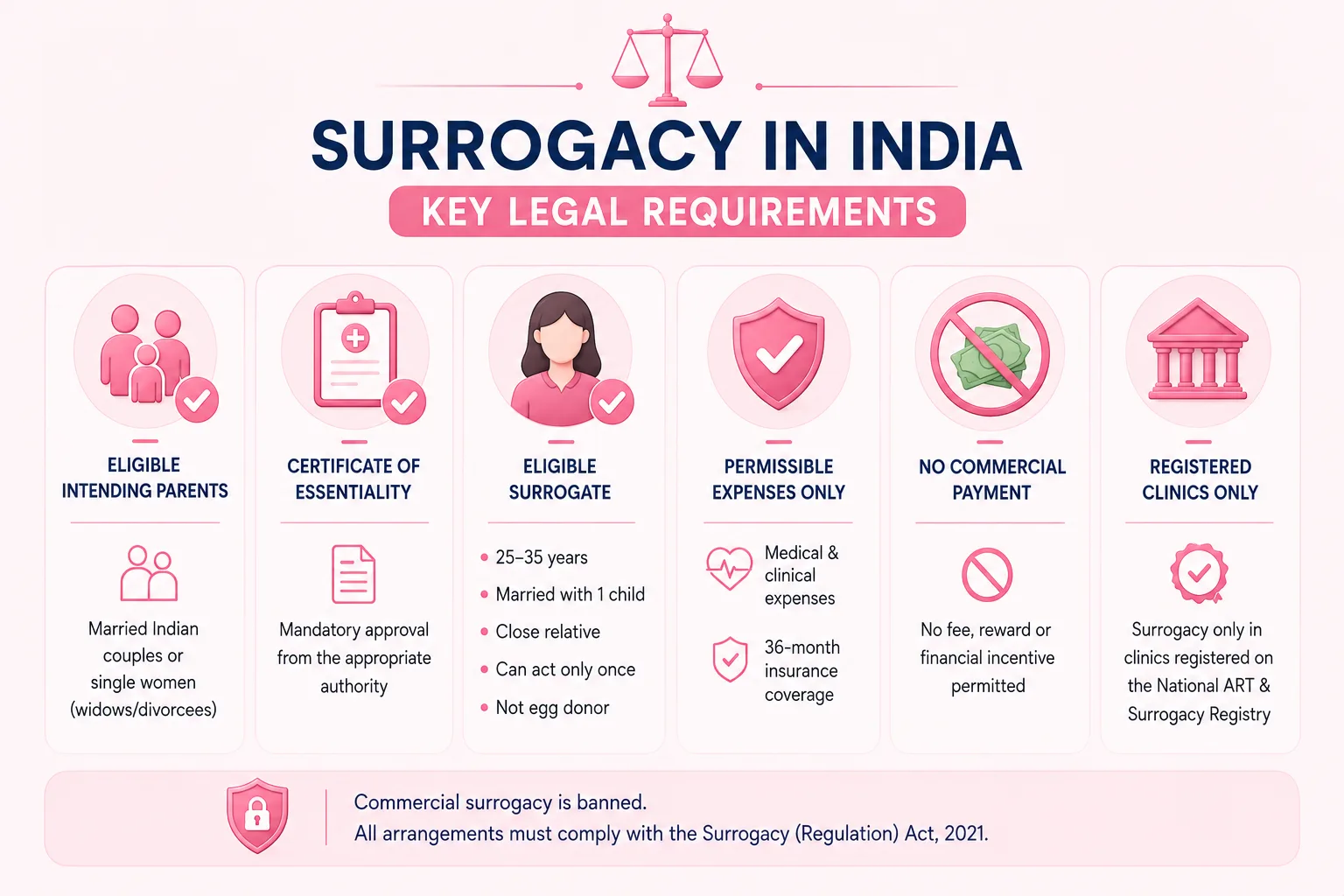
Altruistic surrogacy is legal in India under the Surrogacy (Regulation) Act 2021. Commercial surrogacy is banned. Only married Indian couples and single women who are widows or divorcees are eligible – foreign nationals and single men are currently excluded by law.
Current Status of Surrogacy in India
This section covers the legal framework that governs surrogacy in India today – what changed with the 2021 Act, what is permitted, and which authority enforces the rules.
- The Surrogacy (Regulation) Act 2021 came into force on 25 January 2022. It replaced a patchwork of ICMR guidelines with a binding national statute for the first time.
- Commercial surrogacy is completely banned. Paying a surrogate a fee or financial incentive beyond medical expenses is a criminal offence under the Act.
- Only altruistic surrogacy is permitted. The surrogate may receive coverage for medical expenses and a 36-month insurance policy – nothing more.
- The National Assisted Reproductive Technology and Surrogacy Board (chaired by the Union Minister of Health and Family Welfare) oversees policy and standards at the central level.
- The National ART & Surrogacy Registry (artsurrogacy.gov.in) handles clinic registration. Only registered clinics can legally perform surrogacy procedures.
- All surrogacy arrangements require a Certificate of Essentiality issued by the appropriate authority before any medical procedure begins.
- The Act also prohibits surrogacy for the purpose of selling children, prostitution, or any form of exploitation.
Disclaimer: This is a general legal overview for informational purposes only. Laws and their interpretation can change. Please consult a qualified legal professional for advice specific to your situation.
Get Expert Guidance for Your Fertility Journey
Take the next step with Mediworld Fertility. Connect with our team to book your consultation.
 WhatsApp Us

Altruistic Surrogacy: What the Law Allows
This section explains exactly what “altruistic surrogacy” means under Indian law – who can serve as a surrogate, what expenses are covered, and what is strictly off-limits.
Who can be a surrogate mother in India?
- She must be a willing woman who meets the Act’s conditions – typically a close relative of the intending couple or woman.
- She must be married and have at least one biological child of her own.
- She can act as a surrogate only once in her lifetime.
- She must be between 25 and 35 years of age at the time of implantation.
- She must not be the egg donor for the same surrogacy arrangement.
What expenses are covered?
- All medical and clinical expenses directly related to the pregnancy.
- A 36-month insurance policy covering postpartum complications.
- Any other expenses specifically prescribed by the government – but no monetary compensation or incentive beyond this.
What is strictly prohibited?
- Paying the surrogate a fee, salary, or any financial reward.
- Using the surrogate as an egg donor simultaneously.
- Advertising surrogacy services commercially.
- Any arrangement that exploits the surrogate’s economic vulnerability.
Disclaimer: The precise definition of “permissible expenses” is subject to regulatory interpretation. Consult a legal expert before entering any surrogacy agreement.
Request a Consultation
Who Can Opt for Surrogacy in India?
Eligibility under the Surrogacy (Regulation) Act 2021 – and its 2023 amendment – is tightly defined. This section sets out exactly who qualifies and who does not.
Eligible: Married Indian couples
- Both partners must be Indian citizens.
- They must have been legally married for at least 5 years.
- The wife must be between 23 and 50 years old; the husband between 26 and 55 years old.
- There must be a proven medical need – a certificate of infertility or a medical condition that makes carrying a pregnancy impossible or dangerous, issued by the District Medical Board.
- Under the 2023 amendment, couples must use their own gametes – donor eggs or donor sperm are not permitted for married couples pursuing surrogacy.
Eligible: Single women (widows and divorcees)
- A widow or divorcee aged between 35 and 45 years may opt for surrogacy as an “intending woman.”
- She must use her own eggs combined with donor sperm (per the 2023 amendment).
- She must obtain the same Certificate of Essentiality as a couple.
Not eligible under current law:
- Single men (whether divorced, widowed, or unmarried) – the Act does not recognise a single male as an “intending person.”
- Same-sex couples – the Act’s definition of “intending couple” covers only a married man and woman.
- Live-in couples – only legally married couples qualify.
- Foreign nationals – discussed separately below.
Disclaimer: Eligibility criteria are defined by statute and subject to judicial interpretation. This is a summary overview; please seek legal advice before proceeding.
Is Surrogacy Legal in India in 2026?
A direct answer to one of the most searched questions on this topic – confirming the current legal status and what the regulatory landscape looks like right now.
- Yes, altruistic surrogacy remains fully legal in India in 2026. The Surrogacy (Regulation) Act 2021 is in force and actively enforced.
- All surrogacy clinics must be registered on the National ART & Surrogacy Registry. Operating without registration is a punishable offence.
- The regulatory framework – including the National Board, state-level Appropriate Authorities, and the Registry – is operational and functional.
- Constitutional challenges to the Act’s eligibility restrictions (particularly the exclusion of single men and same-sex couples) have been filed before the Supreme Court of India. As of the date of this article, the core ban on commercial surrogacy and the altruistic-only framework remain unchanged.
- The Supreme Court heard connected matters in Arun Muthuvel & Others v. Union of India & Others (2025), but the fundamental legal position – altruistic surrogacy only, for eligible Indian citizens – has not been overturned.
- Couples and individuals exploring surrogacy should verify the current legal position with a qualified lawyer before taking any steps, as this is an evolving area of law.
Disclaimer: Legal positions in active litigation can change. This article reflects the status as of September 2026 and is not a substitute for professional legal advice.
Is Surrogacy Legal in India for Single Males?
No. Single men are not eligible for surrogacy in India under the Surrogacy (Regulation) Act 2021.
Here is why:
- The Act defines two categories of intending parents: an “intending couple” (a legally married man and woman) and an “intending woman” (a widow or divorcee aged 35–45).
- A single man – whether divorced, widowed, or unmarried – falls into neither category.
- The Department of Health Research has explicitly stated in its official FAQ: “Single man cannot avail Surrogacy in India.”
- This exclusion has been challenged in court. Petitioners have argued before the Supreme Court that barring single men while permitting single women (widows/divorcees) is discriminatory under Articles 14 and 21 of the Constitution. The Supreme Court issued notice and sought the government’s response – but as of September 2026, no ruling has changed the law on this point.
- The legal position can evolve. Anyone in this situation should track ongoing Supreme Court proceedings and take specific legal advice.
Disclaimer: This is a factual summary of the current statutory position. It is not legal advice. The law in this area is subject to ongoing judicial scrutiny, and the position may change. Please consult a qualified lawyer.
Is Surrogacy Legal in India for Foreigners?
No. Foreign nationals cannot pursue surrogacy in India.
- The ban on commercial surrogacy for foreigners effectively began with ICMR guidelines in 2015, which prohibited foreign nationals from commissioning surrogacy in India.
- The Surrogacy (Regulation) Act 2021 reinforced this position. The Act limits eligibility to Indian citizens only.
- India’s Ministry of External Affairs has confirmed that no visa is issued to foreign nationals travelling to India to commission surrogacy.
- OCI (Overseas Citizen of India) cardholders are also not granted permission to commission surrogacy in India, per official government communications.
- NRI (Non-Resident Indian) couples who are Indian citizens may qualify – but their eligibility depends on meeting all the statutory conditions, including citizenship proof. This is a nuanced area and legal advice is essential.
Disclaimer: Nationality and residency rules in the context of surrogacy are complex and subject to ongoing regulatory interpretation. This is a general overview only. Please consult a qualified legal professional before making any decisions.
Finding a Surrogacy Centre in Delhi NCR
If you are eligible for surrogacy under Indian law, choosing the right centre is one of the most important decisions you will make. Here is what to look for when evaluating a surrogacy centre in Delhi NCR.
Registration and compliance
- The centre must be registered on the National ART & Surrogacy Registry (artsurrogacy.gov.in). Verify this before anything else.
- It should comply with both the Surrogacy (Regulation) Act 2021 and the ART (Regulation) Act 2021, which governs the clinical side of assisted reproduction.
Clinical expertise
- Look for an experienced embryology team with a documented track record in IVF and gestational surrogacy.
- The centre should have robust genetic screening protocols and modern laboratory infrastructure.
Legal support
- A reputable surrogacy centre in Delhi will have – or will coordinate with – a qualified legal team to help you navigate the Certificate of Essentiality, the magistrate’s order on parentage and custody, and the surrogacy agreement itself.
- Never proceed without a properly drafted, legally vetted surrogacy agreement.
Transparency and process
- The centre should walk you through every step: medical workup, surrogate matching, legal documentation, and post-birth procedures.
- Avoid any centre that is vague about documentation, surrogate welfare, or regulatory compliance.
- Ask specifically how the centre handles surrogate insurance and medical expense coverage under the Act.
Counselling and emotional support
- Surrogacy is a long, emotionally demanding process for all parties. A good altruistic surrogacy center in Delhi will offer dedicated counselling for both the intending parents and the surrogate.
Mediworld Fertility, based in Delhi NCR, is one example of a registered fertility centre that offers surrogacy in Delhi NCR with a focus on legal compliance, clinical rigour, and personalised care. When evaluating any best surrogacy clinic in Delhi NCR, use the checklist above – registration status, clinical team, legal support, and transparency – as your baseline.
Disclaimer: Choosing a surrogacy centre involves both medical and legal decisions. This section is for general guidance only and does not constitute a medical or legal recommendation.
Frequently Asked Questions
Is surrogacy legal in India? expand_more
Yes. Altruistic surrogacy is legal in India under the Surrogacy (Regulation) Act 2021, which came into force on 25 January 2022. Commercial surrogacy - where the surrogate is paid a fee - is banned.
Is commercial surrogacy banned in India? expand_more
Yes, completely. Paying a surrogate any financial compensation beyond medical expenses and insurance is a criminal offence under the 2021 Act. India moved from being one of the world's largest commercial surrogacy markets to a strict altruistic-only model.
Can a single man opt for surrogacy in India? expand_more
No. Under the current law, single men are not eligible. The Act covers only an "intending couple" (married man and woman) or an "intending woman" (widow or divorcee aged 35–45). This exclusion has been challenged in the Supreme Court, but the law has not changed as of September 2026. Seek legal advice for the latest position.
Can foreigners do surrogacy in India? expand_more
No. Foreign nationals are not eligible for surrogacy in India. The 2021 Act restricts surrogacy to Indian citizens. No visa is issued for this purpose, and OCI cardholders are also excluded. NRI Indian citizens should take specific legal advice on their eligibility.
Who can be a surrogate mother in India? expand_more
Under the Act, a surrogate must be a willing woman (typically a close relative of the intending parents), married, with at least one biological child of her own, aged between 25 and 35 years, and acting as a surrogate for the first and only time in her life. She cannot simultaneously be the egg donor.
What documents are needed for surrogacy in India? expand_more
The core document is the Certificate of Essentiality, which requires: (1) a certificate of proven infertility from the District Medical Board; (2) a magistrate's order confirming parentage and custody of the child; and (3) proof of 36-month insurance coverage for the surrogate. Supporting documents typically include marriage certificate, proof of age, medical records, and (where applicable) divorce or death certificate.