
Top Reasons Why IVF Fails: Causes, Warning Signs, and What to Do Next
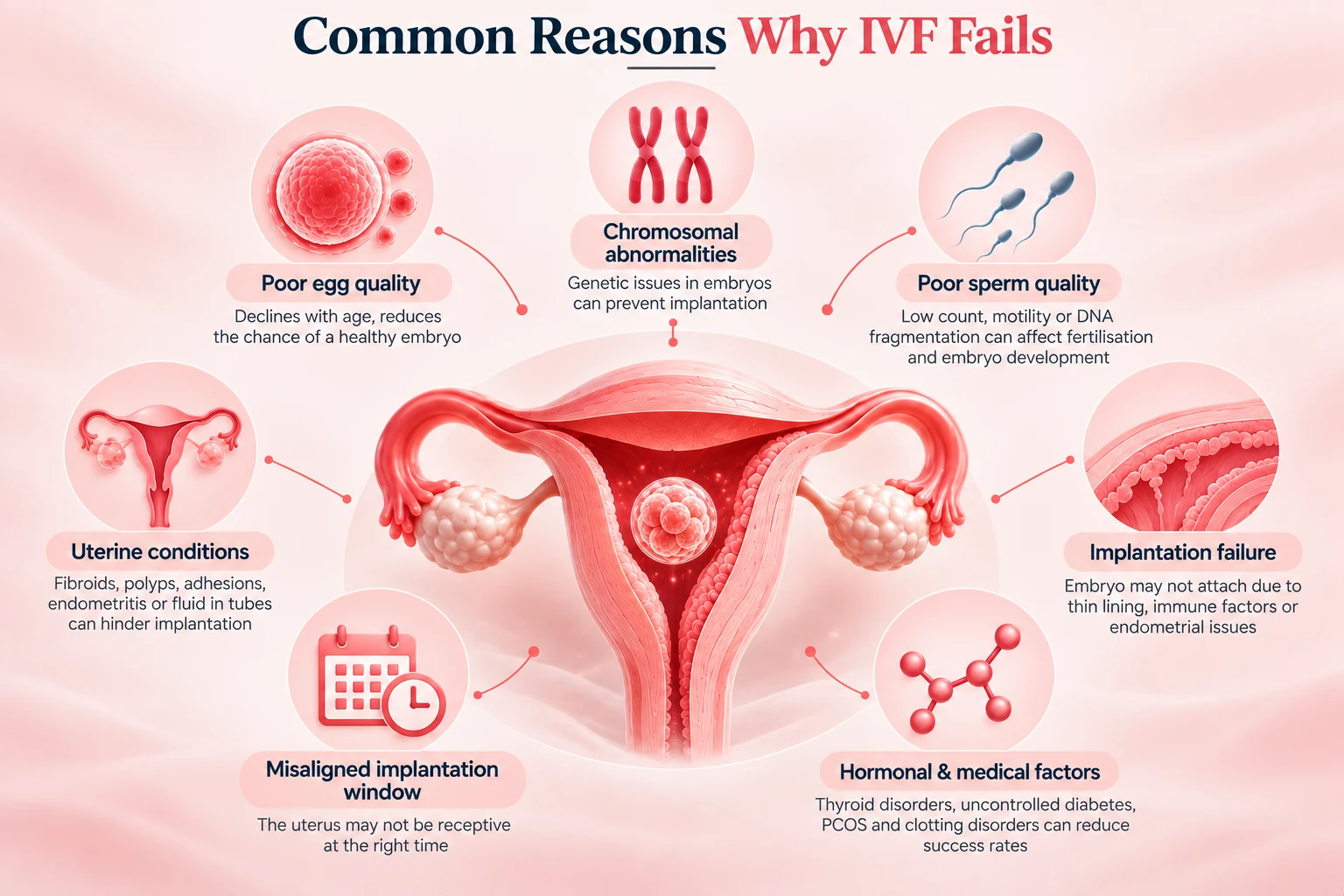
IVF fails most commonly due to chromosomal abnormalities in embryos, implantation failure, poor egg or sperm quality, uterine conditions, or a misaligned window of implantation. First-cycle failure is medically normal, with cumulative success rising significantly over two to three cycles. At Mediworld Fertility Delhi, Dr. Neha Gupta’s team conducts detailed failed-cycle reviews – including PGT-A screening, ERA testing, and hysteroscopy – to identify correctable causes and build a stronger protocol for the next attempt.
Is It Common for IVF to Fail the First Time?
Yes, and understanding this early helps couples in Delhi NCR set realistic expectations. Even at the best IVF centres, a single cycle is never a guarantee, and first-cycle failure is medically normal.
- A single IVF cycle typically succeeds in about 30-45% of cases for women under 35, which means more than half of first attempts may not result in pregnancy.
- Success rates decline with age, dropping significantly after 38-40 due to egg quality.
- IVF failing the first time does not mean IVF will never work for you. Cumulative success over two to three cycles is far higher than any single attempt.
- Many couples experience a first IVF failed, second successful pattern, because the first cycle gives doctors crucial information about how your body responds to stimulation and transfer.
- At Mediworld Fertility, every unsuccessful cycle is reviewed in detail so the next protocol is smarter, not just repeated.
Get Expert Guidance for Your Fertility Journey
Take the next step with Mediworld Fertility. Connect with our team to book your consultation.
 WhatsApp Us

Why Does IVF Fail With Good Embryos?
This is the question that troubles couples most: the embryologist graded the embryo as excellent, yet the cycle still failed. Even in top Delhi IVF labs, embryo grading only tells part of the story.
- Grading is based on how an embryo looks under a microscope, so it cannot see chromosomes. A beautiful-looking embryo can still carry genetic abnormalities that prevent implantation or cause early loss.
- Chromosomal errors are the single biggest reason good embryos fail, and they increase sharply with maternal age.
- The uterus may not be receptive on transfer day. Implantation needs the endometrium and embryo to be perfectly synchronised, a narrow phase called the “window of implantation.”
- Undetected uterine issues such as polyps, adhesions, chronic endometritis (low-grade infection of the lining), or hydrosalpinx (fluid-filled tubes) can sabotage even a genetically normal embryo.
- Preimplantation Genetic Testing (PGT-A), available at Mediworld Fertility’s advanced lab, screens embryos for chromosomal normalcy before transfer, dramatically reducing failures with “good” embryos.
Request a Consultation
Reasons for Implantation Failure in IVF
Implantation failure means the embryo did not attach to the uterine lining after transfer. It is the most common point of IVF failure, and identifying the cause is central to how our Delhi specialists plan repeat cycles.
- Thin or unresponsive endometrium: a lining under 7 mm often struggles to support implantation.
- Displaced implantation window: in some women, the lining becomes receptive earlier or later than standard timing. An ERA (Endometrial Receptivity Analysis) test can pinpoint your personal window.
- Chronic endometritis: silent inflammation of the lining, treatable with a simple antibiotic course once diagnosed.
- Immunological factors: an overactive immune response or elevated natural killer (NK) cell activity may reject the embryo.
- Blood clotting disorders (thrombophilia): conditions like antiphospholipid syndrome reduce blood flow to the implantation site.
- Embryo-lining crosstalk failure: sometimes both embryo and lining are healthy individually but fail to signal each other correctly. Frozen embryo transfer in a natural or medicated cycle often solves this.
Unsuccessful Implantation Symptoms After IVF
Many women ask whether their body signals a failed transfer. The honest answer, which our doctors share openly with every Delhi NCR patient, is that symptoms are unreliable. Only a beta hCG blood test confirms the outcome.
- Absence of symptoms means nothing, as many successful pregnancies begin with zero early signs.
- Spotting or light bleeding before the pregnancy test may suggest the cycle has not worked, but it can also be harmless implantation bleeding.
- Cramping, breast tenderness, and bloating are usually caused by progesterone support medicines, not by success or failure.
- The onset of a full period-like flow before test day is the clearest physical sign of an unsuccessful cycle.
- Never stop progesterone or other medicines based on symptoms alone. Always wait for your blood test and your doctor’s confirmation.
Egg Quality, Sperm Quality, and Age: The Biological Reasons
Fertility is a two-person equation, and gamete quality drives IVF outcomes more than any other single factor. Mediworld Fertility’s diagnostic workup in Delhi evaluates both partners before any cycle begins.
- Maternal age: egg quantity and chromosomal quality decline steadily after 35, which is why IVF fails more often in later attempts at conception.
- Diminished ovarian reserve: low AMH or high FSH means fewer eggs retrieved and fewer embryos to choose from.
- Poor ovarian response: some women produce few eggs despite high stimulation doses. Protocols must be individualised, not copied.
- Sperm DNA fragmentation: a normal semen analysis can hide high DNA damage, which causes fertilisation failure, poor embryo development, and miscarriage. A DFI test detects it.
- Severe male factor infertility: very low counts or motility may require ICSI, where a single healthy sperm is injected directly into each egg.
Uterine, Hormonal, and Medical Reasons for IVF Failure After Embryo Transfer
Beyond eggs and embryos, the environment receiving the embryo must be healthy. Structural and hormonal problems are among the most correctable reasons for IVF failure after embryo transfer, once they are actually looked for.
- Fibroids and polyps: growths inside or pressing on the uterine cavity distort the implantation surface. Hysteroscopic removal often transforms outcomes.
- Hydrosalpinx: fluid from a blocked fallopian tube leaks into the uterus and is toxic to embryos. Removing or clipping the tube before transfer can nearly double success rates.
- Uterine septum or adhesions (Asherman’s syndrome): scar tissue from past surgeries or infections reduces usable lining.
- Thyroid disorders and uncontrolled diabetes: even mild hypothyroidism raises failure and miscarriage risk. TSH should ideally be optimised before transfer.
- PCOS-related hormonal imbalance: affects egg maturity and endometrial quality if not managed properly.
- Progesterone insufficiency: inadequate luteal support after transfer can cause the lining to break down too early.
Lifestyle and Laboratory Factors That Quietly Lower Success
Some reasons for failure lie outside the body, in daily habits and in the IVF lab itself. This is why choosing an experienced fertility centre in Delhi matters as much as the treatment protocol.
- Smoking (both partners) reduces implantation rates and egg and sperm quality measurably.
- Obesity and being significantly underweight both disrupt hormonal balance and endometrial receptivity.
- Excessive alcohol, high caffeine intake, and chronic sleep deprivation are associated with poorer outcomes.
- Unmanaged stress affects hormone regulation. Counselling and structured support during cycles genuinely help.
- Lab quality is decisive: embryo culture conditions, air purity, incubator stability, and embryologist skill directly determine how many embryos reach the healthy blastocyst stage. Mediworld Fertility’s labs are equipped with advanced culture systems, genetic screening facilities, and a senior embryology team with over 15 years of IVF cycles behind them.
What Happens to Your Body After Failed IVF?
Physically, recovery is quicker than most women expect; emotionally, it deserves just as much care. Our Delhi team supports patients through both, because healing well is part of preparing for the next attempt.
- Once progesterone support is stopped, your period typically arrives within 3 to 10 days after a failed embryo transfer. This bleed may be heavier or more crampy than usual because of the medicated lining.
- Hormone levels from stimulation settle over one to two cycles. Mild bloating, mood swings, and breast tenderness fade as they normalise.
- Your natural menstrual rhythm usually returns fully by the second cycle after treatment.
- Grief, anger, and anxiety are normal and valid, because a failed cycle is a real loss. Speaking to a counsellor, and to your doctor about what was learned, helps enormously.
- Medically, most women can attempt another transfer after one to two full menstrual cycles, and you can generally do two to three complete IVF cycles in a year with adequate recovery gaps. Your specialist will personalise this timeline.
3 Failed IVF Cycles: What Next?
Three or more unsuccessful cycles is termed recurrent implantation failure, and it changes the medical approach entirely. At this stage, repeating the same protocol is not the answer; deeper investigation is.
- A structured recurrent-failure workup should include PGT-A for embryos, ERA testing for the implantation window, hysteroscopy to inspect the cavity, endometritis screening, thrombophilia and immune panels, and sperm DNA fragmentation testing.
- Protocol changes, such as switching stimulation drugs, moving to frozen embryo transfer, or adjusting progesterone routes, resolve many hidden problems.
- Chances of IVF success after 3 failed attempts remain genuinely encouraging once a correctable cause is found. Many couples conceive on the very next optimised cycle.
- Even after 4, 5, or 6 failed IVF cycles, there is hope. Options like PGT-tested transfers, immune-modulated protocols, and where appropriate, donor eggs or donor embryos, offer realistic paths to parenthood.
- At Mediworld Fertility, recurrent failure cases are reviewed by a multidisciplinary team of fertility specialists, embryologists, and nutrition and lifestyle experts, so no possible cause goes unexamined.
Why Couples Across Delhi NCR Choose Mediworld Fertility After a Failed Cycle
A failed cycle deserves answers, not just another attempt. Mediworld Fertility has spent over 15 years helping couples in Delhi turn unsuccessful cycles into successful pregnancies through evidence-based, personalised care.
- Comprehensive failed-cycle review: every previous protocol, embryo record, and report is analysed before a new plan is made.
- Advanced in-house facilities: PGT screening, painless tubal patency testing, ICSI, frozen embryo transfer, and world-class embryology labs under one roof.
- Multidisciplinary support: fertility, nutrition, and lifestyle experts working together, with 24×7 patient care and dedicated aftercare.
- Honest counselling: you’ll always know your realistic chances, your options, and the reasoning behind every recommendation.
If your IVF cycle has failed, whether it was your first attempt or your fourth, don’t lose hope, and don’t repeat the same cycle blindly. Book a consultation with the specialists at Mediworld Fertility in Delhi, get a complete failure analysis, and take your next step with a plan built specifically for you. Your story isn’t over; it may simply need a better-written next chapter.