
How to Improve Egg Quality Naturally
Egg quality is one of the biggest factors in IVF success and natural conception. You cannot improve egg quality in 10 days – follicles take roughly 90 days to mature, so a 10-day sprint changes nothing structurally. Even improve egg quality in 30 days is a partial picture: 30 days is enough to start reducing oxidative stress and improving mitochondrial function, but the full benefit shows up closer to the 90-day mark. What you can do immediately – today – is cut processed food, start CoQ10, and fix your sleep. That matters. Women with PCOS, low AMH, or age-related concerns have real, evidence-backed options. Starting early gives you the best results.
Foods That Improve Egg Quality
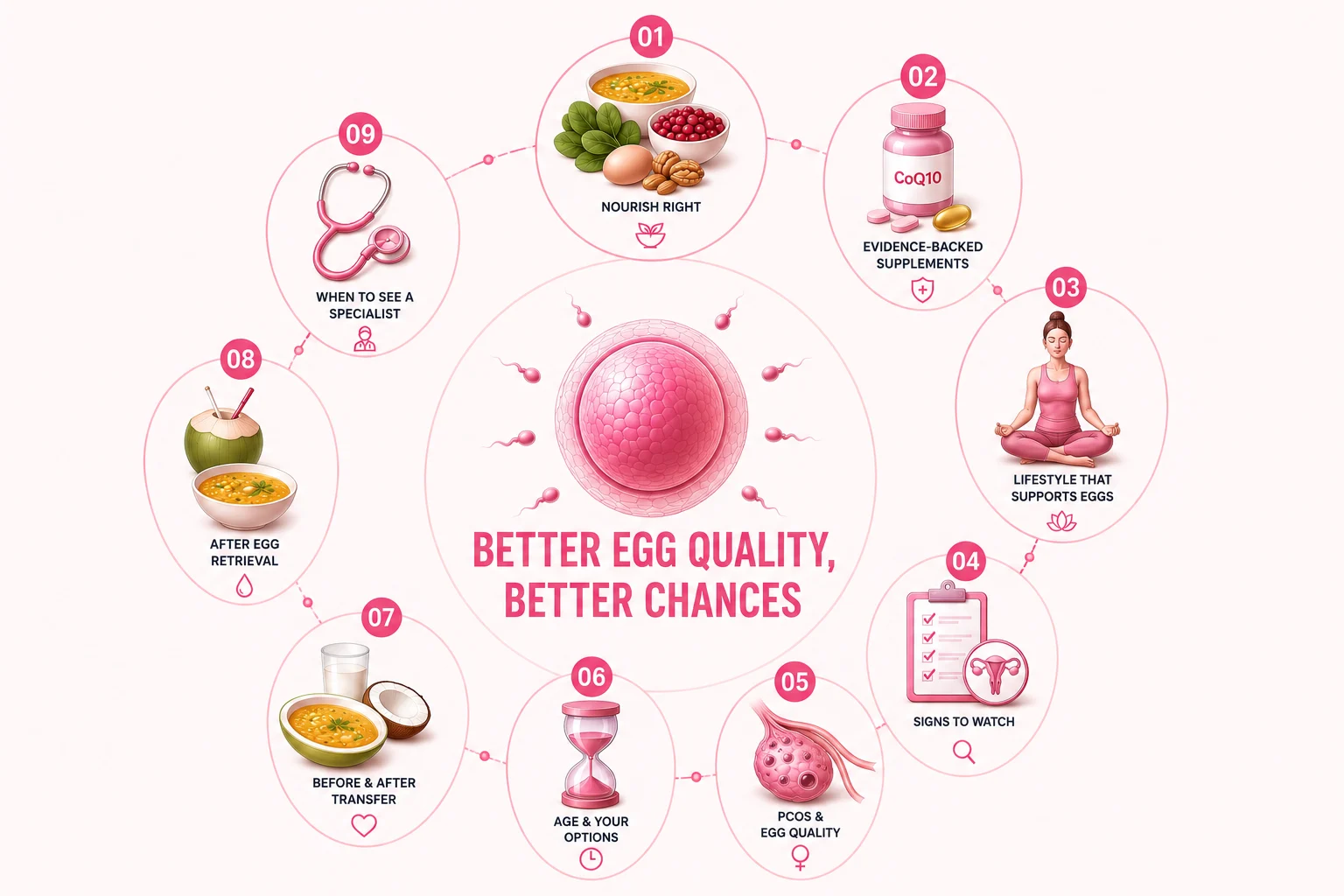
What you eat in the 90 days before egg retrieval genuinely matters. Eggs take roughly three months to mature, so the nutrients you put in now are the building blocks your follicles are working with. Think of food as food for egg growth and ovulation – not a one-time fix, but a consistent three-month investment.
Here are the top 10 foods to improve female egg quality, in an Indian context:
1. Dal, rajma, and chana (legumes) – high-protein, low-glycaemic, and rich in folate. Aim for at least one serving at every main meal.
2. Eggs – complete protein with choline, which supports healthy cell division in developing follicles.
3. Spinach and methi (fenugreek leaves) – loaded with folate and iron, both critical for healthy egg DNA and endometrial support.
4. Walnuts and flaxseeds – among the best plant-based sources of omega-3 fatty acids, which support egg membrane integrity.
5. Amla (Indian gooseberry) – one of the richest natural sources of Vitamin C; a potent antioxidant that fights oxidative stress in follicular fluid.
6. Pomegranate – rich in antioxidants and shown in small studies to support uterine blood flow and ovarian health.
7. Whole grains: ragi, bajra, jowar, brown rice – stabilise blood sugar and insulin, which directly affects ovarian hormone balance.
8. Paneer and curd – good sources of protein and calcium; curd also supports gut health, which influences hormone metabolism.
9. Ghee (in moderation) – a source of fat-soluble vitamins A, D, E, and K, all of which play roles in reproductive health.
10. Citrus fruits and guava – high in Vitamin C and bioflavonoids; excellent for reducing inflammation around the ovaries.
A simple Indian IVF diet chart for one day: soaked almonds at wake-up → moong dal chilla with curd for breakfast → brown rice + dal + sabzi + salad for lunch → roasted makhana or sprouts for a snack → roti with palak paneer or vegetable soup for dinner.
Limit what harms eggs. Cut back on maida-based foods, packaged snacks, sugary drinks, and deep-fried items. These promote inflammation and insulin resistance, both of which hurt egg quality.
Stay well hydrated. 2–3 litres of water a day supports follicular fluid quality. Coconut water is a great addition.
Get Expert Guidance for Your Fertility Journey
Take the next step with Mediworld Fertility. Connect with our team to book your consultation.
 WhatsApp Us

Supplements for Egg Quality
Supplements are not magic, but a few have solid enough evidence to be worth discussing with your doctor – especially if you are preparing for IVF.
- CoQ10 (Coenzyme Q10): the strongest evidence. A 2024 meta-analysis found CoQ10 consistently improved clinical pregnancy rates and oocyte/embryo metrics in women with diminished ovarian reserve or ovarian aging. Typical doses studied are 200–600 mg daily, started at least 2–3 months before an IVF cycle.
- DHEA: for poor responders. DHEA is most useful for women with low AMH or poor ovarian response. Evidence is moderate – some pooled analyses show better embryo quality and pregnancy rates, but it is a specialist-directed supplement, not a self-prescribed one.
- Melatonin: supports embryo quality. Research suggests melatonin may increase the number of high-quality embryos by reducing oxidative stress in follicular fluid. The evidence is weaker than CoQ10, but it is a reasonable adjunct when embryo quality is the concern.
- Folic acid: non-negotiable. 400–800 mcg daily is recommended for all women trying to conceive. It supports healthy DNA replication in the egg and reduces the risk of neural tube defects.
- Vitamin D: check your levels first. Vitamin D deficiency is extremely common in India and is linked to poorer IVF outcomes. A simple blood test tells you whether you need supplementation.
- Omega-3 fatty acids. If your diet is low in fish and nuts, an omega-3 supplement (fish oil or algae-based) can help reduce inflammation around the ovaries.
- Do not self-prescribe. Dosing, timing, and combinations matter. Always run your supplement plan by your fertility specialist before starting.
On the 30-day question: if you are asking whether you can improve egg quality in 30 days naturally, the honest answer is – partially. Thirty days of CoQ10, a clean diet, and better sleep will reduce oxidative stress and begin improving mitochondrial energy in your follicles. But the cohort of eggs you retrieve in 30 days started maturing before you changed anything. The full benefit lands at 90 days. Start now, stay consistent.
Request a Consultation
Lifestyle Changes for Better Egg Quality
Diet and supplements get most of the attention, but lifestyle habits can quietly make or break your egg quality – especially over months of preparation.
- Prioritise 7–8 hours of sleep. Melatonin (your body’s own version) is produced during deep sleep and protects eggs from oxidative damage. Chronic poor sleep disrupts this cycle.
- Try yoga for fertility. Systematic reviews show that yoga significantly reduces anxiety and stress in women undergoing fertility treatment. Poses like Supta Baddha Konasana (reclining butterfly), Viparita Karani (legs up the wall), and Balasana (child’s pose) are gentle, safe, and promote pelvic blood flow.
- Manage stress actively. High cortisol suppresses the hormones that drive follicle development. Meditation, pranayama, journaling, or even a 20-minute walk daily can make a real difference over a 3-month period.
- Maintain a healthy weight. Both underweight and overweight status affect hormone levels and egg quality. A BMI between 18.5 and 24.9 is the sweet spot for fertility.
- Quit smoking completely. Smoking accelerates ovarian aging and is directly linked to lower egg quality. There is no safe level of exposure.
- Limit alcohol. Even moderate alcohol consumption is associated with reduced IVF success rates. During your fertility preparation window, it is best avoided entirely.
- Reduce BPA and chemical exposure. Avoid heating food in plastic containers, switch to glass or steel water bottles, and choose natural personal care products where possible. Endocrine-disrupting chemicals interfere with ovarian function.
- Exercise moderately. Brisk walking, swimming, or light yoga 4–5 days a week supports circulation and hormone balance. Avoid very high-intensity exercise during stimulation or the two-week wait.
Signs That May Indicate Poor Egg Quality
Poor egg quality rarely announces itself with obvious symptoms – which is part of what makes it so frustrating. These are the clinical patterns that fertility specialists look for. None of them is a definitive diagnosis on its own, and many are treatable or manageable.
- Irregular or absent menstrual cycles. Cycles shorter than 21 days or longer than 35 days can signal hormonal imbalances that affect egg maturation.
- Repeated miscarriages (recurrent pregnancy loss). Two or more consecutive miscarriages, especially early ones, are often linked to chromosomal issues in the egg – the most common cause of first-trimester loss.
- Poor IVF response. Producing fewer than 3–4 mature eggs despite adequate stimulation, or consistently poor fertilisation rates, can point to egg quality issues rather than just low reserve.
- Low fertilisation rates. If eggs retrieved during IVF fail to fertilise normally – even with ICSI – the quality of the egg’s cytoplasm may be a factor.
- Elevated FSH (Follicle-Stimulating Hormone). A consistently high FSH (above 10–12 IU/L on Day 3) suggests the brain is working harder to recruit follicles – a sign of declining ovarian reserve and often egg quality.
If any of these apply to you, the right response is not panic – it is information. An AMH test, antral follicle count, and a conversation with a fertility specialist will give you a much clearer picture than any symptom list can.
PCOS and Egg Quality
PCOS is one of the most common reasons women in India seek fertility treatment. The relationship between PCOS and egg quality is more nuanced than most people realise.
- PCOS often means more eggs, not necessarily better ones. Women with PCOS typically have high AMH and many follicles, but the eggs may have impaired maturation or implantation potential – especially when insulin resistance is present.
- Insulin resistance is the key target. Managing blood sugar through a low-glycaemic diet (millets, legumes, vegetables over refined carbs) and regular exercise directly improves hormonal balance and egg quality in PCOS.
- Inositol supplements help. Myo-inositol (2–4 g daily) is well-studied in PCOS and has been shown to improve egg maturation rates and IVF outcomes. Ask your doctor about this.
- Weight loss of even 5–10% can restore ovulation. For women with PCOS who are overweight, modest weight loss significantly improves both natural conception chances and IVF response.
- OHSS risk is real. Because PCOS ovaries respond strongly to stimulation, there is a higher risk of ovarian hyperstimulation syndrome (OHSS) during IVF. A good clinic will use a tailored, lower-dose protocol to manage this.
- Metformin may be prescribed. Some fertility specialists prescribe metformin before IVF in PCOS patients to improve insulin sensitivity and reduce OHSS risk. This is a clinical decision – do not self-medicate.
- Stress worsens PCOS symptoms. Cortisol directly amplifies androgen levels in PCOS. Yoga for fertility, adequate sleep, and stress management are not optional extras for women with PCOS – they are part of the treatment plan.
Egg Quality and Age: What You Can Control
Age is the single biggest factor in egg quality. But “age affects eggs” does not mean “nothing can be done.” Here is what the numbers actually say – and what your real options are.
- AMH and egg quality: understand the difference. AMH (Anti-Müllerian Hormone) measures your ovarian reserve – how many eggs you have left. It does not directly measure egg quality. A low AMH means fewer eggs, but the ones you have may still be healthy, especially before 35.
- Egg quality declines from the mid-30s. By 38–40, the rate of chromosomally abnormal eggs rises significantly, which is why IVF success with own eggs in India typically falls to 10–20% per cycle after 40.
- If you are over 35: the 90-day window still works for you. Women asking how to improve egg quality after 35 naturally often assume the window has closed. It has not. CoQ10 at 400–600 mg daily, a diet rich in antioxidants and healthy fats, and active stress management can still meaningfully improve the quality of the eggs you have before a cycle. The key is starting at least 3 months before your planned retrieval – not waiting until the week before.
- Food to improve egg quality after 40. If you are over 40 and preparing for IVF with your own eggs, these four foods deserve a specific focus: walnuts (omega-3s for egg membrane health), amla or Vitamin C-rich fruits (antioxidant protection against age-related oxidative damage), eggs and paneer (complete protein to support follicle development), and dark leafy greens (folate and iron for healthy cell division). None of these are exotic – they are everyday Indian foods that do real work at the cellular level.
- Egg freezing is most effective before 35. If you are in your late 20s or early 30s and not ready to conceive, egg freezing is a genuine option worth exploring. Freezing 10–15 mature eggs before 35 gives you the best future success rates.
- Donor egg IVF changes the equation after 40. Donor egg success rates over 40 in India are typically 50–70% per transfer – because success is driven by the donor’s egg age, not the recipient’s. This is a medically sound and increasingly chosen path.
- Do not delay testing. If you are over 35 and have been trying for 6 months without success, get an AMH test and antral follicle count (AFC). Early information means more options.
Before and After Embryo Transfer: Diet and Egg Quality Tips
The weeks around your embryo transfer are high-stakes. What you eat supports both the embryo and the uterine lining that needs to receive it.
Before embryo transfer diet chart:
- Eat warm, cooked, easy-to-digest meals – avoid raw salads and cold foods in the days leading up to transfer.
- Prioritise iron-rich foods (spinach, lentils, dates, jaggery) to support endometrial thickness.
- Include protein at every meal: dal, paneer, curd, eggs, or legumes.
- Drink 2–3 litres of fluids daily, including coconut water and warm soups.
- Avoid alcohol, excess caffeine (limit to one cup of tea or coffee), and processed foods.
After embryo transfer diet chart (the two-week wait):
- Continue warm, nourishing meals. Moong dal khichdi, idli-sambar, roti with dal and sabzi are ideal.
- Eat pineapple core in moderation if you like – it contains bromelain, which some believe supports implantation, though evidence is limited. It will not harm you.
- Avoid raw papaya, raw eggs, and unpasteurised dairy.
- Keep caffeine under 200 mg/day (roughly one cup of coffee).
- Rest, but gentle walking is fine. Bed rest is not required and is not recommended by most specialists.
After egg retrieval, what to eat:
- Focus on protein and fluids to help your body recover from stimulation.
- Electrolyte-rich drinks (coconut water, nimbu pani with a pinch of salt) help prevent OHSS.
- Avoid strenuous activity for 48–72 hours post-retrieval.
- Warm, light meals like dal soup, khichdi, or vegetable broth are easiest on the body.
When to See a Fertility Specialist in Delhi NCR
Knowing when to stop waiting and start investigating is one of the most important decisions in your fertility journey.
- Under 35? See a specialist after 12 months of trying. If you have been trying to conceive for a year without success, it is time for a full fertility workup – for both partners.
- Over 35? Do not wait 12 months. See a specialist after 6 months. Over 38, go after 3 months. Time matters more as egg quality and reserve decline with age.
- Have PCOS, irregular cycles, or known low AMH? See a specialist now – do not wait for a 12-month window. Early intervention gives you more options.
- What to expect at a good fertility centre in Delhi NCR. A thorough first consultation includes AMH, FSH, LH, and antral follicle count for you, and a semen analysis for your partner. Avoid any clinic that skips this baseline.
- Look for personalised protocols. The best IVF clinic for you is one that tailors stimulation doses to your ovarian reserve – not one that uses the same protocol for every patient.
- Faridabad and surrounding NCR areas are well-served. You do not need to travel to central Delhi for world-class fertility care. Several experienced fertility centres in Faridabad and South Delhi NCR offer the full range of services including IVF, egg freezing, donor egg programmes, and PCOS management.
One centre worth knowing about is Mediworld Fertility in Delhi NCR, led by Dr. Neha Gupta, a fertility specialist with extensive IVF experience. The clinic offers personalised IVF stimulation protocols tailored to each patient’s ovarian reserve, as well as egg freezing and donor egg programmes – which is particularly relevant for women over 35 or 40 who want to understand all their options in one place. The approach is thorough and individualised, which matters when your situation does not fit a standard template.
- Ask the right questions. Before committing to a clinic, ask about their live birth rate (not just clinical pregnancy rate), their OHSS management protocol, and their embryology lab standards.
Frequently Asked Questions
Can I really improve egg quality naturally, or is it all about genetics and age? expand_more
Both matter, but lifestyle factors are not trivial. The 3–4 months before an IVF cycle - when eggs are maturing - are a genuine window for improvement. Diet, supplements like CoQ10, sleep, and stress reduction can all influence the mitochondrial health and chromosomal integrity of your eggs. You cannot reverse age, but you can optimise what you have.
How long does it take for lifestyle changes to improve egg quality? expand_more
Eggs take approximately 90 days (3 months) to mature from primordial follicle to ovulation-ready egg. This means changes you make today will affect the eggs available in about 3 months. Starting your diet and supplement plan at least 3 months before your IVF cycle gives you the best chance of seeing a difference.
Is CoQ10 safe to take during IVF preparation? expand_more
CoQ10 is generally considered safe and is widely used in IVF preparation. Most studies use doses of 200–600 mg daily. However, always confirm the dose and timing with your fertility specialist, as individual needs vary - especially if you have other health conditions or are taking other medications.
I have PCOS. Does that mean my egg quality is poor? expand_more
Not necessarily. PCOS means your ovaries produce many follicles, but the eggs may have maturation challenges - particularly when insulin resistance is present. Managing blood sugar, maintaining a healthy weight, and working with a specialist to choose the right stimulation protocol can significantly improve your IVF outcomes with PCOS.
At what age should I consider donor eggs instead of my own? expand_more
There is no single cut-off age, but donor egg IVF is often discussed when a woman's own egg quality or reserve is significantly compromised - typically after 42–43, or earlier if AMH is very low and previous IVF cycles have produced poor results. Donor egg success rates over 40 in India are 50–70% per transfer, making it a highly effective option. This is a decision to make with your specialist based on your individual test results, not age alone.