
Low Sperm Count in Men: Signs, Causes, and What to Do Next
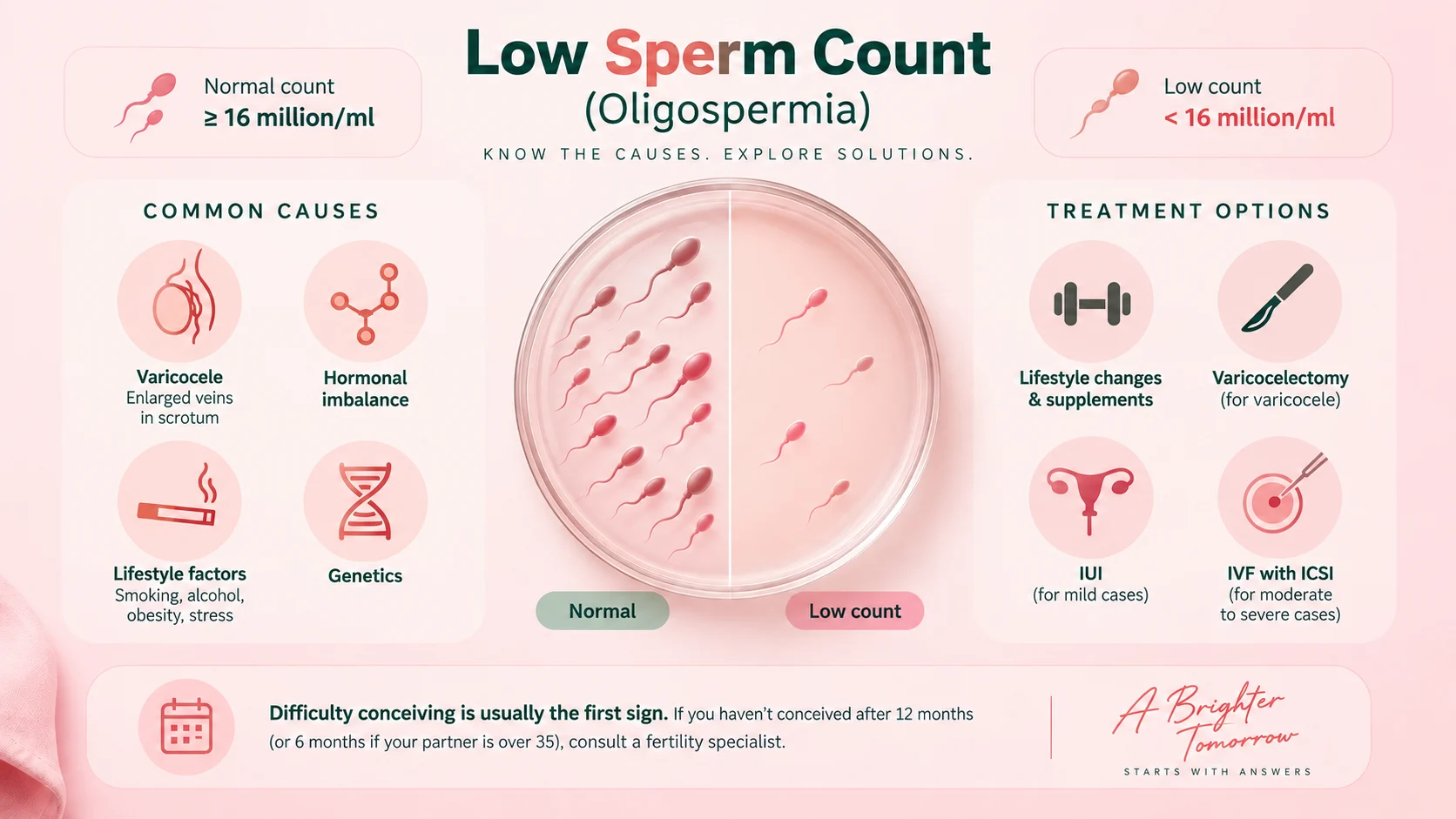
Low sperm count (oligospermia) rarely causes symptoms – difficulty conceiving is usually the first sign. Causes include varicocele, hormonal imbalance, lifestyle factors, and genetics. Treatment ranges from lifestyle changes and supplements to varicocelectomy, IUI, or IVF with ICSI depending on severity.
What Is Low Sperm Count? The Numbers You Need to Know
Low sperm count means that the concentration of sperm in your semen is below the threshold considered normal for fertility. According to the WHO 2021 (6th edition) guidelines – the current global standard – a normal sperm count is 16 million sperm per millilitre (ml) of semen or more, with a total count of at least 39 million per ejaculate.
Falling below this level is called oligospermia. It’s graded by severity:
- Mild oligospermia: 10-15 million/ml – natural conception is possible but may take longer
- Moderate oligospermia: 5-10 million/ml – medical intervention is usually recommended
- Severe oligospermia: below 5 million/ml – assisted reproduction is typically required
- Azoospermia: no sperm present in the ejaculate at all – a separate and more complex condition
Sperm count is only one parameter. A complete semen analysis also measures motility (how many sperm are moving, and how well), morphology (the percentage with a normal shape), and volume (how much semen is produced per ejaculate). A man can have a count above 16 million/ml and still have a fertility problem if motility or morphology is poor. This is why a full semen analysis, interpreted by a specialist, matters far more than a single number.
Get Expert Guidance for Your Fertility Journey
Take the next step with Mediworld Fertility. Connect with our team to book your consultation.
 WhatsApp Us

Signs of Low Sperm Count: What Men Actually Experience
This is where most information misleads men: the majority of oligospermia cases have no obvious external symptoms at all. The condition is clinically silent. You cannot feel a low sperm count, and it has no impact on sexual performance or libido in most cases.
That said, there are signs – some direct, some indirect – that can prompt earlier investigation.
The Primary Sign: Difficulty Conceiving
The most reliable indicator of low sperm count is a couple’s inability to conceive after a defined period of regular, unprotected intercourse. Clinically, a couple is considered to have a fertility problem after:
- 12 months of trying if the female partner is under 35
- 6 months of trying if the female partner is 35 or older
If pregnancy hasn’t occurred within these windows, both partners should be evaluated simultaneously. Male factor infertility is a contributing cause in nearly half of all cases – making semen analysis as essential a first step as any investigation of the female partner.
Physical Signs Linked to Underlying Causes
When low sperm count is caused by a specific medical condition, that condition may produce its own symptoms. These are worth knowing:
- Scrotal or testicular changes A dull ache, feeling of heaviness, or visible swelling in the scrotum can indicate varicocele – an enlargement of the veins within the scrotum that raises testicular temperature and is found in approximately 40% of infertile men. Varicocele is also one of the most treatable causes of low sperm count. A lump or unusual firmness in the testicle warrants urgent evaluation.
- Hormonal signs Low testosterone – one of several hormonal causes of oligospermia – can present as reduced facial or body hair, decreased muscle mass, enlarged breast tissue (gynaecomastia), or low energy that isn’t explained by sleep or lifestyle. These are not common presentations, but when they appear alongside difficulty conceiving, they point toward a hormonal workup.
- Reduced sexual drive or erectile difficulty Hormonal imbalances affecting sperm production can also reduce libido or make maintaining an erection harder. If this is a new development rather than a longstanding pattern, it deserves investigation rather than dismissal.
- Changes in ejaculate Low semen volume, a watery appearance, or pain during ejaculation can indicate blockages in the reproductive tract, prostate issues, or retrograde ejaculation (where semen travels backward into the bladder rather than forward). Any of these changes should prompt a semen analysis.
- Unexplained fatigue Persistent, unexplained tiredness can be linked to low testosterone – which is sometimes the underlying driver of reduced sperm production. On its own it’s non-specific, but in combination with other signs it becomes more meaningful.
Less Common Signs
Some conditions that cause low sperm count have associated symptoms that are easy to overlook:
- Respiratory problems or chronic sinusitis can sometimes be linked to a genetic condition called Primary Ciliary Dyskinesia, which affects sperm motility and count
- Thyroid disorders (both hypothyroidism and hyperthyroidism) can disrupt sperm production and are often asymptomatic until tested
- A history of mumps in adulthood, undescended testicles, or a previous hernia repair can all affect sperm production in ways that show up only in a semen analysis
Request a Consultation
What Causes Low Sperm Count in Men?
Understanding the cause matters because it directly determines the treatment. The main categories are:
Medical Causes
- Varicocele is the single most common reversible cause of low sperm count in India, found in approximately 40% of infertile men. The enlarged scrotal veins raise testicular temperature, which damages ongoing sperm production. Varicocele repair (varicocelectomy) can significantly improve sperm count and motility, often enabling natural conception or IUI afterward.
- Hormonal imbalances – involving FSH (follicle-stimulating hormone), LH (luteinising hormone), testosterone, prolactin, or thyroid hormones – disrupt the signalling cascade that drives sperm production in the testes. These are identifiable through a blood panel and, in many cases, treatable.
- Infections and blockages – past STIs, prostatitis, epididymitis, or orchitis can scar the reproductive ducts or damage sperm-producing tissue. Some men carry the effects of a mumps infection from years earlier without realising it.
- Genetic conditions – Klinefelter syndrome (an extra X chromosome) and Y-chromosome microdeletions account for a meaningful subset of severe oligospermia and azoospermia cases. Genetic testing is recommended for men with very low counts or no sperm before proceeding with ICSI, as the findings change both the treatment plan and the counselling conversation.
- Previous surgeries or injury – hernia repairs, orchidopexy for undescended testes, or any pelvic surgery can affect the vas deferens or blood supply to the testes.
- Cancer treatment – chemotherapy and radiation can significantly reduce sperm production, sometimes permanently. Sperm banking before treatment is the recommended approach wherever possible.
Lifestyle Causes
These factors directly affect sperm production and quality, and most are modifiable:
- Smoking reduces average sperm count by approximately 23% and impairs motility
- Alcohol – chronic, heavy consumption reduces testosterone and can physically affect testicular tissue
- Obesity raises estrogen relative to testosterone and is independently associated with poorer sperm parameters
- Heat exposure – regular use of saunas, hot tubs, tight underwear, or keeping a laptop on the lap raises scrotal temperature. The testes are positioned outside the body precisely because sperm production requires a temperature 2-3°C cooler than core body temperature
- Stress – sustained psychological stress elevates cortisol, which suppresses the hormonal axis governing sperm production
- Anabolic steroids and testosterone supplements – these are among the most underreported causes of low sperm count. Exogenous testosterone signals the body to stop producing its own, effectively shutting down sperm production. This is a particularly important point for men who use performance-enhancing supplements
Environmental Causes
Exposure to pesticides, industrial solvents, heavy metals (particularly lead), and BPA (a chemical in certain plastics) can interfere with testosterone and reduce sperm production. Air pollution in urban environments – including Delhi NCR – has increasingly been studied for its effects on male reproductive health.
The Semen Analysis: What Your Report Actually Means
A semen analysis is the essential first investigation for any man concerned about fertility. It is minimally invasive, requires a sample provided at the clinic after 2-5 days of abstinence, and delivers results within 24-48 hours in most Delhi NCR labs.
The key parameters, and what they mean:
| Parameter | WHO 2021 Lower Reference Limit | What It Measures |
| Semen volume | ≥1.4 ml | How much fluid is produced |
| Sperm concentration | ≥16 million/ml | Sperm per millilitre |
| Total sperm count | ≥39 million/ejaculate | Total sperm in the sample |
| Total motility | ≥42% | Percentage of moving sperm |
| Progressive motility | ≥30% | Percentage moving forward purposefully |
| Normal morphology | ≥4% | Percentage with normal shape |
| Vitality | ≥54% | Percentage of living sperm |
Important: one result is never the whole story. Sperm take approximately 72-74 days to mature, meaning a semen analysis reflects what was happening in your body more than two months ago. A fever, a period of heavy alcohol use, or a significant stressor three months before the test can produce an abnormal result that normalises on repeat testing. Most fertility specialists request a second analysis 4-8 weeks after the first before drawing conclusions.
Beyond the Basic Semen Analysis
- Sperm DNA fragmentation testing measures the integrity of the genetic material inside the sperm. A man can have normal count, motility, and morphology and still have high DNA fragmentation – which is associated with fertilisation failure, poor embryo development, and recurrent miscarriage. This test is particularly important for couples with unexplained infertility, recurrent IVF failure, or repeated pregnancy loss.
- Hormone panel – FSH, LH, testosterone, prolactin, and thyroid function tests – tells you whether the problem is in the signalling from the brain to the testes, or in the testes themselves.
- Scrotal ultrasound – identifies varicocele, testicular abnormalities, or structural issues that can’t be felt on physical examination.
- Genetic testing – karyotype and Y-chromosome microdeletion analysis – recommended for men with severe oligospermia or azoospermia before ICSI.
Can Low Sperm Count Be Treated? Options Available in Delhi
Yes – and the range of options is wider than most men realise. The right treatment depends entirely on the cause and the severity of the semen parameters.
Lifestyle and Medical Management (3-6 Months)
For men with mild to moderate oligospermia linked to modifiable factors, a structured three-to-six-month programme of lifestyle change can produce meaningful improvement in sperm parameters:
- Stopping smoking and cutting alcohol
- Reaching and maintaining a healthy BMI
- Switching from briefs to boxers; stopping hot baths and sauna use
- Managing sleep (7-8 hours is the target)
- Reviewing any medications or supplements that suppress sperm production
Targeted nutritional supplementation can support this process. The nutrients with the strongest evidence base for male fertility are:
- CoQ10 (200-400 mg/day): supports mitochondrial energy production in sperm cells and has been shown to improve motility and concentration
- Zinc (66-500 mg/day): essential for testosterone metabolism and sperm structure
- Selenium (100-300 mcg/day): protects sperm from oxidative damage and improves morphology
- Vitamin C and E: antioxidants that reduce oxidative stress on developing sperm
- Omega-3 fatty acids: support sperm membrane health and reduce inflammation
- L-carnitine: supports energy transfer in sperm cells and is associated with improved motility
Hormone therapy – clomiphene, gonadotropins, or treatment of thyroid and prolactin disorders – is effective where a hormonal imbalance is identified as the primary cause.
- Surgical Treatment: Varicocelectomy – For men where varicocele is the identified cause, microsurgical varicocelectomy – tying off the enlarged veins – can significantly improve sperm count, motility, and morphology. In many cases, natural conception or IUI becomes possible following successful repair, without needing to proceed to IVF. In Delhi NCR, this is performed as a day procedure by urologists or andrologists specialising in male fertility.
- IUI (Intrauterine Insemination) – For men with mild oligospermia where sperm can be washed and concentrated, IUI – placing prepared sperm directly into the uterus at the time of ovulation – is a less invasive first step. It is most effective when tubes are open, female partner factors are minimal, and total motile sperm count after preparation is adequate.
- IVF with ICSI – Intracytoplasmic sperm injection (ICSI) is the standard treatment for moderate to severe oligospermia. Unlike conventional IVF (where thousands of sperm are placed near an egg), ICSI involves a single sperm being injected directly into each egg – meaning even men with very few sperm can achieve fertilisation. ICSI success rates in India for male factor infertility are broadly comparable to standard IVF rates for age-matched female partners, making it a genuinely viable path for most couples.
- Sperm Retrieval: TESA and Micro-TESE – For men with azoospermia (no sperm in the ejaculate), sperm can often be retrieved directly from the testicular tissue:
- TESA (Testicular Sperm Aspiration): a needle inserted into the testis aspirates fluid containing sperm. Best for obstructive azoospermia (where sperm are produced but blocked). Retrieval rates are high – around 50-80% in appropriate candidates.
- Micro-TESE (Microdissection Testicular Sperm Extraction): a surgical approach using an operating microscope to identify and extract sperm from specific areas of testicular tissue. Used for non-obstructive azoospermia. More complex, but retrieval is possible in roughly 40-50% of cases.
Retrieved sperm is used with ICSI, giving men with azoospermia a realistic path to biological fatherhood.
Diet and Nutrition to Support Sperm Health
Sperms take 72-74 days to mature. The nutritional environment during that window directly influences sperm quality. An Indian diet can be very well-suited to supporting male fertility – if built around the right priorities.
Foods that support sperm production:
- Walnuts (akhrot): one of the richest plant sources of omega-3 fatty acids; a handful daily has been shown to improve sperm motility and morphology
- Pumpkin seeds (kaddu ke beej): rich in zinc, essential for testosterone production and sperm structure
- Eggs: complete protein plus zinc and selenium; among the most nutritionally complete fertility foods
- Tomatoes and guava: high in lycopene and Vitamin C respectively – both protect developing sperm from oxidative damage
- Garlic: contains allicin (improves circulation to reproductive organs) and selenium
- Lentils and dal: plant-based zinc and folate, essential for DNA integrity in sperm
- Ashwagandha: an adaptogen with a reasonable evidence base for improving sperm count and motility in men with stress-related hormonal disruption
- Dark leafy greens (palak, methi): folate for DNA synthesis in developing sperm
- Sunflower seeds: selenium and Vitamin E
Foods that harm sperm quality:
- Processed and packaged foods (trans fats and additives impair sperm membrane health)
- Refined sugar and high-GI carbohydrates (worsen insulin sensitivity, disrupt testosterone balance)
- Excessive soy products (phytoestrogens may interfere with testosterone in large amounts)
- Alcohol in significant quantities
- Processed meats (associated with poorer morphology in research)
When Should a Man in India See a Specialist?
If you and your partner have been trying for 12 months (or 6 months if the female partner is over 35) without success, book a fertility evaluation – for both partners, at the same time. Male factor is a contributing cause in roughly half of all cases, and investigating it in parallel rather than after a female workup is simply more efficient.
See a specialist immediately – without waiting – if:
- You have a known history of varicocele, undescended testis, or reproductive tract surgery
- You have had mumps as an adult or received chemotherapy/radiation
- You or your partner have had a previous pregnancy loss (two or more warrants investigation of both partners)
- You notice pain, swelling, or a lump in the testicle or scrotum
- You are using anabolic steroids or testosterone supplements and plan to try for a child
- Genetic screening has previously identified a condition relevant to fertility
A semen analysis is straightforward, inexpensive, and non-invasive. It is always the right first step – and it tells you more than any symptom checklist ever will.
Ready to Get Answers?
A low sperm count is a medical finding, not a verdict. The majority of causes are identifiable, many are reversible, and the range of treatment available today – from lifestyle change and medication to ICSI and surgical sperm retrieval – means that biological fatherhood remains a realistic goal for most men who seek evaluation early.
For men and couples in Delhi NCR seeking a comprehensive male fertility evaluation, Mediworld Fertility offers the full range of diagnostic investigations – semen analysis, sperm DNA fragmentation testing, hormonal workups, and scrotal ultrasound – alongside personalised treatment planning from experienced reproductive specialists. Evidence-based, confidential, and genuinely patient-centred care, all under one roof. Visit mediworldfertility.com to book your consultation.
Frequently Asked Questions
What are the main signs of low sperm count in men? expand_more
The most common sign is difficulty conceiving after 12 months of regular, unprotected intercourse (or 6 months if the female partner is over 35). Most men with oligospermia have no other symptoms. When an underlying cause is present, you may notice scrotal discomfort or swelling (varicocele), reduced libido, decreased body hair, or changes in ejaculate volume - but these are secondary to the cause, not the low count itself.
What is a normal sperm count according to WHO 2021 guidelines? expand_more
The current WHO 2021 (6th edition) lower reference limit is 16 million sperm per millilitre and a total count of 39 million per ejaculate. Below this level is classified as oligospermia. Motility (≥42% total), morphology (≥4% normal forms), and vitality (≥54%) are assessed alongside count, as all parameters contribute to fertility.
Can low sperm count be treated naturally? expand_more
Mild oligospermia linked to lifestyle factors - smoking, obesity, heat exposure, poor nutrition, or stress - can improve significantly over three to six months with targeted changes. Stopping smoking, reaching a healthy BMI, avoiding heat to the testes, and supplementing with CoQ10, zinc, selenium, and omega-3 fatty acids can all move parameters in the right direction. Medical and surgical causes (varicocele, hormonal imbalance) require clinical treatment. Severe oligospermia or azoospermia almost always requires assisted reproduction.
Does low sperm count affect sexual performance? expand_more
Not usually. Sperm makes up only about 2-5% of the volume of semen, so low sperm count has no impact on ejaculation, sensation, or erection in most men. Only when the cause is hormonal - specifically low testosterone - does sexual function sometimes become affected. The two issues are related to the same underlying hormonal problem, not to the sperm count itself.
What tests are done for male infertility in Delhi? expand_more
The standard workup includes a semen analysis, hormone blood tests (FSH, LH, testosterone, prolactin, thyroid), and scrotal ultrasound. Sperm DNA fragmentation testing is increasingly recommended for couples with unexplained infertility or recurrent IVF failure. Genetic testing (karyotype, Y-chromosome microdeletion analysis) is advised for men with severe oligospermia or azoospermia. Most of these investigations can be completed within a week at a comprehensive fertility centre.
Is ICSI the right treatment for low sperm count? expand_more
ICSI (Intracytoplasmic Sperm Injection) is the most effective assisted reproduction technique for moderate to severe oligospermia. A single viable sperm is injected directly into each egg, bypassing the need for large numbers. Even men with very few sperm retrieved surgically (via TESA or micro-TESE) can achieve fertilisation through ICSI. Whether IUI, IVF with ICSI, or surgical sperm retrieval is the right starting point depends on the severity of the sperm parameters, the female partner's findings, and how long the couple has been trying.