
Irregular Periods Treatment in Delhi
Irregular periods result from PCOS, thyroid disorders, hormonal imbalance, fibroids, or stress disrupting ovulation. Treatment ranges from hormonal therapy and lifestyle changes to ovulation induction or IVF -q guided by diagnosis, fertility goals, and the underlying cause.
What Are Irregular Periods? (Irregular Menstrual Cycle Explained)
An irregular menstrual cycle is any pattern that consistently falls outside the normal range – and understanding what “normal” actually means is the first step.
- Normal cycle length is 21 to 35 days, measured from the first day of one period to the first day of the next. Flow lasting 3–7 days is typical.
- What counts as irregular: missing periods entirely, cycles shorter than 21 days or longer than 35 days, bleeding that is unpredictably heavy or extremely light, or a cycle length that shifts by more than 7–9 days from month to month.
- Medical terms you may hear:
- Oligomenorrhea – infrequent periods, with cycles longer than 35 days; common in PCOS.
- Amenorrhea – complete absence of periods for 90 days or more (primary amenorrhea if periods never started; secondary if they stop after having been regular).
- Polymenorrhea – periods coming too frequently, with a cycle interval shorter than 21 days.
- Dysmenorrhea – severely painful periods, often linked to endometriosis or fibroids.
- When to see a doctor: if your cycle has been irregular for three or more consecutive months, if you are trying to conceive, if bleeding is very heavy (soaking more than one pad per hour), or if you have missed periods and are not pregnant.
Get Expert Guidance for Your Fertility Journey
Take the next step with Mediworld Fertility. Connect with our team to book your consultation.
 WhatsApp Us

Common Causes of Irregular Periods
The reasons for irregular menstrual cycle are many – and identifying the exact cause is what makes treatment effective.
- PCOS (Polycystic Ovary Syndrome): the single most common cause of irregular periods in India, affecting an estimated 1 in 5 women of reproductive age. PCOS disrupts ovulation, leading to oligomenorrhea or amenorrhea.
- Thyroid disorders: both hypothyroidism (underactive thyroid) and hyperthyroidism (overactive thyroid) interfere with the hormones that regulate your cycle. A simple TSH blood test can confirm this.
- Hormonal imbalance: a disrupted ratio of estrogen and progesterone – or elevated prolactin levels – is a very frequent underlying driver of cycle irregularity.
- Extreme weight changes or eating disorders: significant weight loss or gain alters the body’s hormonal signalling, often suppressing ovulation entirely.
- Stress and lifestyle factors: chronic stress raises cortisol, which directly suppresses GnRH (gonadotropin-releasing hormone) and disrupts the entire hormonal cascade.
- Perimenopause: in women approaching their mid-40s, fluctuating estrogen levels naturally cause cycles to become unpredictable before periods stop altogether.
- Uterine fibroids or polyps: these benign growths inside or on the uterus can cause heavy, prolonged, or irregular bleeding.
- Certain medications or contraceptives: hormonal birth control (especially the mini-pill or hormonal IUDs), antipsychotics, and some blood pressure medications can alter cycle regularity.
Reach Out for Expert Care
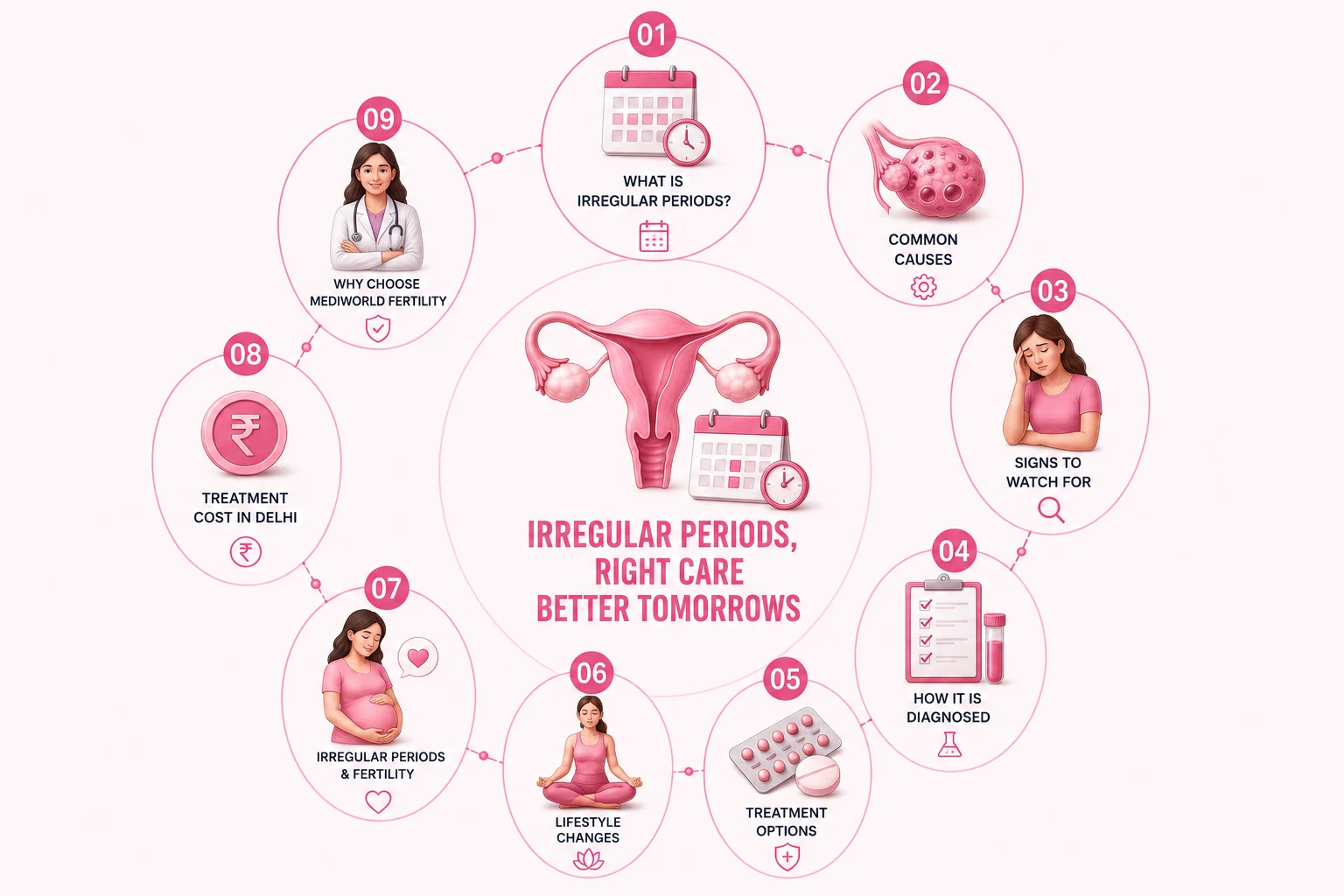
Signs and Symptoms to Watch For
Your body often signals a problem well before a formal diagnosis – knowing what to look for helps you act early.
- Missed or very late periods – especially if you are not pregnant and this is a new pattern.
- Periods arriving too frequently – less than 21 days apart, which is a classic sign of polymenorrhea.
- Unusually heavy bleeding – passing large clots or needing to change protection every hour or two.
- Very light or “spotting” periods – a thin, scanty flow that barely qualifies as a period.
- Severe cramping or pelvic pain – particularly if it is worsening over time, which may point to endometriosis.
- Spotting between periods – mid-cycle bleeding that is not ovulation spotting deserves investigation.
- Periods lasting more than 7 days – prolonged bleeding can indicate fibroids, polyps, or a clotting issue.
- Associated symptoms linked to PCOS irregular periods: persistent acne along the jawline, noticeable hair thinning or loss, unexplained weight gain, or excess facial/body hair (hirsutism). If you have three or more of these alongside irregular cycles, PCOS is a strong possibility.
How Are Irregular Periods Diagnosed?
Getting the right diagnosis is not guesswork – it is a structured, step-by-step process that looks at your hormones, your anatomy, and your history together.
- Detailed menstrual history and physical examination: the consultation begins with a thorough discussion of your cycle pattern, associated symptoms, family history, and lifestyle. A pelvic examination is performed where clinically indicated.
- Blood tests: a targeted hormone panel typically includes FSH (follicle-stimulating hormone), LH (luteinising hormone), TSH (thyroid-stimulating hormone), prolactin, AMH (anti-Müllerian hormone, a marker of ovarian reserve), and testosterone. These results together paint a clear hormonal picture and help identify hormonal imbalance periods at their root.
- Pelvic ultrasound: a transvaginal or abdominal ultrasound checks the ovaries for cysts (characteristic of PCOS), the uterine lining thickness, and the presence of fibroids or polyps.
- Hysteroscopy: a thin camera is passed into the uterine cavity to directly visualise and, if needed, remove polyps or small fibroids – done when ultrasound findings are inconclusive.
- Laparoscopy: a minimally invasive surgical procedure recommended when endometriosis is suspected as the cause of painful, irregular cycles.
Treatment Options for Irregular Periods in Delhi
Treatment of irregular periods is never one-size-fits-all – the right approach depends entirely on the underlying cause and whether you are trying to conceive.
- Hormonal therapy: combined oral contraceptive pills (COCs) are first-line for regulating cycles when pregnancy is not the immediate goal. Cyclic progesterone is used to protect the uterine lining in women with infrequent periods. Both are safe, well-tolerated, and effective for most women.
- Irregular periods medicine for specific causes: metformin is prescribed for PCOS with insulin resistance to improve hormonal balance and restore ovulation. Thyroid medication (levothyroxine for hypothyroidism, or antithyroid drugs for hyperthyroidism) often normalises cycles within a few months of starting treatment. Cabergoline is used when elevated prolactin is the culprit.
- Ovulation induction: for women trying to conceive, medications such as letrozole or clomiphene citrate stimulate the ovaries to release an egg, directly addressing anovulation caused by PCOS or hormonal imbalance.
- Surgical options: hysteroscopic removal of polyps or submucous fibroids, and laparoscopic treatment of endometriosis, can restore normal bleeding patterns when structural causes are identified.
- IUI or IVF: when irregular periods and fertility are intertwined – particularly in cases of severe PCOS, blocked tubes, or poor ovarian reserve – intrauterine insemination (IUI) or in vitro fertilisation (IVF) may be the most effective path to pregnancy. Mediworld Fertility offers all of these treatment pathways under one roof in Delhi NCR, so you never have to travel between multiple clinics.
Reach Out for Expert Care
Lifestyle Changes That Help Regulate Your Cycle
Medication works best when it is supported by the right daily habits – and for many women, lifestyle changes alone can make a meaningful difference.
- Maintain a healthy BMI: even a 5–10% reduction in body weight in women with PCOS-related obesity can restore ovulation and regularise cycles within months.
- Stress management: yoga, meditation, and even 20 minutes of daily mindful breathing lower cortisol and support hormonal balance. Irregular menstrual cycle treatment is genuinely incomplete without addressing chronic stress.
- Eat for your hormones: a diet rich in iron (spinach, lentils), zinc (pumpkin seeds, chickpeas), and omega-3 fatty acids (flaxseed, walnuts, fatty fish) supports healthy progesterone and estrogen levels.
- Regular, moderate exercise: 30 minutes of brisk walking or swimming five days a week improves insulin sensitivity and supports cycle regularity. Avoid over-exercising – intense training without adequate caloric intake is itself a cause of amenorrhea.
- Avoid crash diets: severe caloric restriction suppresses GnRH and shuts down ovulation. Sustainable, gradual dietary changes are far more effective.
- Track your cycle: apps like Clue or Flo let you log cycle length, symptoms, and flow – data that is genuinely useful when you come in for a consultation and helps identify patterns over time.
Irregular Periods and Fertility – What You Need to Know
An irregular cycle is often a signal that ovulation is not happening reliably – and ovulation is the cornerstone of natural conception.
- Irregular periods often mean irregular or absent ovulation (anovulation). Without a predictable ovulation window, timing intercourse for conception becomes very difficult.
- PCOS is the leading cause of anovulatory infertility in India, accounting for a large proportion of couples who struggle to conceive despite trying for over a year.
- Irregular cycles make it harder to time intercourse – and without knowing when (or whether) ovulation is occurring, even fertile couples can miss their window month after month.
- Early diagnosis and treatment significantly improve pregnancy chances. Women who address irregular periods and fertility concerns early – before a year of failed attempts – tend to have better outcomes with less intervention.
- Irregular periods treatment for unmarried women is equally important. Cycle irregularity does not wait until marriage to cause damage. Untreated PCOS, for example, can affect ovarian reserve over time. Seeking care early – regardless of marital status – protects future fertility. Our consultations are completely judgement-free.
- With the right treatment, most women with irregular periods can conceive. Ovulation induction, IUI, and IVF have helped thousands of women with PCOS and other cycle disorders achieve successful pregnancies. Irregular periods and pregnancy are not mutually exclusive – far from it.
Irregular Period Treatment Cost in Delhi
Treatment costs vary based on the diagnosis and the plan your doctor recommends. Hormonal therapy and blood tests are relatively affordable; surgical options such as hysteroscopy or laparoscopy involve higher costs. Book a consultation at Mediworld Fertility for a transparent, personalised cost estimate with no hidden charges.
Why Choose Mediworld Fertility for Irregular Periods Treatment in Delhi?
- Led by Dr. Neha Gupta, with 21+ years of experience in reproductive medicine and gynaecology – she has seen and treated virtually every pattern of irregular menstrual cycle treatment, from straightforward hormonal imbalance to complex PCOS with infertility.
- Comprehensive, under-one-roof care: from your first hormone panel to ovulation induction, IUI, or IVF – everything happens at one clinic, with one consistent care team.
- Advanced diagnostic lab with same-day blood test results: FSH, LH, TSH, AMH, prolactin, and testosterone panels are processed in-house, so your treatment plan can begin at the same visit.
- Personalised treatment plans: no two women have the same hormonal profile or the same life circumstances. Treatment is built around you – your diagnosis, your goals, your timeline.
- Sensitive, judgement-free consultations for unmarried women and teenagers: cycle problems do not discriminate by age or marital status, and neither does our care. Young women and unmarried patients are seen with the same respect and thoroughness as anyone else.
- Conveniently located in Delhi NCR with flexible appointment slots, including early morning and weekend availability.
- Trusted by thousands of women across Delhi, Noida, Gurgaon, and Faridabad – many of whom came to us after months of unanswered questions elsewhere.
Frequently Asked Questions
Can irregular periods be treated permanently? expand_more
Yes, in most cases. Once the underlying cause - whether PCOS, thyroid disorder, or hormonal imbalance - is identified and treated, cycles regularise and often remain stable long-term.
Is irregular periods treatment safe for unmarried women? expand_more
Absolutely. Hormonal therapy and diagnostic tests are safe for unmarried women and teenagers. Treatment does not affect virginity or future fertility - it protects it.
How long does it take for periods to become regular after starting treatment? expand_more
Most women see improvement within 2–3 menstrual cycles of starting hormonal therapy or treating the root cause. PCOS management may take 3–6 months for full cycle regularisation.
Can I get pregnant if I have irregular periods? expand_more
Yes. With the right treatment - ovulation induction, lifestyle changes, or assisted reproduction - most women with irregular periods and fertility concerns go on to conceive successfully.
What is the cost of a hormone blood test for irregular periods in Delhi? expand_more
A basic hormone panel for irregular periods - covering TSH, FSH, LH, and prolactin - typically costs between ₹1,500 and ₹3,000+ at a private clinic or diagnostic centre in Delhi. Adding AMH (ovarian reserve) and testosterone brings the total to approximately ₹3,500–₹5,500+ . At Mediworld Fertility, blood tests are processed in-house, with same-day results, so your treatment plan can be discussed at the same appointment.

Dr. Neha Gupta's Medical Content Team
Dr. Neha Gupta’s medical content team specialises in creating accurate, clear, and patient-focused healthcare content. With strong clinical understanding and expertise in technical writing and SEO, the team translates complex medical information into reliable, accessible resources that support informed decisions and uphold Dr. Neha Gupta’s commitment to quality care.
Dr. Neha Gupta
Dr. Neha Gupta is an experienced fertility specialist, IVF expert, and senior gynecologist with 21+ years in reproductive medicine. She has successfully treated 2000+ couples using advanced IVF, ICSI, IUI, donor programs, and fertility preservation techniques.