
Implantation Bleeding vs Period: How to Tell the Difference
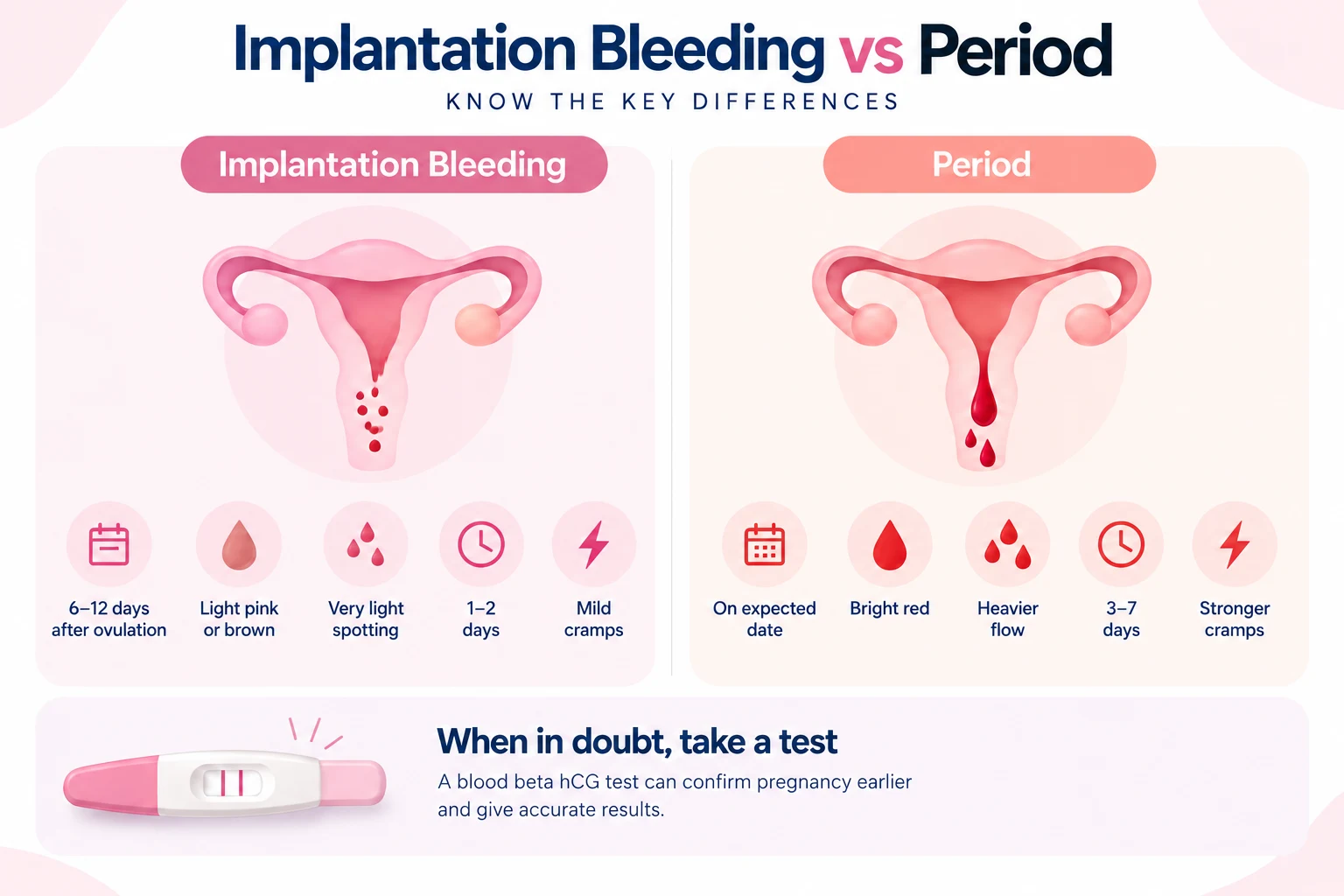
Implantation bleeding is light pink or brown spotting lasting one to two days, arriving six to twelve days after ovulation – typically two to seven days before your expected period. A period brings progressively heavier red flow, clots, and stronger cramps lasting three to seven days. Key differences are timing, colour, volume, and duration. At Mediworld Fertility, Dr. Neha Gupta’s team offers same-day beta hCG blood tests to confirm pregnancy when spotting causes confusion.
What Is Implantation Bleeding and Why Does It Happen?
Implantation bleeding occurs when a fertilised embryo burrows into the wall of the uterus. It is an early sign of pregnancy, not a problem, as our Delhi specialists reassure patients daily.
- Around 6 to 12 days after ovulation, the embryo embeds itself into the endometrium, the blood-rich lining of the uterus.
- As it burrows in, tiny blood vessels in the lining break, releasing a small amount of blood that slowly travels out.
- Because this blood takes time to exit, it often looks pink or brown rather than fresh red.
- Only about 15 to 25 percent of pregnant women notice implantation bleeding, so most pregnancies begin without any spotting at all.
- It needs no treatment and does not harm the embryo. The pregnancy continues normally in the vast majority of cases.
Get Expert Guidance for Your Fertility Journey
Take the next step with Mediworld Fertility. Connect with our team to book your consultation.
 WhatsApp Us

Timing: When Each Type of Bleeding Arrives
Timing is the single most useful clue. Implantation bleeding comes earlier than a period, in a fairly narrow window after ovulation, which cycle-tracking makes easy to spot.
- Implantation bleeding: typically 6 to 12 days after ovulation, which usually means 2 to 7 days before your expected period date.
- Period: arrives on or around your expected date, roughly 14 days after ovulation in a regular cycle.
- Spotting that shows up a full week before your period is due leans strongly toward implantation.
- Bleeding that starts exactly on your usual date and behaves normally is almost always menstruation.
- Irregular cycles blur this clue, which is why women with PCOS or unpredictable periods should rely on testing rather than timing.
Request a Consultation
Colour: Pink and Brown vs Bright Red
Blood colour reflects how fresh the bleeding is. Implantation blood is old and slow-moving, while period blood is fresh and continuous, a distinction our Delhi NCR patients find easiest to check.
- Implantation bleeding: light pink (a trace of blood mixed with discharge) or brown (older blood that took time to exit).
- Period: usually starts pinkish or brown for a few hours, then turns bright or dark red as full flow establishes.
- Implantation bleeding never progresses to bright red flow. If the colour deepens and volume rises, it is your period.
- Brown spotting alone can also come from ovulation, hormonal pills, or cervical irritation after intercourse, so colour is a clue, not proof.
- Any bleeding pattern that is completely new for you deserves a note in your cycle app and, if repeated, a doctor’s review.
Flow and Clots: Spotting vs a True Flow
Volume separates the two most decisively. Implantation bleeding is spotting that barely marks a liner, while a period requires pads or tampons and often carries clots.
- Implantation bleeding: a few drops or streaks, on and off, often noticed only when wiping. A panty liner is more than enough.
- Period: a steady flow that soaks pads or tampons over hours and typically follows your familiar heavy-then-light pattern.
- Clots are the strongest differentiator: implantation bleeding contains no clots, while periods commonly shed small clots of lining.
- If you need to change a pad because of actual soaking, it is not implantation bleeding.
- Implantation spotting also tends to be intermittent, appearing and vanishing, rather than continuous like menstrual flow.
Duration and Cramping Compared
Implantation bleeding is brief and gentle, while periods last longer and cramp harder. Together with timing, these two features settle most confusing months.
- Implantation bleeding lasts a few hours to a maximum of about 2 days, then stops completely.
- A normal period lasts 3 to 7 days, tapering gradually rather than stopping abruptly.
- Implantation cramps are mild, fleeting twinges or a light pulling sensation low in the pelvis.
- Period cramps are stronger, more rhythmic, may radiate to the back and thighs, and often need a heat pad or painkiller.
- After implantation spotting stops, early pregnancy signs such as breast tenderness and fatigue often continue building, whereas after a period, PMS symptoms fade away.
Implantation Bleeding After IVF, IUI, or Embryo Transfer
Spotting during the two-week wait after fertility treatment causes enormous anxiety.
- After an embryo transfer, implantation spotting typically appears between Day 5 and Day 8, pink or brown and scanty.
- Progesterone support can make the cervix and vaginal tissues more delicate, so pessaries and intercourse-free examinations can also cause light spotting.
- Spotting during the two-week wait does not reduce your chance of success. Continue every medicine exactly as prescribed.
- Never stop progesterone because of spotting. Stopping it prematurely is far riskier than the spotting itself.
- Heavy red bleeding with clots after a transfer needs a same-day call to your clinic. Mediworld Fertility patients can reach our team 24×7 for exactly this.
Other Causes of Spotting Between Periods
Not all mid-cycle spotting is implantation. Several everyday and medical causes can mimic it, which is why persistent spotting deserves evaluation at a fertility clinic in Delhi NCR.
- Ovulation spotting: a day of light pink discharge mid-cycle when the egg is released.
- Hormonal contraception: missed pills, new pills, or hormonal IUDs commonly cause breakthrough spotting.
- Cervical causes: polyps, erosion, or irritation after intercourse can produce light fresh-red spotting.
- Thyroid imbalance and PCOS both disturb cycles and can create irregular spotting that imitates implantation.
- Infections, fibroids, and, rarely, early miscarriage or ectopic pregnancy also present as abnormal bleeding, so repeated unexplained spotting should never be self-diagnosed from the internet.
When to Take a Pregnancy Test After Suspected Implantation Bleeding
Testing immediately after spotting usually shows a false negative because hCG needs time to rise. A short, disciplined wait gives you a trustworthy answer.
- Wait at least 3 to 4 days after the spotting stops before using a home urine test, ideally with first morning urine.
- The most reliable day for a urine test remains the day your period was due or any day after.
- A blood beta hCG test can confirm pregnancy earlier and give an exact number. It is a quick same-day test at Mediworld Fertility in Delhi.
- If the first test is negative and your period still does not arrive, repeat after 48 to 72 hours, since hCG doubles roughly every two days.
- A faint positive line is a positive. Confirm it with a blood test and book an early consultation.
When Bleeding Needs a Doctor, Not Just a Test
Most spotting is harmless, but some patterns need prompt medical attention. Delhi NCR patients can walk into our clinic the same day for any of these.
- A positive pregnancy test followed by heavy red bleeding, clots, or severe cramping.
- Sharp one-sided pelvic pain with spotting, with or without shoulder-tip pain or dizziness, which can indicate an ectopic pregnancy and is an emergency.
- Spotting accompanied by fever, foul-smelling discharge, or burning urination, suggesting infection.
- Bleeding between periods that repeats over multiple cycles, even if light.
- Any bleeding during a known pregnancy, which should always be reported to your doctor even when it settles on its own.
Confused Every Month? Mediworld Fertility Can Give You Certainty
If you find yourself examining spotting month after month while trying to conceive, structured testing beats guesswork. Mediworld Fertility helps couples across Delhi NCR get definitive answers fast.
- Same-day beta hCG blood tests and early pregnancy ultrasounds, so a confusing spotting episode becomes a clear yes or no within hours.
- Complete bleeding evaluations, including hormonal profiles, thyroid testing, pelvic ultrasound, and hysteroscopy where needed, to find the real cause of irregular spotting.
- Full fertility care under one roof, from ovulation tracking and IUI to IVF and ICSI, led by Dr. Neha Gupta with 21+ years in reproductive medicine.
- Round-the-clock support for treatment cycles, because bleeding worries do not keep office hours, and neither do we.
Implantation bleeding and a period can look similar for a few hours, but timing, colour, flow, duration, and cramps almost always give the game away. When in doubt, test at the right time instead of decoding stains, and if spotting keeps confusing your cycles while you are trying for a baby, book a consultation at Mediworld Fertility in Delhi. One visit can replace months of monthly uncertainty with a clear plan.