
hCG Levels in Early Pregnancy: Normal Range, Week-by-Week Chart & What Your Results Mean
hCG levels in early pregnancy are one of the first numbers your doctor will track – this guide covers what hCG is and why it matters, the beta hCG normal range by week (weeks 3–12), how fast levels should rise (hCG doubling time), what causes low hCG levels in early pregnancy or unexpectedly high hCG levels, when to get a beta hCG test done, and the warning signs that need immediate medical attention.
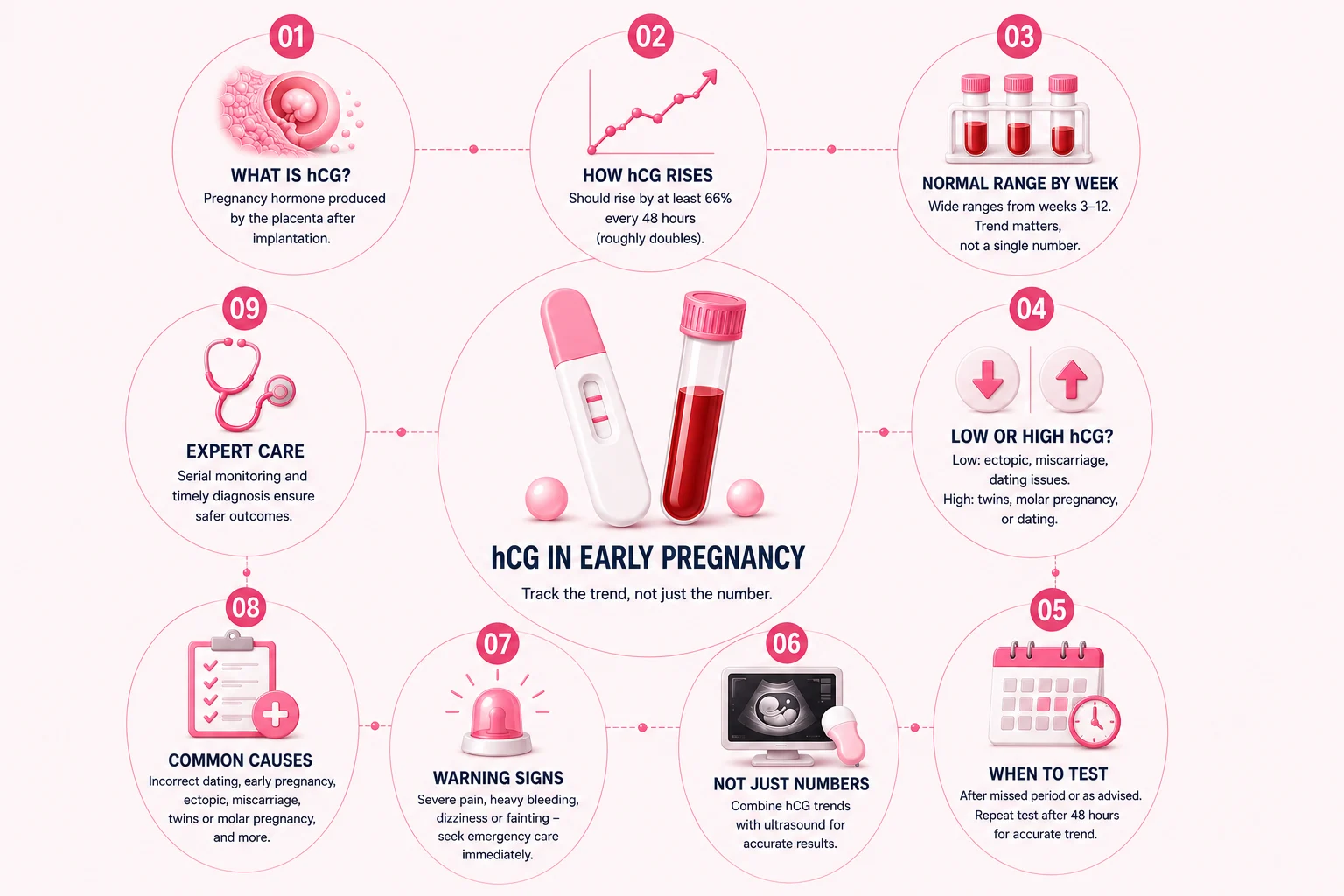
The Key Facts at a Glance
- hCG is the “pregnancy hormone” produced by the placenta; it’s what makes a pregnancy test turn positive.
- Normal ranges vary enormously – a single number means little. What matters is the trend over 48 hours.
- In early pregnancy, hCG should rise by at least 66% every 48 hours (roughly doubling). A slower rise needs investigation.
- Low hCG can signal ectopic pregnancy, miscarriage, or simply incorrect dating. High hCG may indicate twins or, rarely, a molar pregnancy.
- One abnormal result is not a diagnosis. Always repeat the beta hCG test and combine results with an ultrasound.
What Is hCG and Why Does It Matter in Pregnancy?
hCG – human chorionic gonadotropin – is the hormone at the heart of every early pregnancy. Understanding what it does (and what it doesn’t tell you alone) is the foundation for interpreting any test result you receive.
- What it is: A glycoprotein hormone produced by the trophoblast cells of the developing placenta, almost immediately after a fertilised egg implants in the uterine wall – typically 6–10 days after conception.
- Why it matters: hCG signals the corpus luteum to keep producing progesterone, which prevents the uterine lining from shedding and protects the pregnancy in its earliest, most vulnerable weeks.
- How it’s detected: The beta subunit (β-hCG) is what blood and urine tests measure. A beta hCG test on blood is more sensitive than a home urine strip – it can detect pregnancy as early as 10–11 days after conception, before a missed period.
- What it tells you: Rising hCG confirms a pregnancy is developing. The rate of rise tells you whether it’s developing normally.
- What it doesn’t tell you alone: A single hCG number cannot confirm a viable pregnancy, rule out an ectopic pregnancy, or date the pregnancy precisely. Context – your cycle dates, symptoms, and ultrasound – always matters.
Get Expert Guidance for Your Fertility Journey
Take the next step with Mediworld Fertility. Connect with our team to book your consultation.
 WhatsApp Us

Normal hCG Levels by Week – The Reference Chart
The beta hCG normal range is genuinely wide. Two women at exactly the same gestational age can have hCG values that differ by a factor of ten and both be carrying healthy pregnancies. This section gives you the reference numbers – but please read the caveats below the table before drawing any conclusions.
hCG Level Chart: Weeks 3–12 (from Last Menstrual Period)
| Week of Pregnancy (from LMP) | Beta hCG Normal Range (mIU/mL) |
| Week 3 | 5 – 50 |
| Week 4 | 5 – 426 |
| Week 5 | 18 – 7,340 |
| Week 6 | 1,080 – 56,500 |
| Week 7 | 7,650 – 229,000 |
| Week 8 | 7,650 – 229,000 |
| Week 9 | 25,700 – 288,000 |
| Week 10 | 25,700 – 288,000 |
| Week 11 | 25,700 – 288,000 |
| Week 12 | 25,700 – 288,000 |
Source: Cleveland Clinic / UCSF Health reference ranges.
Three things to keep in mind:
- The ranges overlap heavily between weeks. A result of 10,000 mIU/mL could be perfectly normal at week 7 or concerning at week 9 – context is everything.
- hCG peaks around weeks 8–10, then naturally plateaus and gradually declines through the second trimester. A falling hCG after week 10 is expected, not alarming.
- Different labs use slightly different assays. Always compare your results against your own lab’s reference range, not a generic chart.
Request a Consultation
How Fast Should hCG Levels Rise? (Doubling Time Explained)
The trend of your hCG – not the single number – is what your doctor is really watching. This is what “hCG doubling time” means in practice, and it’s arguably the most clinically important concept on this page.
The classic rule: In a healthy early pregnancy, hCG roughly doubles every 48–72 hours up to about 6 weeks.
The more nuanced, evidence-based picture (2024 guidance):
| Starting hCG Level | Minimum expected rise over 48 hours |
| Below 1,500 mIU/mL | ≥ 49% |
| 1,500 – 3,000 mIU/mL | ≥ 40% |
| Above 3,000 mIU/mL | ≥ 33% |
Based on: NCBI / PMC evidence review (PMC10940029), 2024.
What this means for you:
- A rise below these thresholds – called a “slow-rising hCG” – warrants investigation, but does not automatically mean the pregnancy is lost.
- A rise at or above these thresholds is reassuring, but still needs to be combined with an ultrasound to confirm the pregnancy is in the right location.
- After about 6 weeks, hCG doubling time naturally slows. At higher levels (above 6,000 mIU/mL), it’s normal for hCG to take 72–96 hours to double.
- A single slow result is not a diagnosis. Repeat testing in 48 hours, combined with ultrasound, gives the full picture.
What Causes Low hCG Levels in Early Pregnancy?
Low hCG levels in early pregnancy are one of the most anxiety-inducing results a woman can receive. But “low” is relative – and there are several reasons hCG might read lower than expected, not all of them serious.
Common causes of low hCG:
| Cause | What It Means | Next Step |
| Incorrect pregnancy dating | Your cycle may be longer than 28 days; conception happened later than assumed | Repeat test in 48–72 hours |
| Very early pregnancy | Test done before implantation is complete | Repeat test after 48 hours |
| Ectopic pregnancy | Embryo implanted outside the uterus (usually in a fallopian tube) | Urgent ultrasound + serial hCG |
| Threatened miscarriage | Pregnancy may be at risk; bleeding or cramping present | Ultrasound + close monitoring |
| Blighted ovum | Gestational sac formed but embryo did not develop | Ultrasound confirmation needed |
| Early pregnancy loss | Miscarriage in progress; hCG will fall | Supportive care + follow-up |
| Placental development issues | Placenta not producing adequate hCG | Serial monitoring |
Symptoms that sometimes accompany low hCG:
- Light vaginal spotting or bleeding
- Lower abdominal or pelvic discomfort
- Pregnancy symptoms (nausea, breast tenderness) that are milder than expected or have faded
The most important point: hCG levels and miscarriage are connected, but a low single reading does not confirm pregnancy loss. Serial testing – two readings 48 hours apart – is the standard of care. At Mediworld Fertility, our specialists in Delhi NCR always interpret hCG trends alongside ultrasound findings before drawing any conclusions.
What Causes High hCG Levels in Early Pregnancy?
High hCG levels get less attention than low ones, but they matter too. An unexpectedly elevated result has a short differential – and most causes are benign.
Common causes of high hCG:
| Cause | What It May Indicate | Recommended Action |
| Multiple pregnancy (twins/triplets) | More placental tissue = more hCG | Confirm with ultrasound |
| Incorrect dating | Pregnancy is further along than thought | Ultrasound for accurate dating |
| Molar pregnancy (gestational trophoblastic disease) | Abnormal placental tissue producing very high hCG | Urgent specialist review |
| Down syndrome or chromosomal abnormality | Associated with elevated hCG in first trimester screening | Combined first-trimester screening |
| Normal variation | Some women simply produce more hCG | Serial monitoring |
Key facts about high hCG:
- Twins can produce hCG levels 30–50% higher than a singleton pregnancy at the same gestational age – but the ranges overlap, so hCG alone cannot confirm twins.
- A molar pregnancy typically produces markedly elevated hCG – often above 100,000 mIU/mL in the first trimester – and requires prompt evaluation.
- High hCG is also used as part of the double marker test (first-trimester screening) to assess chromosomal risk; an elevated result in that context is interpreted alongside PAPP-A and nuchal translucency, not in isolation.
When Should You Get a Beta hCG Test Done?
Knowing when to test is just as important as knowing how to read the result. A beta hCG test done too early can give a falsely reassuring or falsely low reading.
Timing guidelines:
- After a missed period: The most reliable time for a first beta hCG test. Blood hCG can be detectable from about 10–11 days post-conception, but waiting until your period is due gives a more meaningful baseline.
- After IVF or IUI: Your fertility specialist will schedule a beta hCG test exactly 14 days after egg retrieval (for IVF) or 14 days after the procedure (for IUI). Do not test earlier – the trigger injection (hCG) used in IVF cycles can cause a false positive.
- Serial testing: If your first result is low or ambiguous, a repeat test 48 hours later is standard. The change between the two readings is what your doctor will act on.
- During early pregnancy monitoring: Women with a history of ectopic pregnancy, recurrent miscarriage, or fertility treatment are often monitored with serial hCG tests through weeks 6–8.
Blood vs. urine test:
- A serum beta hCG test (blood draw) is quantitative – it gives an exact number in mIU/mL.
- A urine pregnancy test (home kit) is qualitative – positive or negative only.
- For clinical decision-making, always use the serum test.
In Delhi NCR: Most accredited labs (SRL, Dr. Lal PathLabs, Metropolis) offer same-day results for serum beta hCG. If you’re seeking hCG levels Delhi monitoring as part of fertility treatment, your clinic will typically have a dedicated protocol.
When to Call Your Doctor – Warning Signs
Most hCG anxiety resolves with a repeat test and an ultrasound. But some symptoms alongside an abnormal hCG result need same-day or emergency attention.
Call your doctor the same day if:
- Your hCG is not rising as expected on a repeat test
- You have light spotting with no pain (may need monitoring)
- You have mild, one-sided pelvic discomfort
Go to the emergency room immediately if:
- Severe abdominal or shoulder-tip pain – shoulder pain can signal internal bleeding from a ruptured ectopic pregnancy
- Heavy vaginal bleeding (soaking more than one pad per hour)
- Dizziness, fainting, or feeling faint – signs of haemodynamic instability
- Sudden disappearance of all pregnancy symptoms combined with a falling hCG
Remember: An ectopic pregnancy can rupture even when hCG levels are low or falling. If you have any of the emergency symptoms above, do not wait for a repeat blood test – seek care immediately.
Frequently Asked Questions
What is a normal beta hCG level at 4 weeks pregnant? expand_more
At 4 weeks from your last menstrual period, the beta hCG normal range is 5–426 mIU/mL. The range is wide because implantation timing varies. A result anywhere in this range - or even slightly outside it - needs to be interpreted alongside a repeat test 48 hours later, not in isolation.
How do I know if my hCG doubling time is normal? expand_more
A healthy hCG doubling time in early pregnancy (before 6 weeks) means your levels rise by at least 66% every 48 hours. After 6 weeks, the rise naturally slows. Your doctor will compare two readings taken exactly 48 hours apart. A rise below the expected threshold on a single occasion is not a definitive diagnosis - it's a signal to investigate further with ultrasound.
Can low hCG levels go back to normal? expand_more
Yes, in some cases. If low hCG is due to incorrect dating (your ovulation happened later than assumed), levels may be perfectly normal on a repeat test a few days later. However, if low hCG is due to a failing pregnancy or ectopic implantation, levels will continue to fall or plateau. This is why serial testing is essential - one number tells you very little.
What does high hCG mean - could I be having twins? expand_more
Possibly, but not necessarily. Twins do tend to produce higher hCG than singleton pregnancies, but the ranges overlap significantly. High hCG is also seen with incorrect dating, molar pregnancy, and normal individual variation. An ultrasound at 6–7 weeks is the only reliable way to confirm a multiple pregnancy.
Is a beta hCG test the same as a pregnancy test? expand_more
A home urine pregnancy test detects hCG but only tells you positive or negative. A serum beta hCG test (blood test) gives you an exact quantitative number in mIU/mL, which is far more useful for monitoring early pregnancy, especially after fertility treatment or when there's a concern about ectopic pregnancy or miscarriage. For clinical decisions, always use the blood test.