
IVF After 40: Success Rates and What to Expect
- IVF after 40 is possible, but success rates with your own eggs drop significantly with each passing year – from roughly 11% per embryo transferred at 40–42 to around 5% at 43–44 (HFEA, 2023 preliminary data).
- Donor egg IVF changes the picture dramatically: live birth rates of 30–45% are achievable regardless of the recipient’s age, because it’s the egg donor’s age that drives success.
- Key factors – your AMH level, uterine health, and clinic quality – matter as much as your age on paper.
- Going in with realistic expectations and a clear plan (including whether PGT-A testing makes sense for you) is the most useful thing you can do before your first appointment.
Why Age 40 Is a Turning Point for Fertility
Forty isn’t just a number. It’s the point at which the biology of egg ageing shifts from a gradual slope to something steeper.
Two things happen simultaneously as you approach and pass 40:
- Egg quantity falls. Your ovarian reserve – measured by AMH (anti-Müllerian hormone) and antral follicle count (AFC) on ultrasound – declines. Fewer eggs are retrieved per stimulation cycle, which means fewer embryos to work with.
- Egg quality drops. The proportion of eggs carrying chromosomal errors rises sharply. At age 35, roughly 30% of embryos are chromosomally abnormal (aneuploid). By age 40, that figure climbs to anywhere between 40% and 60%, depending on the study and the testing method used. By 43–44, most embryos from a given cycle may be aneuploid.
This is why chromosomal abnormalities – not implantation failure or uterine problems – are the leading reason IVF cycles don’t result in a baby after 40. The uterus of a 42-year-old is generally perfectly capable of carrying a pregnancy. The bottleneck is almost always the egg.
That said, “40” is not a cliff edge. Women at 40 with a good AMH, a strong antral follicle count, and a well-run IVF cycle can and do have babies with their own eggs. The data just demands honesty about the odds.
Get Expert Guidance for Your Fertility Journey
Take the next step with Mediworld Fertility. Connect with our team to book your consultation.
 WhatsApp Us

IVF Success Rates After 40 – The Real Numbers
Let’s look at what the data actually says. The figures below come from the HFEA (UK’s Human Fertilisation and Embryology Authority) 2023 preliminary report – one of the most rigorous national datasets in the world – and the US CDC/SART national ART summary.
Using Your Own Eggs
The HFEA reports live birth rates per embryo transferred using fresh transfers and the patient’s own eggs:
| Age Group | Live Birth Rate (Own Eggs) – HFEA 2023 |
| Under 35 | 35% |
| 35–37 | ~28% (estimated from pregnancy rate trend) |
| 38–39 | ~20% |
| 40–42 | ~11% |
| 43–44 | ~5% |
| 45+ | Below 5% |
The US CDC national ART summary (cumulative live birth rate per retrieval cycle, all transfers within 12 months) shows higher absolute numbers because it measures cumulative outcomes across all transfers from one egg collection:
| Age | Cumulative Live Birth Rate (Own Eggs) – CDC |
| 40 | ~32% |
| 41 | ~28% |
| 42 | ~25% |
| 43 | ~20% |
| 44 | ~16% |
| 45 | ~14% |
Important context: The HFEA figure is per single embryo transfer; the CDC figure is cumulative across all transfers from one retrieval. Neither is “wrong” – they measure different things. When your doctor quotes you a success rate, always ask: per transfer or per retrieval cycle?
Using Donor Eggs
This is where the picture changes completely. With donor eggs, success rates are driven by the donor’s age (typically 23–32), not yours.
| Age Group (Recipient) | Live Birth Rate (Donor Eggs) |
| 40–44 | 35–45% |
| 45+ | 35–45% |
HFEA data shows that patients aged 43–50 who switched to donor eggs saw birth rates rise from around 5% (own eggs) to over 30% per cycle. The CDC national summary reports an overall donor egg live birth rate of approximately 41% per embryo transfer – and this figure holds relatively stable across recipient age groups.
The IVF success rate at 42 with own eggs is around 25% cumulatively (CDC) or roughly 10–11% per single transfer (HFEA). With donor eggs at the same age, you’re looking at 35–45% per transfer. That gap is the core of the own-eggs-vs-donor-eggs conversation.
Request a Consultation
Factors That Affect Your IVF Success After 40
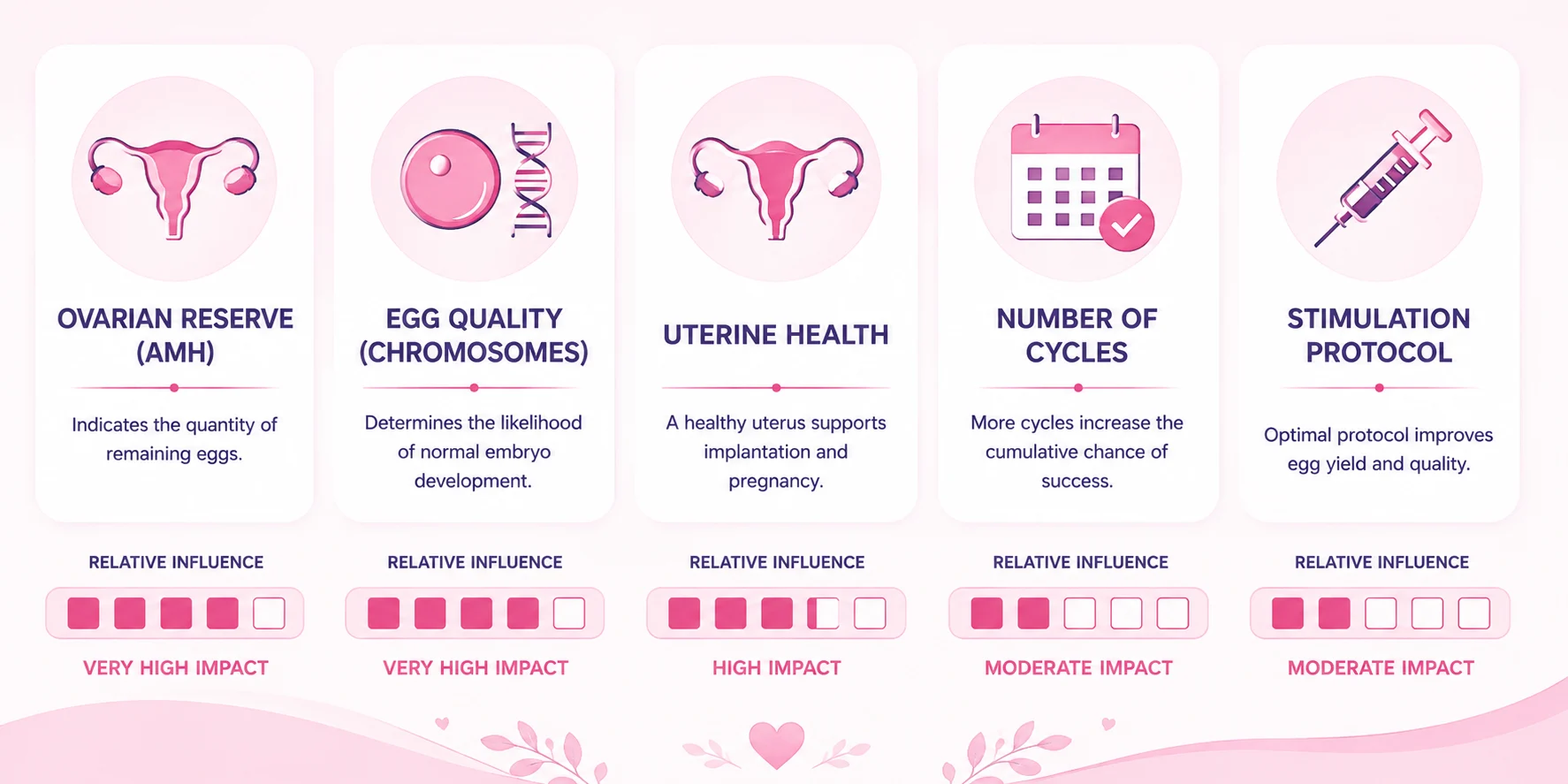
Age is the biggest variable, but it’s not the only one. These factors can meaningfully shift your individual odds:
1. AMH and Ovarian Reserve AMH is the single most useful starting point. A low AMH at 40 means fewer eggs retrieved per cycle, which reduces the number of embryos available for selection or genetic testing. A relatively preserved AMH gives your team more to work with.
2. Uterine Health Fibroids, polyps, a thin endometrium, or previous uterine surgery can all affect implantation. These are largely treatable – but they need to be assessed before you start. A saline sonogram or hysteroscopy is often part of the pre-IVF workup after 40.
3. Sperm Quality Male factor infertility is present in roughly 40–50% of couples. Sperm DNA fragmentation – which rises with age and lifestyle factors – can affect embryo development even when a basic semen analysis looks normal. Ask about DNA fragmentation testing if it hasn’t been done.
4. Number of Embryos Retrieved More eggs retrieved = more embryos = better chances of finding at least one chromosomally normal embryo. After 40, your doctor may recommend a higher stimulation dose to maximise the number of eggs collected per cycle.
5. Clinic Experience and Lab Quality This one is underappreciated. Embryology lab conditions – temperature, air quality, culture media, the skill of the embryologist – directly affect whether embryos reach the blastocyst stage. A clinic’s published success rates for your age group are worth asking about specifically.
Own Eggs vs Donor Eggs – Which Is Right for You?
There’s no universal answer. This is genuinely one of the most personal decisions in fertility treatment after 40, and it involves both medical and emotional considerations.
When to Try Your Own Eggs First
- Your AMH is above 1.0 ng/mL and your antral follicle count is reasonable (typically 5 or more follicles)
- You’ve had a previous good response to stimulation
- You’re 40–42 and emotionally committed to trying with your own genetic material first
- Your doctor expects to retrieve enough eggs to create at least 2–3 blastocysts for testing
IVF with its own eggs after 40 is a legitimate path. It just requires going in clear-eyed about the numbers and having a plan for how many cycles you’re willing to attempt.
When Donor Eggs Are Recommended
- Repeated IVF failures with own eggs despite good stimulation
- Very low AMH or antral follicle count
- Age 43 or above, especially 45+, where own-egg live birth rates fall below 5% per transfer
- Multiple chromosomally abnormal embryos on PGT-A testing
- Premature ovarian insufficiency
Donor egg IVF after 40 is not giving up. It’s choosing the path most likely to bring you a healthy baby. Many women describe it as a relief – a clear, high-probability route after months or years of uncertainty.
The Emotional Side
This decision deserves more than a clinical checklist. Some women need to try with their own eggs first, even knowing the odds, because the genetic connection matters deeply to them. Others feel ready to move to donor eggs quickly once they understand the data. Both responses are valid. What matters is that you make the choice with full information – not under pressure, and not in the dark.
What the IVF Process Looks Like After 40
The basic IVF protocol is the same at 40 as it is at 32. But there are a few important differences in how it’s typically managed.
- Higher Medication Doses Because ovarian reserve is lower, your fertility doctor will usually prescribe a higher dose of follicle-stimulating hormones (FSH) to recruit as many eggs as possible. Your response will be monitored closely with blood tests and ultrasound scans every 2–3 days.
- PGT-A: Preimplantation Genetic Testing PGT-A (preimplantation genetic testing for aneuploidy) involves biopsying a few cells from each blastocyst embryo and testing them for chromosomal abnormalities before transfer. After 40, when the majority of embryos may be aneuploid, PGT-A helps identify which embryos are chromosomally normal – significantly reducing the risk of miscarriage and failed implantation.
PGT-A adds cost (typically ₹60,000–₹1,00,000 or more, depending on the number of embryos tested), but for women over 40 it can save both time and emotional energy by avoiding transfers of embryos that were never going to work. It’s worth a detailed conversation with your doctor about whether it makes sense for your specific situation.
- Frozen Embryo Transfer (FET) Most clinics now prefer to freeze all viable embryos after retrieval and transfer in a subsequent, hormonally prepared cycle. This allows the uterus to recover from stimulation, improves the implantation environment, and – if you’re doing PGT-A – gives time for the genetic results to come back. Frozen embryo transfer success rates have improved dramatically: the HFEA reports an average birth rate of 33% per frozen embryo transfer in 2023, up from 18% a decade ago.
- Realistic Timeline Plan for 1–3 complete cycles. Some women in their early 40s conceive on the first transfer. Others need multiple retrievals to bank enough chromosomally normal embryos. Going in expecting a single cycle to work is possible – but going in prepared for more than one is wise.
Questions to Ask Your Fertility Doctor Before Starting
Walk into your first consultation with these questions ready. The answers will tell you a lot about both your situation and the clinic.
1. What is my AMH level and antral follicle count, and what do they mean for my expected egg yield?
2. How many eggs do you typically retrieve from someone with my ovarian reserve profile?
3. Do you recommend PGT-A for my age group, and what are the pros and cons in my specific case?
4. What are your clinic’s live birth rates for women aged 40–42 and 43–44 using their own eggs?
5. At what point would you recommend moving to donor eggs, and what does that process look like here?
6. What tests do I need before we start – uterine assessment, sperm DNA fragmentation, thyroid, anything else?
A good fertility specialist will welcome these questions. If you feel rushed or dismissed, that’s information too.
A Note on Emotional Resilience
IVF is hard. IVF after 40 – with its lower per-cycle odds and the weight of time pressure – can be harder still.
Multiple cycles are common. A failed transfer doesn’t mean IVF won’t work for you; it means that particular embryo didn’t implant, which happens even in younger women. But knowing that intellectually and feeling it after a negative test are two very different things.
A few things that genuinely help:
- Set decision points in advance. Decide before you start how many cycles you’re willing to attempt with your own eggs, and what would make you consider donor eggs. Having this conversation early – when you’re calm – is easier than having it mid-treatment.
- Build a support system. Whether that’s a partner, a close friend, a therapist, or an online community of women going through the same thing, isolation makes this harder.
- Give yourself permission to grieve and to hope at the same time. Both are appropriate. This is genuinely difficult, and you don’t have to pretend otherwise.
The women who navigate IVF after 40 most successfully aren’t the ones who feel no fear. They’re the ones who get good information, ask hard questions, and keep going with their eyes open.
Frequently Asked Questions
What is the IVF success rate at 40 in India? expand_more
India doesn't publish a national ART registry with age-stratified live birth rates the way the HFEA or CDC does - the ART (Regulation) Act 2021 established a national registry framework, but clinic-level outcome data isn't yet publicly reported in the same granular way. As a reference point, global data (HFEA 2023) shows a live birth rate of approximately 11% per embryo transferred at ages 40–42 using their own eggs. Individual clinic rates in Delhi NCR vary, and the best approach is to ask your specific clinic for their own age-stratified success data.
Can I use my own eggs for IVF at 42? expand_more
Yes - and many women do successfully. The IVF success rate at 42 with own eggs is approximately 25% cumulatively per retrieval cycle (CDC data) or around 10–11% per single embryo transfer (HFEA). The key factors are your AMH level, antral follicle count, and how many good-quality blastocysts can be created. PGT-A testing at this age is often recommended to identify chromosomally normal embryos before transfer.
Is donor egg IVF a good option after 40? expand_more
For many women, yes - it's the most effective path to a healthy pregnancy after 40. Live birth rates with donor eggs are typically 35–45% per transfer regardless of the recipient's age, because success is driven by the donor's egg quality. Donor egg IVF after 40 is particularly worth considering if you've had repeated failures with your own eggs, have a very low ovarian reserve, or are 43 or older.
How many IVF cycles should I try after 40? expand_more
There's no single right answer. Most fertility specialists recommend assessing after 2–3 complete cycles with own eggs before reconsidering the approach. If PGT-A testing shows that no chromosomally normal embryos are being produced, that's a strong signal to discuss donor eggs sooner. The decision depends on your AMH, your embryo quality, your emotional bandwidth, and your financial situation. Set these parameters with your doctor before you start, not in the middle of treatment.
What tests do I need before starting IVF after 40? expand_more
A standard pre-IVF workup after 40 typically includes:
AMH blood test and antral follicle count (Day 2–3 ultrasound) to assess ovarian reserve
Day 2–3 FSH and oestradiol levels
Uterine assessment - saline sonogram (SIS) or hysteroscopy to check for polyps, fibroids, or adhesions
Semen analysis with DNA fragmentation testing for your partner
Thyroid function (TSH), prolactin, and full blood count
Infectious disease screening (HIV, hepatitis B/C, rubella immunity)
Karyotyping may be recommended if there's a history of recurrent miscarriage