
hCG Levels After IVF: Beta hCG Chart by Week and What Your Number Means
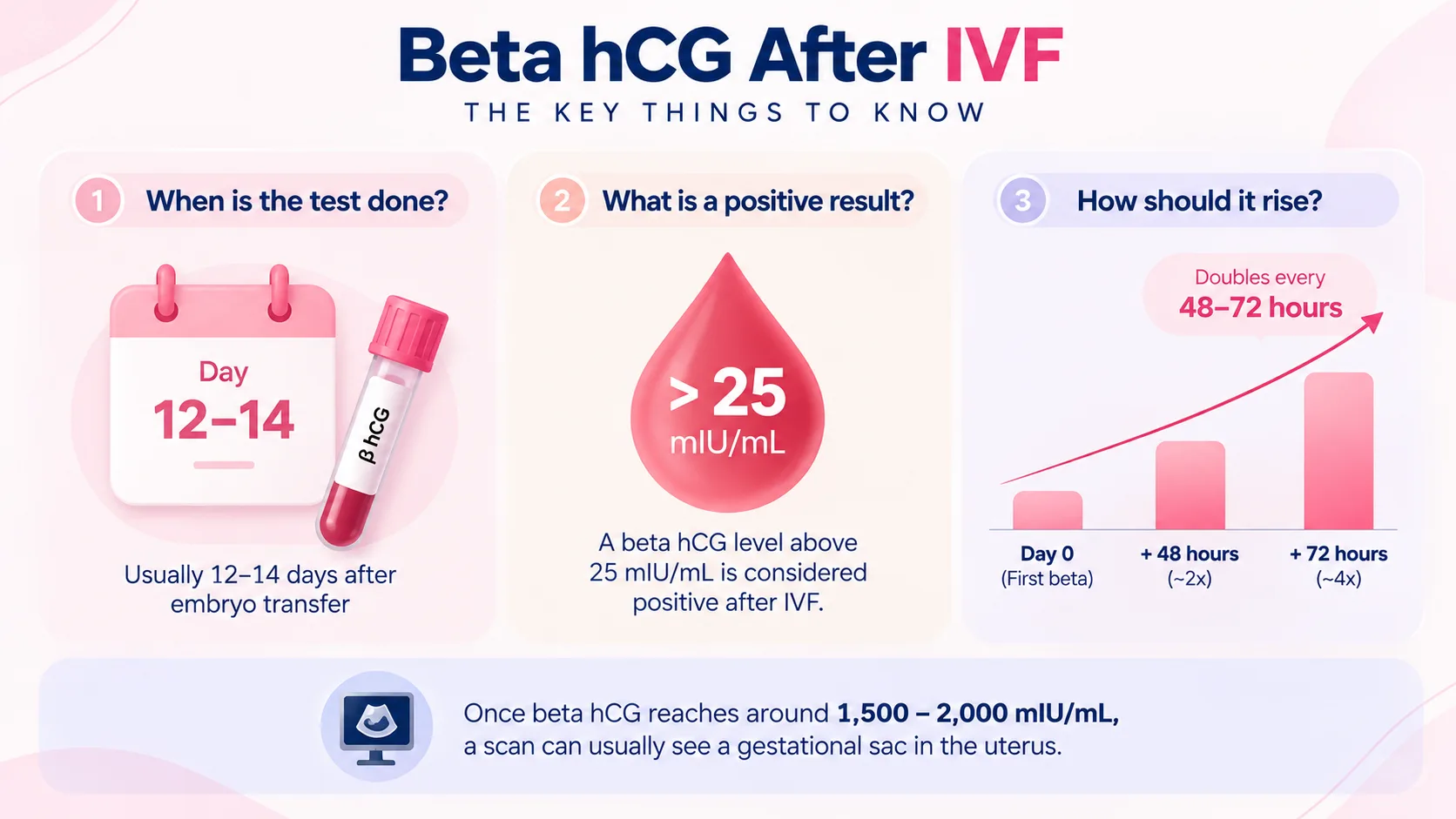
After IVF, a beta hCG blood level above 25 mIU/mL taken 12 to 14 days after embryo transfer is considered positive, and a healthy early pregnancy roughly doubles this number every 48 to 72 hours. At Mediworld Fertility, a leading IVF centre in Delhi NCR led by Dr. Neha Gupta interprets hundreds of beta results for anxious couples. This guide gives you the full beta hCG chart by week, what your first number means, doubling rules, and what low or very high values indicate.
What Is Beta hCG and Why Do IVF Clinics Measure It?
Beta hCG is the pregnancy hormone produced once an embryo implants. It is the earliest measurable proof that your IVF cycle has worked, which is why every Delhi clinic tracks it.
- hCG (human chorionic gonadotropin) is released by the cells that form the placenta, starting shortly after implantation completes.
- A blood test measures the beta subunit of hCG, giving an exact number instead of the simple yes or no of a urine strip.
- hCG also keeps the corpus luteum producing progesterone, the hormone that maintains the uterine lining in early pregnancy.
- The number itself matters less than its trend: how it rises over 48-hour intervals tells doctors far more than any single value.
- Blood beta testing detects pregnancy several days before home urine kits and avoids their false negatives.
Get Expert Guidance for Your Fertility Journey
Take the next step with Mediworld Fertility. Connect with our team to book your consultation.
 WhatsApp Us

When Is the Beta hCG Test Done After Embryo Transfer?
Most IVF centres, including ours in Delhi, schedule the first beta 12 to 14 days after transfer. Testing earlier risks false results from the trigger injection or low early levels.
- After a Day 5 blastocyst transfer, the beta is usually drawn on Day 12 to Day 14 post transfer.
- After a Day 3 embryo transfer, clinics often wait until Day 14 to Day 16, since implantation starts later.
- The hCG trigger shot taken before egg retrieval can linger in blood for up to 10 to 12 days and cause false positives if you test too early.
- Home urine tests during the two-week wait are discouraged: early false negatives cause needless despair and false positives from the trigger cause false hope.
- A positive first beta is always followed by a repeat test 48 hours later to confirm an appropriate rise.
Request a Consultation
Beta hCG Chart by Week of Pregnancy
hCG ranges are extremely wide, and every laboratory publishes slightly different values. Use this standard chart as orientation, never as a pass or fail score.
- 3 weeks (around your first beta after IVF): 5 to 50 mIU/mL.
- 4 weeks: 5 to 426 mIU/mL.
- 5 weeks: 18 to 7,340 mIU/mL.
- 6 weeks: 1,080 to 56,500 mIU/mL.
- 7 to 8 weeks: 7,650 to 229,000 mIU/mL.
- 9 to 12 weeks: 25,700 to 288,000 mIU/mL, the usual peak, after which levels plateau and gently decline for the rest of pregnancy.
What Your First Beta Number Means on Day 14
Couples fixate on the first number, but wide overlap exists between outcomes. These Day 12 to 14 benchmarks help set expectations without promising anything, as we counsel patients across Delhi NCR.
- Below 5 mIU/mL: not pregnant for this cycle. Your doctor will guide you on stopping support medicines and planning a review.
- 5 to 25 mIU/mL: borderline or equivocal. The test is repeated in 48 hours, since some healthy pregnancies simply implant late.
- Above 25 mIU/mL: officially positive. Levels above roughly 100 on Day 14 after a blastocyst transfer are generally considered reassuring starting points.
- Several hundred or more: a strong start, and notably high first betas sometimes hint at twins, though only ultrasound can confirm.
- No single first value predicts a healthy pregnancy or a loss. The 48-hour trend is always the real verdict.
hCG Doubling Time: The Rule That Matters Most
In early pregnancy, how fast hCG rises outweighs the absolute number. Doctors everywhere, including our Delhi team, base early decisions primarily on this doubling behaviour.
- Between values of about 25 and 1,200 mIU/mL, hCG typically doubles every 48 to 72 hours in a healthy pregnancy.
- A rise of at least 66 percent over 48 hours is the classic minimum for a normally progressing early pregnancy.
- From 1,200 to 6,000 mIU/mL, doubling naturally slows to roughly every 72 to 96 hours.
- Above 6,000 mIU/mL, doubling times lengthen further and lose meaning, which is when ultrasound takes over from blood tests.
- Once hCG crosses about 1,500 to 2,000 mIU/mL, a transvaginal ultrasound should be able to see a gestational sac inside the uterus.
Low or Slow-Rising hCG: What It Can Mean
A low or sluggish beta is worrying but not always hopeless. It demands close monitoring rather than instant conclusions, a balance our specialists in Delhi manage daily.
- Possible late implantation: some embryos simply embed a day or two later, starting the hCG curve lower but rising normally afterwards.
- Chemical pregnancy: a very early loss where hCG rises briefly and then falls before anything is visible on ultrasound.
- Ectopic pregnancy: hCG that rises slowly or plateaus without proper doubling raises suspicion of implantation outside the uterus, which needs urgent tracking.
- Miscalculated dates in natural cycles can mimic low hCG, though after IVF the transfer date removes this uncertainty.
- Slow rise plus pain or bleeding needs same-day review. Mediworld Fertility runs urgent repeat betas and scans for exactly these situations.
Very High hCG: Twins, Dates, and Rare Causes
A sky-high beta usually brings happy speculation about twins, and sometimes it is right. Occasionally, though, very high values need proper evaluation before celebrating.
- Twin or multiple pregnancies often produce betas well above the typical range for the week, especially when two embryos were transferred.
- High values can also simply reflect the wide normal range, since a singleton at the upper end overlaps with twins at the lower end.
- A molar pregnancy, a rare abnormal growth of placental tissue, causes extremely high hCG with an abnormal ultrasound picture and needs specialist care.
- Only an ultrasound at 6 to 7 weeks can actually count sacs and heartbeats. Betas alone never diagnose twins.
- If your number seems unusually high, avoid panic and avoid celebration in equal measure until the first scan.
Chemical Pregnancy After IVF: When hCG Rises and Then Falls
A positive beta that fades is a real loss and deserves acknowledgement, answers, and a plan. It is also more common, and more survivable, than most couples realise.
- A chemical pregnancy means implantation began, hCG became detectable, but the pregnancy stopped before an ultrasound could see it.
- The most common cause is a chromosomal abnormality in the embryo, a random event rather than anything you did wrong.
- Your period usually arrives within about a week of hCG falling, and physical recovery is quick for most women.
- A chemical pregnancy actually proves your embryos can implant, which is genuinely encouraging information for the next cycle.
- After repeated chemical pregnancies, testing such as PGT-A for embryos, thyroid and clotting panels, and endometrial evaluation, all available at Mediworld Fertility in Delhi, can uncover treatable causes.
After a Positive Beta: What Happens Next in Your IVF Journey
A good first beta is the start of monitoring, not the end. Here is the standard early pregnancy pathway our IVF patients in Delhi NCR follow after that first happy phone call.
- A repeat beta 48 hours later confirms proper doubling, and sometimes a third value is taken to be sure.
- The first ultrasound at about 6 to 7 weeks checks the sac location, counts embryos, and looks for the heartbeat.
- Progesterone and estrogen support continue until roughly 8 to 10 weeks, when the placenta fully takes over hormone production.
- A second scan around 8 to 9 weeks confirms growth before you graduate from the fertility clinic to routine obstetric care.
- Any bleeding, severe pain, or dizziness between appointments deserves an immediate call, not a wait for the next scheduled visit.
Why Couples Across Delhi NCR Trust Mediworld Fertility With Their Beta Days
Beta hCG day is the most emotional blood test in medicine. Mediworld Fertility makes sure no couple in Delhi faces that number, whatever it is, without expert support.
- Same-day beta hCG results with a doctor’s interpretation, never a bare number on a report you must decode alone.
- Structured 48-hour repeat testing and early pregnancy scans in-house, so monitoring never gets fragmented across labs.
- 21+ years of reproductive medicine experience under Dr. Neha Gupta, covering everything from routine betas to complex slow-rise and recurrent-loss cases.
- Complete IVF care under one roof in Delhi, including ICSI, frozen embryo transfer, genetic testing, and 24×7 patient support throughout the two-week wait and beyond.
Your beta hCG number is a milestone, not a verdict. Read it with the chart, trust the 48-hour trend more than any single value, and let ultrasound answer what blood tests cannot. If you are approaching your beta day, or trying to make sense of a confusing result, book a consultation with Mediworld Fertility in Delhi. We will help you understand exactly what your numbers mean and what to do next.
Frequently Asked Questions
What is a good beta hCG level 14 days after embryo transfer? expand_more
Anything above 25 mIU/mL is positive, and values above roughly 100 are generally reassuring after a blastocyst transfer. The 48-hour doubling matters far more than the first number itself.
Can hCG be low and the pregnancy still be healthy? expand_more
Yes. Late implantation can start the curve low, and plenty of healthy babies began with modest first betas. A proper rise on repeat testing is what counts.
Does a high first beta confirm twins? expand_more
No. High betas raise the possibility, especially after a double embryo transfer, but singleton and twin ranges overlap heavily. Only the 6 to 7 week ultrasound can count sacs and heartbeats.
Can drinking more water or food affect my beta hCG result? expand_more
Blood beta values are not meaningfully changed by meals or hydration, so no fasting is needed. Urine tests, however, can be diluted by heavy water intake.
My beta is positive but I have no pregnancy symptoms. Is that normal? expand_more
Completely. Symptoms depend on individual hormone sensitivity, and many women feel nothing until well after 6 weeks. The blood value is the evidence, not the nausea.