
IUI vs IVF: Which Fertility Treatment Is Right for You?
Choosing between IUI vs IVF is one of the most emotionally charged decisions a couple can face. You’ve probably spent hours on the internet, read conflicting things, and still feel no clearer. That’s completely normal – because the honest answer is: it depends on you specifically, not on what worked for your neighbour or what you read in a forum at midnight.
This guide breaks it down plainly. What each treatment actually involves, what the real numbers say, what it costs in Delhi NCR, and – most importantly – how to figure out which path makes sense for your situation.
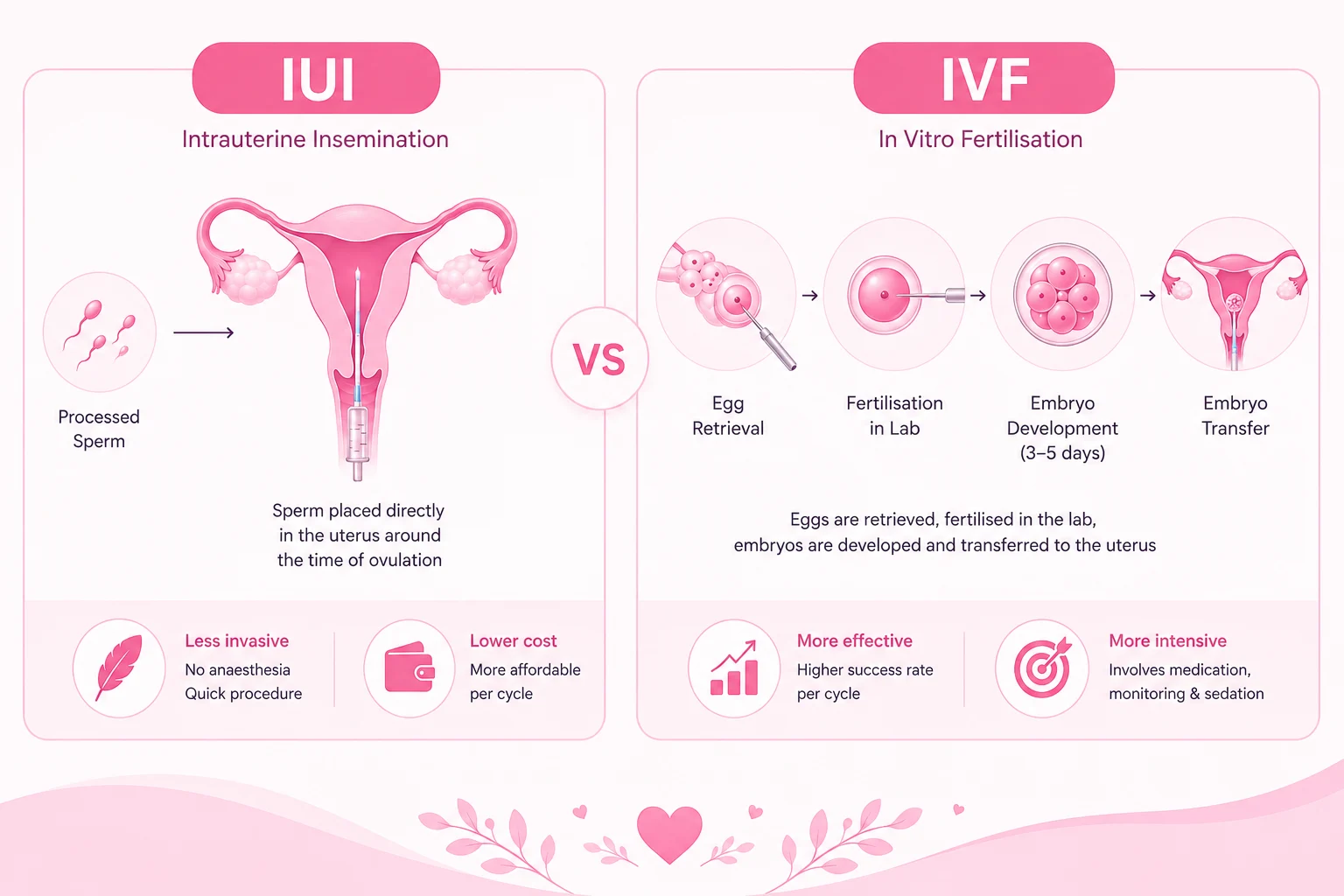
What Is IUI?
IUI stands for intrauterine insemination. It’s the simpler of the two treatments, and for many couples, it’s the right starting point.
Here’s how it works: sperm – either from a partner or a donor – is washed and concentrated in a lab, then placed directly into the uterus through a thin, flexible catheter at the time of ovulation. The goal is to shorten the distance sperm has to travel and increase the number of healthy sperm reaching the egg.
The procedure itself takes about 10–15 minutes in the clinic. Most women describe it as mild discomfort, similar to a cervical smear. No anaesthesia is needed. You can go home the same day and return to normal activity almost immediately.
IUI is typically recommended for:
- Couples with unexplained infertility (especially under 35)
- Mild male factor infertility – low sperm count or motility that isn’t severe
- Single women or same-sex couples using donor sperm
- Couples where cost is a significant consideration
- Women with regular ovulation and at least one open fallopian tube
The cycle usually involves a few days of oral or injectable medication to stimulate ovulation, followed by an ultrasound to time the insemination precisely. It’s low-tech compared to IVF, but it’s not without science behind it.
What Is IVF?
In an IVF cycle, the ovaries are stimulated with injectable hormones over 10–14 days to produce multiple eggs. Those eggs are then retrieved under light sedation in a minor surgical procedure. In the lab, they’re fertilised with sperm – either naturally or via ICSI (intracytoplasmic sperm injection, where a single sperm is injected directly into each egg). The resulting embryos are cultured for 3–5 days, and the best one (or two) is transferred into the uterus.
The egg retrieval is done under sedation, so you won’t feel it during the procedure. Some women experience bloating and mild cramping for a day or two afterwards – manageable, but real.
IVF is typically recommended for:
- Blocked or damaged fallopian tubes
- Severe male factor infertility (very low count, poor motility, or abnormal morphology)
- Women with low ovarian reserve or poor egg quality
- Endometriosis affecting fertility
- Couples who have had 3 or more failed IUI cycles
- Women over 38 where time is a genuine factor
- Situations where genetic testing of embryos (PGT-A) is needed
The process is more demanding – emotionally, physically, and financially. But for the right patient, it’s also dramatically more effective.
IUI vs IVF – Key Differences at a Glance
| Factor | IUI | IVF |
| Procedure | Sperm placed in uterus | Eggs retrieved, fertilised in lab, embryo transferred |
| Invasiveness | Minimal – no sedation needed | Moderate – egg retrieval under sedation |
| Cost per cycle (Delhi) | ₹8,000–₹30,000+ | ₹1.2L–₹2.5L+ |
| Success rate per cycle (under 35) | 10–20% | 40–55% |
| Time commitment | ~2 weeks per cycle | ~4–6 weeks per cycle |
| Lab involvement | Sperm preparation only | Full embryo culture, possible genetic testing |
| Best suited for | Mild infertility, open tubes, mild male factor | Blocked tubes, severe male factor, older age, failed IUI |
| Emotional intensity | Lower | Higher |
IUI Success Rates – What the Numbers Say
Let’s be honest about what “success rate” actually means. Most clinics quote pregnancy rate per cycle, not live birth rate – and those are different numbers.
For women under 35, IUI success rates in India typically run 15–20% per cycle with stimulated cycles (using gonadotrophins). Natural-cycle IUI drops to around 4–8% per cycle. The national average across all age groups sits at 10–20% per cycle.
After 3 stimulated IUI cycles, the cumulative success rate can reach 30–45% – which is why most fertility specialists recommend giving IUI a fair run of 2–3 cycles before escalating.
Age has a significant impact:
- Under 35: 15–20% per cycle
- 35–38: 10–15% per cycle
- Over 38: often below 8% per cycle, and declining sharply
The other key variable is sperm quality. IUI works best when the total motile sperm count after washing is above 5–10 million. Below that threshold, success rates fall considerably – and IVF becomes a more efficient use of time and money.
One important note: a failed IUI cycle is not a failure of your body. It’s information. Each cycle tells your doctor something useful about how you respond to stimulation and whether IUI is the right tool for your situation.
IVF Success Rates – What the Numbers Say
IVF success rates are meaningfully higher – but they’re also more variable, and age is the single biggest driver.
For women under 35 using their own eggs, IVF success rates in India typically run 40–55% per cycle (clinical pregnancy rate). Some well-equipped clinics in Delhi NCR report figures at the higher end of this range.
Age-wise breakdown:
- Under 35: 40–55% per cycle
- 35–37: 35–45% per cycle
- 38–40: 25–35% per cycle
- Over 40: 10–20% per cycle (own eggs)
Donor egg IVF changes the picture significantly. Since donor eggs come from young, screened women, success rates climb to 50–70% per transfer – and they’re largely independent of the recipient’s age. This is why donor egg IVF is often recommended for women over 40 or those with very low ovarian reserve.
One thing worth understanding: IVF success compounds across frozen embryo transfers. If a single stimulation cycle produces 3–4 good-quality embryos, you may get multiple transfer attempts from one retrieval – which improves cumulative success rates considerably.
The data is clear: IVF is more effective per cycle than IUI. But that doesn’t automatically make it the right first step for everyone.
IUI Cost in Delhi vs IVF Cost in Delhi
Cost is a real and legitimate part of this decision. There’s no point pretending otherwise.
- IUI cost in Delhi typically ranges from ₹8,000 to ₹30,000+ per cycle, depending on whether oral or injectable medications are used, the number of monitoring scans required, and the clinic’s infrastructure. Medicated cycles with gonadotrophins cost more than oral-stimulation cycles.
- IVF cost in Delhi NCR ranges from ₹1.2 lakh to ₹2.5+ lakh per cycle, and that range reflects real differences – the type of protocol used, whether ICSI is needed, the cost of medications (which can add ₹40,000+ – ₹80,000+ alone), and whether genetic testing of embryos is included.
What drives the cost difference?
- IVF requires a full embryology lab, incubators, and specialist embryologists
- Egg retrieval is a surgical procedure requiring an OT and anaesthesia
- Medication costs for IVF stimulation are substantially higher
- Monitoring (blood tests + ultrasounds) is more intensive
The cumulative cost question is worth thinking through carefully. Three IUI cycles at ₹20,000 each = ₹60,000 spent. If none succeed, you then move to IVF. For some couples – particularly those over 35 or with a known diagnosis – going directly to IVF may actually be more cost-effective in the long run, even though the upfront cost is higher.
Your fertility doctor should help you model this based on your specific situation, not a one-size-fits-all recommendation.
When Doctors Recommend IUI First
IUI treatment in Delhi is often the right starting point. Here’s when most fertility specialists will suggest beginning there:
- Unexplained infertility in women under 35 – when all tests come back normal and you’ve been trying for 12+ months, IUI with stimulation is a reasonable first step before escalating.
- Mild male factor infertility – if the sperm count and motility are low but not severely so, IUI can significantly improve the odds by concentrating the best sperm.
- Using donor sperm – for single women or same-sex couples, IUI with donor sperm is typically the first-line approach.
- Cost constraints – if budget is a real barrier, starting with IUI makes sense, provided the clinical picture supports it.
- Open fallopian tubes confirmed – IUI cannot work if the tubes are blocked. Once tubal patency is confirmed (via HSG or laparoscopy), IUI is a viable option.
- Ovulatory disorders that respond to medication – conditions like mild PCOS where ovulation can be induced with medication often respond well to IUI.
The key phrase here is “when the clinical picture supports it.” IUI is not a universal starting point – it’s the right starting point for the right patient.
When IVF Is the Better Choice
Some situations call for going straight to IVF treatment in Delhi, without spending time and money on IUI cycles that are unlikely to work.
- Blocked or damaged fallopian tubes – IUI is physically impossible if the tubes can’t carry eggs to the uterus. IVF bypasses the tubes entirely.
- Severe male factor infertility – very low sperm count, poor morphology, or azoospermia (no sperm in ejaculate) requires ICSI, which is only available within an IVF cycle.
- Low ovarian reserve – if AMH levels are very low or antral follicle count is poor, time is genuinely limited. IVF maximises the use of the eggs you have.
- Endometriosis (moderate to severe) – endometriosis affects egg quality, tubal function, and the uterine environment. IVF success rates are significantly better than IUI in these cases.
- Three or more failed IUI cycles – at this point, the evidence strongly supports moving to IVF. Continuing IUI beyond 3–4 cycles rarely improves outcomes.
- Age over 38 – ovarian reserve declines with age, and the window for successful treatment narrows. IVF is a more efficient use of that window.
- Need for genetic testing (PGT-A) – if there’s a family history of genetic conditions, or if recurrent miscarriage suggests chromosomal issues, embryo testing is only possible within an IVF cycle.
The decision to move to IVF isn’t giving up on a simpler path. It’s choosing the right tool for the job.
Questions to Ask Your Fertility Doctor Before Deciding
Walking into a consultation prepared makes a real difference. Here are six questions worth bringing with you:
1. “Based on my test results, what is my realistic success rate with IUI versus IVF?” – Ask for numbers specific to your age and diagnosis, not general statistics.
2. “How many IUI cycles do you recommend before moving to IVF in my case?” – The answer should be personalised, not a blanket “try three times.”
3. “Are my fallopian tubes confirmed open?” – If this hasn’t been checked, it needs to be before IUI is attempted.
4. “What does my AMH level and antral follicle count suggest about my ovarian reserve?” – This is critical for understanding how urgently you need to act.
5. “What would a failed IUI cycle tell us that we don’t already know?” – Sometimes IUI is diagnostically useful; sometimes it’s just delay.
6. “If we go straight to IVF, what does a realistic cost and timeline look like for us?” – Get the full picture, including medications, monitoring, and frozen embryo transfer costs.
A good fertility specialist will welcome these questions. If they don’t – that’s information too.
The Mediworld Fertility Approach
At Mediworld Fertility, the IUI vs IVF decision is never made on the basis of a single consultation or a generic protocol. Dr. Neha Gupta and the team bring over 12 years + of IVF experience to every case – and the approach is always diagnosis-first.
Before any treatment is recommended, the team conducts a thorough workup: hormone profiling, semen analysis, antral follicle count, uterine assessment, and a detailed review of your history. The goal is to understand your fertility picture – not fit you into a standard pathway.
For some couples, that means starting with IUI and monitoring closely. For others, the evidence points clearly to IVF from the outset. What it never means is rushing you into a decision or recommending the most expensive option when a simpler one will work.
The fertility treatment Delhi NCR couples need most isn’t the most advanced treatment – it’s the right treatment, explained clearly, with realistic expectations set from day one.
If you’re still weighing your options, the most useful next step is a proper consultation – not more internet research. Bring your test results, bring your questions, and let the clinical picture guide the conversation.
Book a consultation with the Mediworld Fertility team and get a personalised assessment of which path makes sense for you.
Frequently Asked Questions
Can I try IUI before IVF? expand_more
Yes - in many cases, IUI is the appropriate first step. If your tubes are open, sperm parameters are reasonable, and you're under 35 with no major diagnosis, 2–3 IUI cycles are a clinically sound starting point. Your doctor will advise based on your specific test results.
Is IVF painful? expand_more
The egg retrieval is done under sedation, so you won't feel it during the procedure. Afterwards, some women experience bloating, mild pelvic discomfort, or cramping for 1–2 days - manageable with rest and over-the-counter pain relief. The injections during stimulation are subcutaneous (under the skin) and most women find them very tolerable after the first few days.
How many IUI cycles before moving to IVF? expand_more
Most fertility specialists recommend 2–3 stimulated IUI cycles before escalating to IVF, provided the clinical picture supports continuing. NICE guidelines (NG257) suggest up to 4 stimulated IUI cycles for unexplained infertility before moving to IVF. If there's a clear diagnosis that makes IUI unlikely to succeed, your doctor may recommend IVF sooner.
Does age affect IUI vs IVF success? expand_more
Significantly. IUI success rates drop sharply after 35 and are often below 8% per cycle after 38. IVF success rates also decline with age, but remain meaningfully higher than IUI at every age bracket. For women over 38, most specialists recommend moving to IVF without spending time on multiple IUI cycles.
Can IVF work if IUI failed? expand_more
Yes - and this is an important point. Failed IUI cycles do not predict IVF failure. IVF bypasses many of the steps where IUI can fall short (sperm reaching the egg, fertilisation occurring naturally, embryo reaching the uterus). Many couples who had multiple failed IUI cycles go on to have successful IVF pregnancies.
What is the success rate of IUI vs IVF in India? expand_more
For women under 35 in India: IUI success rates run approximately 15–20% per cycle (stimulated), while IVF success rates run approximately 40–55% per cycle (own eggs). These figures vary by clinic, patient profile, and whether pregnancy rate or live birth rate is being reported. Always ask your clinic to clarify which metric they're quoting.
How can I book IVF or IUI in Delhi? expand_more
You can book an IVF or IUI consultation at MediWorld Fertility by contacting the centre's appointment team through phone, WhatsApp, or the official website. The fertility specialist will review your medical history and recommend the most suitable treatment based on your fertility evaluation.

 WhatsApp