
IVF Success Rate by Age in India
If you’ve just been told that age affects your IVF chances, you probably want a straight answer – not a vague “it depends.” Here it is: age is the single most powerful predictor of IVF success, and the numbers do change meaningfully after 35, after 38, and again after 40.
But those numbers don’t tell the whole story. A 30% success rate per cycle is not a 70% failure rate – it’s a 30% chance per attempt, and cumulative success across two or three cycles is substantially higher. Understanding the difference is what separates realistic hope from unnecessary despair.
This guide gives you the real IVF success rate by age in India – the figures that leading fertility networks and peer-reviewed research actually report – along with what they mean for your specific situation.
Why Age Is the Single Biggest Factor in IVF Success
The short version: it’s about egg quality, not just egg quantity.
As women age, two things happen simultaneously. First, the ovarian reserve – the pool of eggs available – shrinks. This is measured by AMH (anti-Müllerian hormone) and antral follicle count (AFC) on an early-cycle ultrasound. A low AMH IVF success rate is lower not just because fewer eggs are retrieved, but because the eggs that remain are more likely to carry chromosomal errors.
Second, and more critically, the rate of chromosomal abnormalities in eggs rises sharply with age. At 35, roughly 40–50% of embryos carry chromosomal errors that prevent healthy implantation. By 40, that figure climbs to 60–70%. By 42–43, it can exceed 80–90%.
This is why IVF success rates with age decline the way they do – and why a woman in her early 40s with a good response to stimulation can still produce several embryos, yet struggle to achieve a live birth. The problem is chromosomal quality, not effort.
The reassuring flip side: the uterus ages much more slowly than the ovaries. A woman’s uterine receptivity remains good well into her mid-40s, which is exactly why donor egg IVF works so well.
Get Expert Guidance for Your Fertility Journey
Take the next step with Mediworld Fertility. Connect with our team to book your consultation.
 WhatsApp Us

IVF Success Rates by Age in India – The Real Numbers
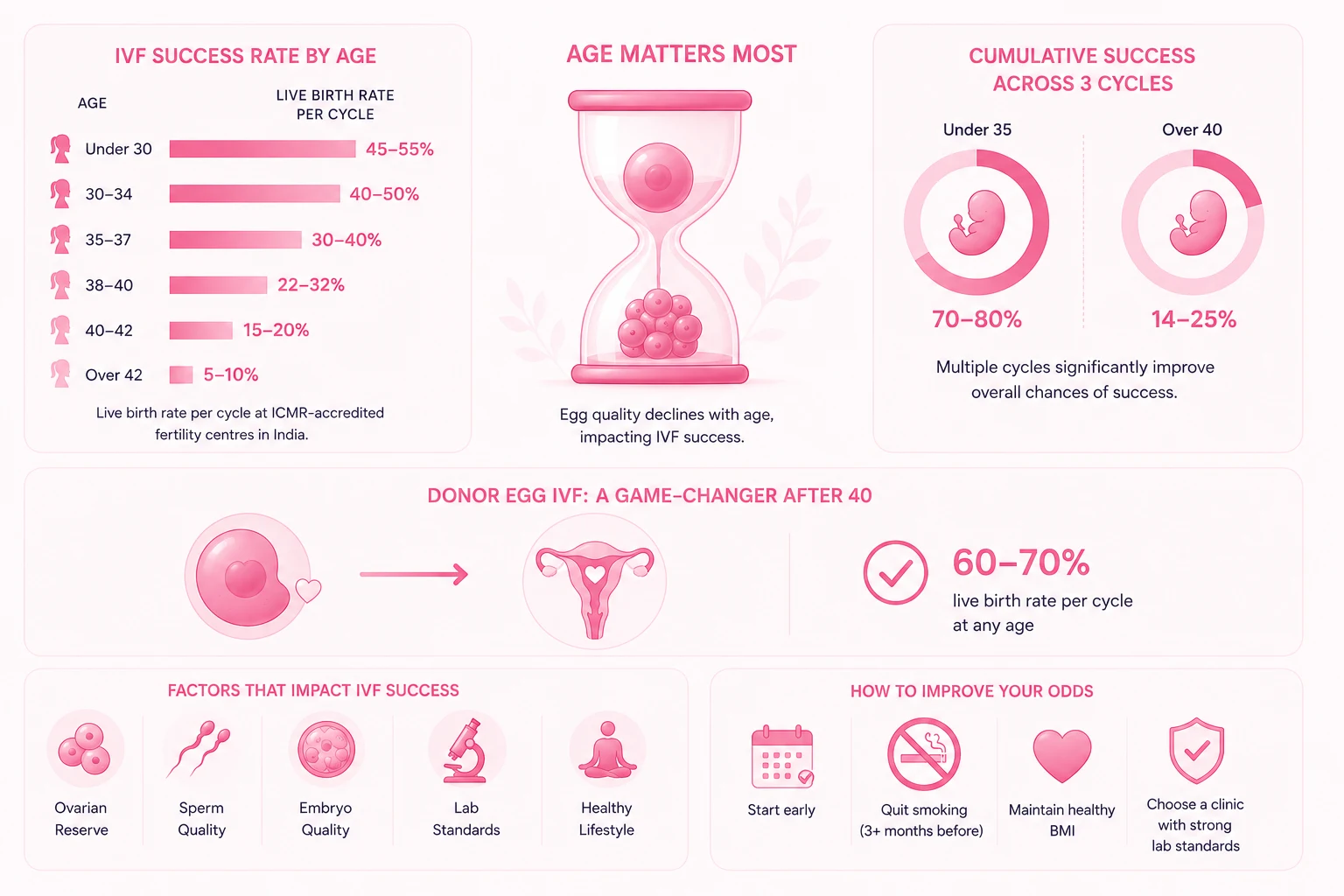
The table below reflects live birth rates per cycle at ICMR-accredited fertility centres in India.
| Age Group | Live Birth Rate / Cycle | Cumulative Rate (3 Cycles) | Key Consideration |
| Under 30 | 45–55% | 78–88% | Peak window. Single embryo transfer strongly recommended. |
| 30–34 | 40–50% | 70–82% | Excellent prognosis. Most couples succeed within 2 cycles. |
| 35–37 | 30–40% | 58–70% | PGT-A embryo screening becomes clinically useful. |
| 38–40 | 22–32% | 42–58% | Ovarian reserve assessment is essential before starting. |
| 40–42 | 15–20% | 25–40% | Multiple cycles likely needed. Discuss donor egg option. |
| Over 42 | 5–10% | 15–25% | Donor egg IVF gives 60–70% live birth rate at any age. |
A few important caveats about these figures:
- Clinics quote different metrics. Some report clinical pregnancy rate (higher), others live birth rate (lower and more meaningful). Always ask which one you’re looking at.
- Patient selection matters. A clinic treating mostly younger, healthier patients will show higher averages. Ask for age-band-specific data, not a headline number.
- Lab quality varies enormously. The gap between a well-equipped embryology lab in Delhi NCR and a smaller facility can be 10–15 percentage points in live birth rate.
Request a Consultation
Cumulative IVF Success Rates – Why Multiple Cycles Matter
One failed IVF cycle is not the end of the story. It’s one data point.
A large linked-cycle analysis published in the New England Journal of Medicine found that cumulative live birth rates across three cycles reached 63–74% for women under 31, and remained meaningful – around 25–40% – even for women aged 41–42. The first cycle is also diagnostically valuable: it tells your doctor how your ovaries respond to stimulation, how many mature eggs you produce, and how your embryos develop.
For women under 35 in India, planning for 2–3 cycles from the outset is realistic and evidence-based. Cumulative success across three cycles can reach 70–80% – a very different picture from the per-cycle figure.
For women over 40, the cumulative benefit of additional cycles is smaller but still real. A peer-reviewed Indian study (PMC, 2024) found cumulative live birth rates of 14.35% at age 40 and 9.63% at age 42 across multiple cycles – modest numbers, but not zero. And for women in this group who switch to donor eggs, the equation changes entirely.
The practical message: don’t judge IVF by one cycle. Plan the journey, not just the first step.
Donor Egg IVF – A Game-Changer After 40
Here’s the number that changes everything for women over 40: donor egg IVF delivers live birth rates of 60–70% per cycle, regardless of the recipient’s age.
Why? Because the eggs come from a young, screened donor – typically aged 23–35 under India’s ART Regulation Act 2021 – and the chromosomal error rate in those eggs is as low as it is in any young woman. The recipient’s uterus, which ages far more slowly than the ovaries, receives a chromosomally healthy embryo. Implantation rates are comparable to those in women under 30.
Who is donor egg IVF suited for?
- Women over 42 with own eggs showing poor quality or very low reserve
- Women with premature ovarian insufficiency at any age
- Women who have had two or more failed IVF cycles with own eggs despite good stimulation
- Women with very low AMH where own-egg IVF is unlikely to yield viable embryos
India’s legal framework under the Assisted Reproductive Technology (Regulation) Act, 2021 and the ART Rules, 2022 is clear: egg donation must be conducted through registered ART banks, donors must be aged 23–35, donation is anonymous, and comprehensive genetic and health screening of donors is mandatory. This regulatory structure protects both donors and recipients – and makes India one of the better-regulated environments globally for donor egg IVF.
The IVF cost in Delhi for donor egg cycles is higher than standard IVF – typically ₹2.5–4 lakh depending on the protocol – but the significantly higher success rate often makes it the most cost-effective path for women in the right clinical situation.
Factors That Affect IVF Success Beyond Age
Age is the dominant variable, but it’s not the only one. These six factors each independently influence your outcome:
- AMH level and ovarian reserve. Low AMH doesn’t make IVF impossible, but it does mean fewer eggs per cycle and a higher chance of needing multiple retrievals. Your doctor will tailor the stimulation protocol to your reserve.
- Sperm quality. A standard semen analysis measures count, motility, and morphology – but not sperm DNA fragmentation. High DNA fragmentation can impair embryo development even when the basic report looks normal. Ask whether advanced sperm testing is appropriate.
- Embryo quality. The number of blastocysts (Day 5 embryos) that develop from a retrieval is a stronger predictor of success than the number of eggs retrieved. Blastocyst culture and grading are standard at well-equipped labs.
- Clinic lab standards. The embryology lab environment – temperature stability, air quality, incubator systems, embryologist experience – directly affects how embryos develop. Ask your clinic for their fertilisation rate and blastocyst development rate.
- Lifestyle factors. Both underweight and overweight status reduce IVF success. Smoking accelerates ovarian ageing and increases chromosomal error rates in embryos – in both partners. Chronic stress affects hormonal signalling. These are modifiable.
- Number of previous IVF attempts. Each cycle generates information. A second or third cycle is almost always better-calibrated than the first, because your doctor knows exactly how you respond.
IVF Success Rates in Delhi – What You Can Expect at a Specialist Clinic
Delhi NCR has emerged as one of India’s strongest hubs for advanced IVF treatment, and for good reason. The concentration of experienced reproductive endocrinologists, high-quality embryology labs, and access to the full range of adjunct technologies – PGT-A, time-lapse embryo monitoring, frozen embryo transfer – means that patients here have access to outcomes that match the best centres globally.
That said, IVF success rates vary significantly between clinics even within Delhi NCR. A clinic’s headline success rate is only meaningful if it’s age-stratified, based on live births (not just pregnancies), and drawn from a patient population similar to yours. Always ask for clinic-specific data for your age group – not national averages.
At Mediworld Fertility, the approach to IVF treatment in Delhi is built around personalised protocols. Dr. Neha Gupta brings 12 years of IVF experience to every case, and no two stimulation plans are the same. The starting point is always a thorough workup – AMH, antral follicle count, Day 2 FSH, uterine assessment, semen analysis – before any protocol is designed. The goal is to understand your specific fertility picture, not fit you into a standard pathway.
If you’re weighing your options or anxious about your age and IVF chances, the most useful next step is a proper consultation – not more internet research. Book a consultation with the Mediworld Fertility team to get a personalised assessment of your realistic success rate and the right protocol for your situation.
How to Improve Your IVF Success Rate at Any Age
Some of the variables that affect IVF outcomes are within your control. These are the actions that are actually supported by clinical evidence:
- Start as early as clinically appropriate. Ovarian reserve declines with every year. If you’re over 35 and have been trying for 6 months without success, see a specialist now – not after 12 months.
- Optimise AMH support if your doctor advises it. Certain supplements – CoQ10, DHEA, vitamin D – have evidence behind them for women with low reserve or over 37. Don’t self-prescribe; the right choice varies significantly by patient.
- Reach a healthy BMI before starting. Even a modest improvement in weight over 3–6 months – not crash dieting – can meaningfully improve ovarian response and implantation rates.
- Both partners should quit smoking at least 3 months before egg retrieval. Smoking accelerates ovarian ageing and increases chromosomal errors in both eggs and sperm.
- Reduce chronic stress where possible. Cortisol affects hormonal signalling. This doesn’t mean “just relax” – it means structured support: counselling, yoga, whatever works for you.
- Choose a clinic with a strong embryology lab. Ask specifically about their blastocyst development rate and fertilisation rate. These numbers tell you more about lab quality than a headline success rate.
- Consider PGT-A if you’re over 37 or have had recurrent implantation failure. Preimplantation genetic testing for aneuploidy screens embryos for chromosomal errors before transfer – improving the predictive value of each attempt and reducing miscarriage risk.
Questions to Ask Your IVF Doctor About Success Rates
Walk into your consultation with these five questions. A good fertility specialist will welcome every one of them.
1. “What is YOUR clinic’s live birth rate for my age group, using own eggs?” – Not the national average. Your clinic’s number, for patients like you.
2. “How many embryos do you typically transfer, and why?” – Single embryo transfer at blastocyst stage is the global standard for women under 38 with good-quality embryos. Understand the reasoning behind the recommendation.
3. “Do you recommend PGT-A for my case, and what would it add?” – The answer should be specific to your age, history, and embryo quality – not a blanket yes or no.
4. “What is my AMH level, and what does it mean for my stimulation protocol?” – AMH is not a pass/fail test. It’s a planning tool. Your doctor should explain what your number means for egg yield and protocol design.
5. “How many cycles should I realistically plan for, and what does the cumulative picture look like?” – Planning one cycle at a time is emotionally understandable but clinically suboptimal. Get the full picture upfront.
Frequently Asked Questions
What is a good IVF success rate in India? expand_more
A live birth rate of 40–55% per cycle for women under 35 is considered good at an accredited Indian fertility centre. For women aged 35–38, 30–40% is a realistic benchmark. Always ask whether the figure quoted is a clinical pregnancy rate or a live birth rate - the former is always higher and less meaningful as a real-world outcome. National averages are a starting point; clinic-specific, age-stratified data is what you actually need.
Does IVF success rate drop after 35? expand_more
Yes - but the decline is gradual between 35 and 37, and steeper after 38. The in vitro fertilization success rate by age drops from roughly 40–50% per cycle at 30–35 to 30–40% at 35–37, and then to 22–32% at 38–40. The primary driver is rising chromosomal error rates in eggs, not uterine problems. PGT-A embryo screening becomes increasingly valuable from 37 onwards because it identifies the chromosomally normal embryos before transfer.
Can I do IVF after 40 in India? expand_more
Yes. IVF after 40 India is both legal and practised widely. Live birth rates with own eggs are 15–20% per cycle at 40–42, which is lower but not negligible - especially when cumulative rates across multiple cycles are factored in. For women over 42, donor egg IVF is the option that most significantly improves the odds, delivering 60–70% live birth rates regardless of recipient age. The ART Regulation Act 2021 sets the legal age limit for IVF with own eggs at 50 years for women in India.
How many IVF cycles does it usually take to get pregnant? expand_more
There's no universal answer, but the data is clear: most successful IVF pregnancies happen within 3 cycles. For women under 35, cumulative live birth rates across three cycles reach 70–80%. For women 35–38, the figure is 58–70%. Planning for 2–3 cycles from the outset - financially and emotionally - is both realistic and evidence-based. A failed first cycle is not a failed treatment; it's information that makes the next cycle better-calibrated.
How do I book an IVF consultation in Delhi? expand_more
At Mediworld Fertility, a specialist IVF centre in Delhi NCR, Dr. Neha Gupta conducts initial consultations personally. The goal of that first appointment is not to sell you a treatment - it's to give you an honest clinical picture of where you stand and what your options are.
What should I bring to my first IVF appointment in Delhi? expand_more
Bring every relevant medical reports you have, even if it's old.
At Mediworld Fertility, the first consultation is designed to review all of these together and recommend a personalised plan - not a generic protocol. The more complete your records, the more specific and useful that first conversation will be.